The Emerging 100: Olectra Greentech’s clean, green, and profitable strategy
/ 5 min read
The EV maker, ranked 21st on the list, is betting on electric buses and trucks to drive growth in the next decade.
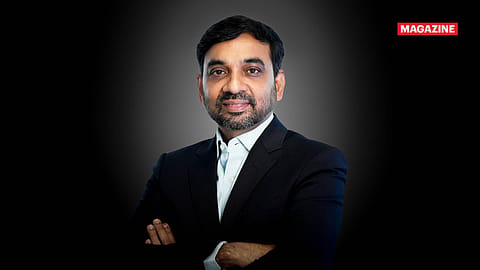
Mahesh Babu, MD, Olectra Greentech
This story belongs to the Fortune India Magazine april-2026-the-emerging-100 issue.
MAHESH BABU certainly knows how to scale electric vehicles. As the CEO of Mahindra Electric Mobility Ltd, he introduced India’s first lithium-ion battery-powered three-wheeler, the Mahindra Treo, almost a decade ago. That was long before EVs became something of a fancy in the world’s third-largest automobile market. Mahindra’s Treo has since sold over 150,000 units and remains India’s largest electric autorickshaw by sales annually.
For Babu, that Mahindra stint was followed by one at Switch Mobility, the electric bus division of the Hinduja Group, owned by Ashok Leyland, where he was instrumental in scaling the division to become one of the Top 3 electric bus makers in the country. Babu left Switch in June last year to join Olectra, the EV arm of infrastructure giant Megha Engineering. During his stint at Switch, he also ensured it became operationally profitable.
That’s why when he took charge at Hyderabad-based Olectra Greentech, expectations were rife about the direction that the company, one of India’s oldest electric bus makers, would take. “Other than economics, nothing works in commercial vehicles,” Babu tells Fortune India. “You can say beautiful vehicle, comfort, and so on, but finally, it needs economics, and there is nothing to beat electric vehicle economics today.”
Babu took over as the MD of Olectra in September 2025 and has been busy transforming the EV maker — with annual revenues of ₹1,802 crore in FY25 — into newer frontiers, including electric trucks. The company currently has about 100 trucks on trial runs at the $30-billion Megha Engineering and Infrastructures Ltd, which could find its way onto Indian roads soon if all goes well.
“Look at China, they have completely transformed,” says Babu. “From what I understand, they have crossed 50% of electric trucks registration in the last calendar year. That is very big. It’s going to happen in India... there is no reason to believe we are delayed.”
Olectra was founded in 2000 as Goldstone Infratech Ltd and had emerged as the largest manufacturer in India for silicone rubber insulators for power transmission and distribution networks. In 2016, the company tied up with Chinese automotive giant BYD — a partnership that runs until 2030 — to manufacture electric buses in the country. Those were India’s first electric buses certified by the Automotive Research Association of India. Today, its battery-powered buses primarily run intercity, intracity, and airport shuttle operations.
From Megha to the world
Olectra delivered its first bus in 2018. Since then, the company has delivered close to 3,600 electric buses, a feat Babu reckons puts them at No. 2 by volumes in the market. While the insulator division continues to be operational and accounts for about 10% of the company’s revenues, Olectra has also begun developing its own bus platform to bid for various government projects, largely due to existing scrutiny of Chinese manufacturers in such projects.
More Stories from this Issue
It has already been selected to deliver 1,785 buses for the PM Electric Drive Revolution in Innovative Vehicle Enhancement (PM E-DRIVE) Scheme. The PM E-DRIVE Scheme is a ₹10,900-crore government initiative running from October 1, 2024, to March 31, 2026, that is aimed at accelerating the adoption of electric vehicles (EVs). The scheme provides subsidies for electric two-wheelers, three-wheelers, ambulances, and trucks, as well as funding for e-buses and charging infrastructure.
About 85% of the company’s orders come from governments, particularly state governments. “We will also participate in the new CESL tenders, which are over 6,200 buses,” Babu says. Convergence Energy Services Ltd (CESL), a subsidiary of the PSU EESL (Energy Efficiency Services Limited), has issued a large-scale tender for the procurement, operation, and maintenance of 6,230 electric buses across multiple Indian cities under the PM E-DRIVE Scheme.
Meanwhile, in the truck segment, the company plans to launch five variants: a 50-tonne tractor-trailer, a 38-tonne tipper, a 35-tonne tipper, and a 28-tonne truck. “So, between bus and truck, we are investing nearly ₹500 crore: ₹350 crore for product development and ₹150 crore for the plant,” Babu adds.
India aims to achieve a 30% share of electric vehicles by 2030. EV sales rose from 50,000 in 2016 to 2.3 million in 2025. In 2020, India’s EV penetration was one-fifth the global average, rising to over two-fifths in 2024, per NITI Aayog.
{{#most-powerful-women-snapshot-individual.slug}} {{/most-powerful-women-snapshot-individual.slug}} {{^most-powerful-women-snapshot-individual.slug}} {{/most-powerful-women-snapshot-individual.slug}} {{#showRanking}} {{current-rank}} {{/showRanking}} {{#photo.0.url}}
{{name}}
Electric buses accounted for about 4% of India’s annual bus registrations in 2025, with 4,237 registrations, according to data from CareEdge Ratings. That was 16% growth compared to the year-ago period, largely driven by expanding government incentives and improving infrastructure. While intra-city bus movement has largely shifted to EVs, it is the intercity arena that will see further action, as companies increase the range of buses and ensure adequate charging infrastructure is in place.
“If you look at the city bus adoption, it is almost 20%-plus, and it’s expected to cross more than 50%,” Babu adds. Various state governments have also been pushing for EVs through tenders and new schemes, such as a gross cost contract that allows state governments to procure and operate buses from manufacturers and pay them on a per-km basis, with the price determined in the tendering process.
Diesel buses, Babu reckons, cost ₹100–120 per km to run, while 12-metre EV buses cost ₹70–80 per km. “That’s a ₹20–30 [per km] difference, which means state governments provide less viability gap funding for electric buses than for diesel,” he says.
Where India stands
India has around 8 e-buses per million people, compared with a global average of 94, according to ratings agency CareEdge. That means, the potential remains enormous, especially since India has a massive unmet need for efficient, sustainable public transit — amid rising concerns about urban air quality and congestion.
Olectra has an order book of 10,000 vehicles for delivery over the next two years. In trucking, Megha’s captive consumption has helped iron out issues before they reach the broader market. “I believe the truck market is open, not government-related, and offers a very good opportunity for us,” Babu says. “Bus and truck will complement each other.”
In the process, Olectra reckons that it has its hands full for the next 10-15 years, as India transitions to electric. “Market leadership is now shifting towards Olectra, JBM, PMI, and Switch Mobility (together accounting for ~47% and ~76% market share in FY25 and 9MFY26, respectively),” CareEdge says. The installed domestic manufacturing capacity of these four OEMs stands at around 32,000 e-buses per annum, with an aggregate order book of about 31,000 e-buses, largely under STU/GCC contracts. A 12–24-month execution timeline offers near-term visibility.”
So, what will it take for Olectra, and other e-bus makers in the country to grow now? “With structural cost advantages, maturing procurement, and risk-sharing, India’s e-bus market is poised for accelerated adoption through FY28 and beyond,” CareEdge says. “The pace and durability of this growth will hinge on timely disbursements and strict enforcement of PSMs (payment security mechanisms), reliable grid supply, adequately developed depot/charging infrastructure, and disciplined, on-schedule deliveries in line with contracted milestones.”
Follow Fortune India
Sign in to read full story
To access our exclusive magazine content, sign in to your Fortune India account.
Sign In NowNEXT STORY