The Emerging 100: Shakti Pumps and the story of a green reinvention
/ 5 min read
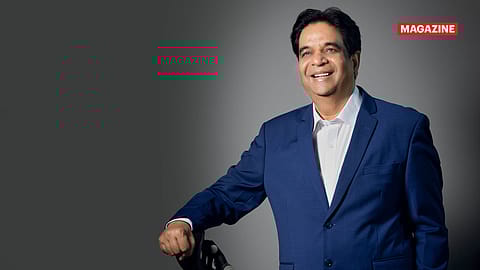
Dinesh Patidar, chairman, Shakti Pumps | Credits: Nishant Ratnakar
The Emerging 100: Shakti Pumps and the story of a green reinvention
Shakti Pumps has transformed from a conventional pump maker into a vertically integrated clean-tech player at the heart of India’s solar irrigation push. Leveraging in-house manufacturing of pumps, motors, VFDs and inverters, it leads the solar pumping market under schemes like PM-KUSUM, while expanding into EV components, rooftop solar and industrial solutions, driving rapid growth and green gains.
This summary is AI-generated, and Fortune India is not responsible for its content or any associated copyright issues.
How Shakti Pumps, ranked 15th on the list, reinvented itself to get on the grid.
Dinesh Patidar, chairman, Shakti Pumps | Credits: Nishant Ratnakar
This story belongs to the Fortune India Magazine april-2026-the-emerging-100 issue.
THERE WAS A time when unreliable power supply dictated irrigation across India’s agricultural heartland. Diesel pumps — costly and inefficient — and grid-connected systems plagued by erratic power supply struggled to sustain farm productivity.
Today, that era is giving way to a cleaner, more dependable alternative — solar power. At the centre of the shift stands Pithampur-based Shakti Pumps — a company that did not merely adapt, but anticipated change.
The company’s evolution has been shaped by the opportunity-driven approach of chairman Dinesh Patidar. At the helm since 1986, Patidar steered the company into becoming one of India’s early manufacturers of stainless steel pumps, followed by a timely move into solar pumping solutions. More recently, it diversified into electronic controllers and motors for electric vehicles — starting with two- and three-wheelers, with plans to enter the four-wheeler segment soon.
The reinvention has translated into strong financial performance: net income grew at a 37.31% CAGR to ₹2,505 crore in FY26 (TTM), while PAT surged 139% to ₹329 crore.
At the core of this growth lies an integrated manufacturing model, backed by technical expertise and long-term planning. Shakti Pumps develops critical components — pumps, motors, VFDs (variable frequency drives), controllers, inverters, and structures — in-house. “This gives us a clear advantage in terms of quality control, cost efficiency, and rapid innovation. Additionally, we focussed on solar-powered pumping solutions early on, when the sector was still nascent. The approach has positioned us as a leader in India’s solar pumping sector today,” says Patidar.
The company has moved beyond traditional pump manufacturing to sustainable water solutions, energy-efficient motors, and solar ecosystems. Positioned at the intersection of renewable energy and industrial efficiency, it has aligned itself with the global push for decarbonisation and sustainable agriculture.
In-house manufacturing has been a key differentiator. While much of the industry relies on fragmented supply chains, Shakti Pumps has built a vertically integrated model over decades. Its 16-acre main facility in Pithampur, Madhya Pradesh, has an annual capacity of 350,000 pumps and motors, alongside an advanced electronics unit producing 400,000 VFDs and inverters using Japanese technology. Complementing this is a 3.15-acre SEZ unit for exports, with a capacity of 150,000 stainless steel submersible pumps annually. This segregation ensures compliance with global standards across more than 100 countries.
More Stories from this Issue
The opportunity landscape remains strong. Government focus on solarisation, energy security, and sustainability — supported by schemes such as PM KUSUM and state-level initiatives — is driving demand for solar pumping. Rising farmer awareness around energy independence and efficient water use is reinforcing long-term growth. Globally, demand for sustainable water management and clean energy solutions are also accelerating.
To capitalise on the burgeoning demand, Shakti Pumps is executing a ₹1,700-crore capex programme. This includes a new unit, as well as expansion of its existing facilities.
“This investment will strengthen our backward integration into solar technology, enhance supply chain reliability, and help meet India’s growing solar demand,” says Patidar.
Banking on sunlight
{{#most-powerful-women-snapshot-individual.slug}} {{/most-powerful-women-snapshot-individual.slug}} {{^most-powerful-women-snapshot-individual.slug}} {{/most-powerful-women-snapshot-individual.slug}} {{#showRanking}} {{current-rank}} {{/showRanking}} {{#photo.0.url}}
{{name}}
Shakti Pumps is building resilience through diversification across four high-growth verticals, leveraging core engineering capabilities across agriculture, mobility, energy, and infrastructure to build resilience.
The flagship solar agriculture business remains its primary growth engine. Under the PM-KUSUM scheme, the company has set in motion a structural shift from diesel pumps to solar-powered stainless steel systems. In 9MFY26 alone, it installed 57,741 solar pumps, reflecting nearly 10% year-on-year growth.
The second vertical — electric mobility — focusses on high-value components through its subsidiary, Shakti EV Mobility. The portfolio includes IP67-rated motors, advanced controllers, and universal chargers compatible with lithium-ion and lead-acid batteries. The strategy is to compete on engineering precision rather than branding.
The third pillar aligns with the rooftop solar opportunity under the PM Surya Ghar initiative. The company offers grid-tie inverters such as Sunshakti 2.0, along with mounting structures designed to withstand wind speeds of up to 150 kmph — suited for India’s diverse climatic conditions.
The fourth vertical — industrial and domestic solutions — provides stability. It spans vertical multi-stage pumps for chemical processes, pressure boosters for high-rise buildings, and wastewater pumps for infrastructure. Though less visible, it ensures steady demand and strengthens the engineering base.
Scaling with strategy
The ₹1,700-crore capex marks a structural shift. At its centre is the 2.2-GW solar cell and module facility (with an allocation of ₹1,200 crore); the first 0.5 GW is expected to be operational by Q1FY27. Besides, ₹250 crore is being invested to expand core manufacturing capabilities, and double capacity across pumps, motors, and structures to 1 million units by August 2026. The dual focus on integration and scale reflects a calibrated growth strategy.
Innovation remains central. The company’s R&D centre, certified by the Department of Scientific and Industrial Research, has tied up with IIT Delhi under the Advanced Invention Scheme. As of early 2026, it has filed 29 patents, of which 15 have been granted — spanning hydraulic systems and power electronics. A network of over 500 dealers and 400 service centres, along with a five-year backend support guarantee, strengthens its rural presence.
Going forward, Patidar envisions a broader identity. “In the next five years, we see Shakti Pumps not just as a pump manufacturer, but a comprehensive renewables and energy technology company.”
During Q3FY26, the company moderated execution to strengthen its balance sheet, focussing on receivables and cash flow to fund capex without straining its credit profile. Even so, the order book remains strong at ₹2,100 crore. Expansion into southern India is gaining traction, with ₹654 crore worth of orders for 16,780 pumps in Karnataka alone. In Maharashtra, the company has installed over 45,000 pumps in a single month, as part of a Guinness World Records attempt.
“Our order book reflects strong demand for solar pumping solutions. However, project management, logistics, and coordination are critical. Focus remains on timely and quality execution,” says Patidar.
Analysts are upbeat about the company’s prospects. “Shakti Pumps has built a meaningful presence in the domestic solar pumps segment, aided by increasing adoption across multiple states. The momentum is closely linked to stronger on-ground execution of subsidy programmes and growing awareness among farmers about long-term cost efficiencies,” says Hariom Sarda, chartered accountant and veteran investor.
The international market is another growth lever. The company is strengthening distribution networks, building tie-ups, and tailoring products for regional needs. Its global footprint spans projects, from de-watering systems for Burj Khalifa and One Za’abeel Tower in Dubai, to hydroponics in Thailand, fountains in Vietnam and South Korea, and drinking water projects in Uganda and Bhutan.
Domestically, it has contributed to landmark projects such as the Statue of Unity, Bharat Mandapam, and the Akshardham temples in New Delhi and Ahmedabad. On the retail side, cash sales rose 68% year-on-year in FY25, supported by over 100 exclusive outlets, while retail exports grew 25%.
“Our integrated manufacturing model allows us to optimise costs, maintain quality, and accelerate development,” says Patidar. “In electric mobility, our strength lies in decades of expertise in motor technology and power electronics, enabling us to deliver efficient and reliable solutions.”
With improving trade prospects, sustained policy support, and expanding capabilities across solar, EVs, and water solutions, Shakti Pumps is not just participating in India’s green transition — it is positioning itself to help shape it.
Follow Fortune India
Sign in to read full story
To access our exclusive magazine content, sign in to your Fortune India account.
Sign In NowNEXT STORY