The Emerging 100: Waaree Renewable Technologies has its eyes set on a green future
/ 4 min read
Waaree Renewable Technologies, ranked 12th, is positioning itself for the next phase of India’s energy transition.
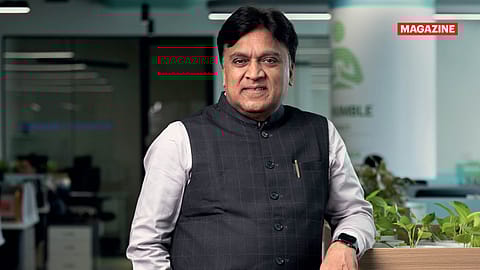
Viren C. Doshi, wholetime director, Waaree Renewable Technologies
This story belongs to the Fortune India Magazine april-2026-the-emerging-100 issue.
WHEN SUNBREEZE RENEWABLES NINE, an SPV of Jindal Renewables, set out to build a 2-GW solar power project in Bikaner — mainly aimed at low-carbon emitting steel production — it had one name as its EPC partner: Waaree Renewable Technologies Ltd (WRTL). It’s not a straightforward mandate. WRTL is responsible for the entire lifecycle — design, engineering, procurement, construction, testing, and commissioning. The power generated must also be seamlessly delivered to the designated point of injection. “It is one of the largest and most complex projects we have handled in recent times,” says Viren C. Doshi, wholetime director at WRTL.
The scale reflects how far WRTL, Waaree Energies’ solar EPC arm, has come. From executing a modest 10-MW EPC project in 2011, WRTL has grown into a full-fledged renewable infrastructure player. It has delivered over 10,000 projects globally, installing more than 2.3 GW across utility-scale, rooftop, floating solar, and solar park segments. Today, its portfolio includes over 50 ground-mounted projects totalling more than 1.9 GW, eight IPP/solar park projects with a capacity exceeding 270 MW, and over 400 rooftop installations generating more than 50 MW, placing it among India’s top solar EPC players alongside heavyweights such as Tata Power, Adani, and L&T, among others.
The journey has essentially been about scaling capabilities. “In the early years, the focus was on building technical expertise and execution credibility. Today, the emphasis is on delivering large, complex renewable infrastructure projects that support India’s clean energy transition at scale,” says Viren, the younger brother of Hitesh C. Doshi, chairman and MD of the Waaree Group.
As part of the Waaree Energies’ ecosystem — India’s largest solar module manufacturer — WRTL benefits from vertical integration. It ensures supply chain reliability, accelerates execution, and helps maintain cost-competitiveness, all decisive factors in a sector defined by scale and speed. The group has more than three-and-a-half decades of experience, with more than 22 GW of global module capacity and expanding capabilities in solar cells, battery storage, and green hydrogen.
The benefits are tangible. During a 50-MW project in Vietnam, logistical constraints and adverse weather threatened delays. WRTL still delivered the project in 100 days, leveraging group manufacturing strengths and local partnerships. Similarly, its floating solar projects have required innovations in anchoring and system design — capabilities built through sustained R&D and collaboration.
Such execution discipline has allowed WRTL to scale without sacrificing profitability, maintaining operating margins close to 20% in a fiercely competitive EPC market. “Differentiation comes from execution capability, supply chain integration, and financial discipline,” says Viren.
The financials mirror the operational momentum. Net income grew from ₹351 crore in FY23 to ₹1,598 crore in FY25, and ₹2,706 crore in FY26 (TTM), with a 3-year CAGR of 97.55%. Profit after tax grew from ₹55 crore in FY23 to ₹229 crore in FY25, and ₹417 crore in FY26 (TTM) with a three-year CAGR at 95.92%. Its credit and cash liquidity positions are also comfortable. “The cash flow from operations increased to ₹308 crore in FY25 (from ₹153 crore in FY24), supported by healthy profitability and an efficient working capital cycle. The company has annual debt obligations of around ₹5.8 crore and ₹5.5 crore in FY26 and FY27, respectively, likely to be comfortably met through the cash from operations,” noted Divya Charen C. and Sudhir Viswanathan, analysts at India Ratings and Research (Ind-Ra), in February.
More Stories from this Issue
Three key factors played a key role in this growth trajectory. “The increasing scale of solar EPC projects across India, strong project execution and operational efficiency, and the strategic advantage of sourcing and integration within the Waaree Group ecosystem,” Viren says. These factors, combined with high capital efficiency, have helped WRTL deliver more than 10,000 solar projects globally. That also helps to maintain strong Ebitda margins in the 18–20% range.
WRTL’s rise aligns with India’s solar ambitions. The country’s installed solar capacity has climbed from 22 GW in 2018 to about 136 GW in March, with a target of 280 GW by 2030. Annual additions of 40-45 GW are expected over the next few years. This is fuelling demand for EPC services, projected to grow at around 23% annually, from ₹60,500 crore in FY23 to ₹1.7 lakh crore by FY28. Similarly, the market potential for third-party O&Ms is estimated to hit 23% CAGR from 16.8 GW in FY23 to 73 GW by FY30. Various government schemes are ensuring this solar growth.
WRTL’s near-term visibility is robust. Its unexecuted order book stands at around 2.92 GW, expected to be completed over the next 12 months. A bidding pipeline of nearly 29 GW underscores sustained demand. “The solar EPC sector will continue to see strong momentum, driven by storage integration, hybrid systems, and round-the-clock renewable solutions,” says Viren. While EPC remains the core — accounting for 95% of revenue — the company is steadily expanding into adjacent segments such as IPP, floating solar, rooftop installations, and O&M. These are expected to contribute 5-10% to revenue. The broader strategy is to evolve beyond EPC. It is building capabilities in battery energy storage and hybrid renewable projects, while the Waaree Group is investing in green hydrogen and industrial decarbonisation technologies. Early this year, WRTL acquired a 55% stake in power transmission and distribution company Associated Power Structures, for ₹1,225 crore.
“Our goal is to transition to [being] a comprehensive clean energy infrastructure partner,” says Viren. In a sector where scale, speed, and integration define winners, WRTL is positioning itself for the next phase of India’s energy transition.
Follow Fortune India
NEXT STORY