The Emerging 100: Why Affle 3i is not a one-trick pony
/ 7 min read
Affle 3i, which works in the adtech space and is ranked 13th, is eyeing ambitious growth in the years ahead.
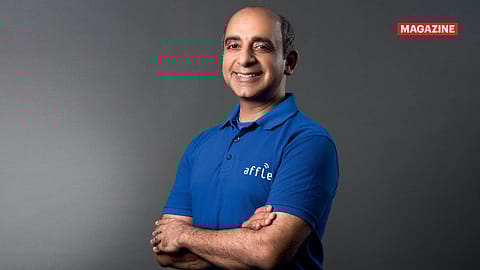
Anuj Khanna Sohum, founder, chairperson, MD & CEO, Affle 3i
This story belongs to the Fortune India Magazine april-2026-the-emerging-100 issue.
LET’S DIAL BACK to 2005. Mobile phone sales are booming in India. Anuj Khanna Sohum, 27, too, is obsessed with mobiles. But there’s a difference in the way Sohum — who grew up in Lucknow and is based in Singapore — views the mobile device. He believes it is not just a tool for communication; it is the world’s most valuable real estate for the next phase of the internet.
With that idea in mind, Sohum launches Affle in Singapore in 2005 as a platform to connect advertisers, mobile phone manufacturers, and consumers. But mobile internet is slow and expensive, and handsets are not optimised for browsing. How will it work?
Sohum and his associates find a way. Affle is built around on-device and contextual formats, rather than browser-based advertising. The idea is to embed advertising within user behaviour itself. “If you were messaging someone about lunch, you could be shown a relevant ad around restaurants or food,” Sohum recalls, describing how ads were triggered in real time based on what a user was doing on their device. Telecom operators and handset manufacturers were also a part of this ecosystem, allowing ads to be delivered outside the traditional web environment.
The larger idea, he says, was straightforward. “Advertising funds everything — newspapers, TV, the internet,” he says, but it has to be acceptable to consumers. Now, more than 20 years in, Affle (called Affle 3i since April 2025; 3i stands for innovation, impact, and intelligence) has scaled into a publicly listed company with steady growth. Revenue from operations stood at ₹717.5 crore in Q3FY26, up 19.2% year-on-year. Profitability has kept pace; Ebitda came in at ₹163 crore, growing 24.1% YoY, marking its seventh consecutive quarter of margin expansion. Profit after tax stood at ₹119.3 crore, up 19.1% YoY.
But Sohum is careful about how the company is positioned. He avoids the term “adtech” and instead frames Affle 3i as a consumer-focussed platform that is “driving conversions between advertisers and users”.
Affle 3i, which operates in multiple countries and reaches about 3.9 billion connected devices, operates differently. Instead of the usual pay-per-impression or pay-per-click model, it functions on the CPCU (cost per converted user) model.
“It’s about delivering consumer conversions, not just showing ads,” Sohum explains. The model, he adds, aligns the platform more closely with advertiser outcomes, as spending is directly tied to measurable results.
More Stories from this Issue
Unlike large digital platforms such as Google and Meta, which operate as closed ecosystems, Affle 3i works as an open platform that integrates directly with advertisers and publishers. For marketers, that means more visibility into outcomes, rather than operating within what Sohum describes as a “black box” environment.
Affle’s advertiser base cuts across a wide range of digital-first sectors, including e-commerce, fintech, gaming, food delivery, travel, and FMCG, along with newer areas such as edtech, healthtech, and government-led digital services. Most of these categories are driven by measurable user actions, such as transactions, registrations, or repeat usage.
In the December quarter of FY26, Affle delivered 119.7 million consumer conversions to advertisers through its platform. The company reported an average CPCU of about ₹59.6 per converted user, earning revenue of ₹714 crore, an increase of 19.6% YoY.
From starting up to going public
{{#most-powerful-women-snapshot-individual.slug}} {{/most-powerful-women-snapshot-individual.slug}} {{^most-powerful-women-snapshot-individual.slug}} {{/most-powerful-women-snapshot-individual.slug}} {{#showRanking}} {{current-rank}} {{/showRanking}} {{#photo.0.url}}
{{name}}
After successfully exiting two startups, Sohum set out to build Affle along a more traditional path — scale first and go public eventually. Even in its early years, the company stayed away from venture capital. “VC funds eventually demand exits,” he explains. Instead, it raised capital from strategic investors, with term sheets coming from names such as Bennett, Coleman & Co. Ltd, Microsoft, DoCoMo, and Dentsu.
The journey, however, was far from smooth. In 2008, even as an investor had committed funding, Sohum was asked to renegotiate the valuation at the last minute — and he was in the middle of his own wedding then! “I said, thank you very much, but I won’t negotiate or do this transaction when my back is against the wall… and my sisters need me on the dance floor,” he recalls.
With payroll due at the end of April, Sohum arranged a bridge loan to keep Affle running. That carried it through the next several months, even as it evaluated other options. By December 2008, Microsoft came on board as an investor, closing the funding just as the global financial crisis was deepening.
After navigating those early setbacks, Affle continued to build out its operations. The company, which was seeded in Singapore (the India-based entity started operations in 2006), eventually chose to list in India in 2019. The Singapore-based promoter entity continues to hold around 55% in the listed business.
By the time it listed, most of Affle’s operations were based in India. Sohum saw India’s capital markets as a credible long-term base, with the depth and participation to support a growing tech company over time.
Betting on emerging markets
Sohum has long argued that building for emerging markets forces the company to operate under tighter constraints — from lower purchasing power to fragmented user behaviour.
With a presence in India, Israel, Spain, and Southeast Asia, he reasons that tougher unit economics, larger user base, and harder technical challenges help build a resilient platform. “If you engineer a Tesla for Calcutta (Kolkata), it will work in California. But not the other way around,” he says.
The company’s recent performance reflects growth across geographies. In Q3FY26, revenue from India and other emerging markets grew 19.8% YoY, while the developed markets also grew 17.8%, indicating traction beyond its core base.
Affle’s expansion beyond its core markets has been driven as much by acquisitions as by organic growth. But the company has been selective about what it buys. Sohum says the filter to acquire a company is fairly clear: technology, data, and customer relationships. The idea is to bring in platforms that already have strong integrations with advertisers, along with teams and market access that Affle does not have yet.
That approach shows up in the deals it has done so far. The acquisition of Spain-based mediasmart gave it access to advertisers in Europe and Latin America, along with capabilities in connected TV. Israel-based Appnext, acquired in 2020, brought deeper integration with handset manufacturers and telecom operators through its on-device software development kit (SDK).
Acquiring the U.S.-based YouAppi in 2023 added a focussed push into the gaming vertical.
The company’s next phase of expansion is likely to be more focussed on developed markets, says Sohum, pointing to regions such as North America and Europe. He adds that the company expects to move on at least one transaction in the current calendar year.
Not a straight line up
In August last year, the Promotion and Regulation of Online Gaming Act, 2025, was passed, which put a blanket ban on real-money gaming, taking a hit on Affle 3i’s revenues by ₹10-12 crore, according to commentary from the management.
Rather than pull back, Sohum points to how the business is structured to absorb such swings. Affle 3i works across multiple sectors, from e-commerce and fintech to gaming and food delivery, which allows it to offset slowdowns in one category with growth in others. “We are not a one-trick pony,” he says.
With teams spread across regions, the company has had to deal with disruptions ranging from Covid to conflicts in places like Israel. Sohum says the structure of the business helps limit the impact as it operates locally in each market. Work is also distributed across teams in different parts of the world, allowing operations to continue even when one region faces disruptions.
But there is a phenomenon that has disrupted across industries: artificial intelligence (AI). Sohum sees AI’s biggest impact on the supply side. As content creation becomes easier and more widespread, the volume of digital inventory is set to rise sharply. “AI will cause an explosion of content, fragmentation of publishing, and therefore [there is] more need for platforms like ours to filter signal from noise,” he says.
For Affle 3i, that shift plays directly into its core business. The platform already relies on identifying high-intent users and filtering out non-human or fraudulent traffic — an area where AI has become central. The company has been building in this direction for some time. “We have been investing in AI-related IP or patents since 2019,” says Sohum.
Internally, AI is also being used across functions — from campaign optimisation to product development. In the earnings call for Q3FY26, Sohum said that current employees will have access to AI tools and agentic AI capabilities to expand their productivity by 50% or more. This would lead to hiring fewer people to achieve incremental growth. “Therefore, the Ebitda growth would be faster than the revenue growth in most cases,” he told analysts.
What the future holds
Like most technology companies, Affle 3i, too, was not immune to the disruption in the overall IT sector in recent times. The Nifty IT index on a YTD basis has sharply declined by 24.65% (as of March 17, 2026). Affle 3i, too, has dipped by 27.59%.
“There is pain in the market… but there is also a clear opportunity for us, because we are a buyer in this market,” says Sohum, adding that lower valuations make acquisitions more attractive.
Analysts also maintain a positive outlook. Axis Direct, in a recent report, said, “From a long-term perspective, we believe Affle has strong device and client additions. The company also demonstrates superior penetration in the international business and holds significant revenue growth potential moving forward.”
Sohum is clear about the scale he sees ahead. “There is a realistic chance that we will grow 10x,” he says, pointing to a mix of organic growth and acquisitions. In the same breath, he says, “As a 21-year-old… it (Affle) has a long way to go.”
Follow Fortune India
Sign in to read full story
To access our exclusive magazine content, sign in to your Fortune India account.
Sign In NowNEXT STORY