Fortune India Exclusive: The next 10 years will be about high-value innovation, says Kiran Mazumdar-Shaw
/ 5 min read
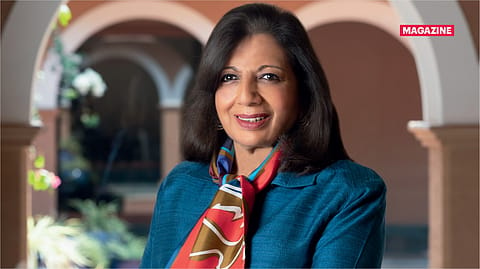
My whole mantra is affordable innovation and access, so I am very proud that we have actually achieved a lot of our objectives, says Mazumdar-Shaw in an interaction with Fortune India.
This story belongs to the Fortune India Magazine may-2026-biocon-next issue.
Are you happy with the progress Biocon has made so far?
Why should I not be happy? I am very happy, very proud, because everything we have done, we have done systematically, with a very strategic thought process, and it has worked. It is now paying back dividends for us. I did very well with enzymes, and, to think about it, I had developed the enzymes for bioethanol in the ’80s. My whole life is [associated with] fermentation science, I went into fermentation-based statins, I was the first one to make insulin in the country, today I am the third-largest insulin company in the world, and that too, it is not a me-too technology, it is a proprietary technology. I have developed novel antibodies and biosimilar antibodies, the only one in the country to do so. My whole mantra is affordable innovation and access, so I am very proud that we have actually achieved a lot of our objectives. The future is of course even bigger, because I really want to make sure that even in biosimilars we innovate to differentiate.
How do you rate Biocon’s growth compared to Indian pharmaceutical/ biotech firms that started around the same time?
Look at their size of business, and look at ours. We are much bigger. My biosimilar business started in 2010. We are only a 15-year-old company when it comes to biosimilars. You compare a 15-year-old generic company with us. Today we are almost $2 billion in revenues. And if you look at the generic companies that started around that time, they are all in their $500 million, maybe $1 billion range. Their Ebitda margins are very low.
Biocon was first identified with enzymes, then came insulin, biosimilars followed, and tomorrow it will probably be innovative cancer medicines. How did the shift happen?
These kinds of journeys are never planned. They are about strategic thinking, challenging the status quo. You have to reinvent. If you think you can go on doing more and more of the same [thing] and you will keep on succeeding, it never works. As an entrepreneur, I always feel every 10 years I must ask are we doing the right thing, can I do something different, should we not do something different, and it happens. The first 10 years, I was developing the company itself, but the first 10 years was enzymes, the next 10 years was insulin, the next 10 years has been biosimilars, and the next 10 years can be very, very high-value innovation, based on a lot of new technologies.
If you look at our growth over the years, we see a lot of big partnerships, like those with Pfizer and Mylan. Collaboration is the best way to accelerate growth. You need capital when you want to do something big, and the best way to raise that capital is through partnership. Equity investors are all very short-term thinkers, so I like to collaborate with companies who share my strategy.
More Stories from this Issue
Biocon India started as a partnership with Irish Biocon, and Viatris with a partnership with a foreign company. Now both Biocon and Viatris are part of your enterprise. How do you see that?
You start with a partnership, and then comes a point where you decide who is really going to take the business forward. In both the cases, whether it was Biocon first, which of course became Unilever’s shareholding later, and when the time came, when Unilever said 'oh, I am not interested in biotech, I want to get out of biotech', I bought it out. When Viatris said we are in a position to offer a sale of biosimilars, I bought it out. It happened that way. As long as the collaboration is ongoing, it’s fine, but the day the partner says, I want to encash, I am ready to buy it because I know that business very well… it shows the value of the partnerships that you enter.
What should India do to nurture the biotech ecosystem?
We should start respecting our own innovation. I have been telling the Securities and Exchange Board of India (Sebi), please allow development-stage biotech companies to list on stock exchanges, provided there is a venture capital (VC) fund that has invested in them, since VCs do due-diligence, and will not simply invest in you. Similarly, in developed markets, the regulatory pathway for biosimilar is very simple. They say because it’s a biosimilar, they don’t need any animal data, but ask for a very strong CMC (chemistry, manufacturing, and controls) package, which means your characterisation of the protein has to be very, very good. So use good instrumentation to show them [the data], and they will just allow you to do a phase 1 clinical trial [of the potential biosimilar drug]. They will waive off the phase 3 trial also, because if the early part works, the phase 3 trial will also work. They know now that if phase 1 is well done, I don’t need to do phase 3, so they have shortened the whole thing. If India follows the same pathway, you have to make sure that your CMC package is what the USFDA (U.S. Food and Drugs Administration) and the EMA (European Medicines Agency) expect and accept, and you do your phase 1 trial as per both. Just waiving phase 3 and animal clinical trials is not enough. We have to do these steps very well. Do we have the rigour to do this, and the capability to review the rigour? That’s the point.
{{#most-powerful-women-snapshot-individual.slug}} {{/most-powerful-women-snapshot-individual.slug}} {{^most-powerful-women-snapshot-individual.slug}} {{/most-powerful-women-snapshot-individual.slug}} {{#showRanking}} {{current-rank}} {{/showRanking}} {{#photo.0.url}}
{{name}}
Where do you see the future of Syngene?
Syngene also has a great business. It is a leading research company in the country, but it has been losing some opportunities because we haven’t focussed on the right things. For instance, we’ve had these remote CEOs for Syngene. You need a resident CEO for making things happen… like CDMO (contract development and manufacturing organisation) is a big business and they have not really focussed on it. That is something our new CEO knows very well because he has come from Biocon. We are going to focus on CDMO, and we have a great opportunity in AI services because Syngene has been doing AI a lot under the radar, and I told them now that AI has arrived, you should make it a very important part of your service. They have got other interesting opportunities where they have some differentiated proprietary technologies, so it will do very well. You will see a big turnaround in the next few years.
How many startups have you supported and mentored, financially or otherwise?
Biocon itself has created almost 100 startups, if you count the number of companies started by former Biocon employees. I am not saying we started it, I am saying Biocon is like the old incubator. So many companies have come out of the Biocon stable. On our own, we have created Bicara, Immuneel, and of course, we support a lot. Personally, I have supported a lot of companies. I also spend a lot of time with them, and make connections, not just financially, and people recognise that. It’s one thing to start a company, and it’s another to create that enabling environment.
Follow Fortune India
NEXT STORY