The turning point in India's artificial intelligence journey
/ 3 min read
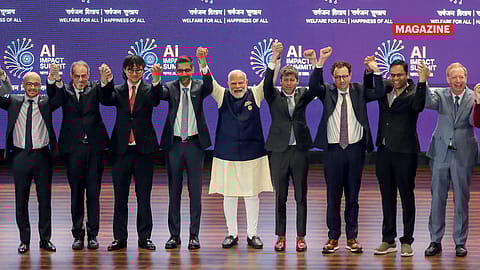
PM Narendra Modi with tech leaders at the India AI Impact Summit 2026. | Credits: Getty Images
The turning point in India's artificial intelligence journey
India's AI ambitions took centre stage at the India AI Impact Summit 2026, where Prime Minister Modi emphasized the country's potential to lead globally in AI development. With commitments exceeding $250 billion, including major investments from Reliance and Google, India aims to become a global AI hub, fostering inclusivity and responsible AI deployment.
This summary is AI-generated, and Fortune India is not responsible for its content or any associated copyright issues.
At the India AI Impact Summit 2026, which brought together more than 100 global leaders on a single stage, New Delhi staked a claim to technology leadership with a stress on human-centric AI.
PM Narendra Modi with tech leaders at the India AI Impact Summit 2026. | Credits: Getty Images
This story belongs to the Fortune India Magazine march-2026-indias-biggest-unicorns issue.
“INDIA HAS DIVERSITY, demography, and democracy. Any AI model that succeeds in India can be deployed globally. Therefore, I invite all of you. Design and develop in India.” Prime Minister Narendra Modi’s words at India AI Impact Summit 2026 captured New Delhi’s intent: it doesn’t want to be merely an adopter; it wants to build, govern, and lead.
Top tech CEOs, including Alphabet’s Sundar Pichai, Anthropic’s Dario Amodei, and OpenAI’s Sam Altman, were in attendance at New Delhi’s Bharat Mandapam amid India’s calls for inclusivity and responsible AI development and deployment. India’s ambition was met with promises: AI-stack investments worth over $250 billion, alongside $20 billion in venture capital and deeptech funding.
This includes investments worth ₹10 lakh crore announced by Reliance Industries chairman Mukesh Ambani to build multi-gigawatt AI-ready data centres over the next seven years. Google, for its part, announced a $15-billion AI hub in Visakhapatnam, as well as an India-U.S. subsea cable initiative to strengthen connectivity for AI workloads. Microsoft outlined plans to partner on skilling initiatives targeting millions, including its ‘Elevate for Educators’ programme, and to support public-sector AI platforms. Mumbai-based neo-cloud provider Neysa secured an equity commitment of up to $600 million from investors, including Blackstone. It plans to raise additional debt to scale its GPU capacity.
The scale of endorsements marks one of India’s biggest diplomatic achievements in the technology policy framework. Signatories included major economies such as the U.S., the U.K., Canada, China, Denmark, and Germany, underscoring India’s emerging role as a bridge between advanced economies and the Global South. Notably, it was the first time the annual summit was held in the Global South. India also joined the Pax Silica, a U.S.-led framework aimed at strengthening supply chains for critical minerals, semiconductors, and AI infrastructure.
The proposed investments will strengthen AI infrastructure and the broader ecosystem, Amit Khanna, partner and lead-dGTL at Grant Thornton Bharat, tells Fortune India. “The summit will help position India as a global AI hub and a growth engine for a vibrant Bharat. It has also staked a clear claim to technology leadership.”
According to Union IT minister Ashwini Vaishnaw, 89 countries and two international organisations, including the EU, signed the AI Impact Summit declaration, formalising principles centred on the “welfare and happiness of all”. This echoes the PM’s MANAV Vision, or human-centric AI. As the visitor headcount exceeded 500,000 and the five-day event got extended by a day, Vaishnaw termed it a “grand success”.
Sovereign AI
A key achievement was the IndiaAI Mission’s expansion to build large-scale GPU clusters and AI-ready data centres to reduce dependency on foreign cloud providers. The push goes beyond hardware. Accelerated public-private partnerships were announced to develop foundational AI models trained on Indian languages and datasets. With India’s vast linguistic diversity, this signals an attempt to democratise AI and make it relevant to local governance, agriculture, healthcare, and education, reflecting economic ambition and geopolitical realism.
More Stories from this Issue
Amit Sheth, founding director and CEO, Indian AI Research Organisation, GIFT City, Gujarat, describes the summit a watershed moment. “For the first time, we can say with confidence that India has definitively embarked on the path towards sovereign AI capability. We are already seeing promising results from initiatives like Sarvam AI and BharatGen, critical in addressing India’s unique linguistic and cultural diversity,” he tells Fortune India.
Follow Fortune India
Sign in to read full story
To access our exclusive magazine content, sign in to your Fortune India account.
Sign In NowNEXT STORY