Tremors at Tata: Noel Tata, Chandrasekaran and the road ahead
/ 8 min read
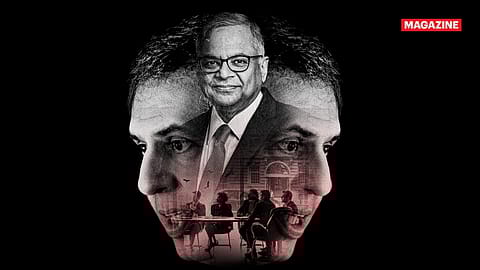
N. Chandrasekaran, chairman, Tata Sons (front) and Noel Tata, chairman, Tata Trusts | Credits: Anirban Ghosh
Tremors at Tata: Noel Tata, Chandrasekaran and the road ahead
The Tata Sons board meeting on February 24 highlighted tensions between Noel Tata and N. Chandrasekaran over financial strategies and leadership extension. Noel expressed concerns about raising capital for new ventures, fearing increased debt. The board deferred Chandrasekaran's extension, reflecting ongoing debates about Tata Sons' future, its private status, and the influence of major shareholders.
This summary is AI-generated, and Fortune India is not responsible for its content or any associated copyright issues.
Noel Tata is in favour of keeping Tata Sons private; N. Chandrasekaran is seeking unanimous support for extending his tenure. And the story is still unfolding.
N. Chandrasekaran, chairman, Tata Sons (front) and Noel Tata, chairman, Tata Trusts | Credits: Anirban Ghosh
This story belongs to the Fortune India Magazine march-2026-indias-biggest-unicorns issue.
ON THE MORNING of February 24, the day the board of directors of Tata Sons was set to convene, Noel Tata walked into Bombay House, the Tata group headquarters, at around 10 a.m., accompanied by his son Neville. Both took the same elevator, but got down on different floors. Noel went to the corner office of group chairman N. Chandrasekaran on the fourth floor. Meanwhile, on the opposite side of the same floor, the large conference hall was being readied to welcome the board members of Tata Sons for their quarterly huddle to discuss business updates and financials.
The board meeting began at 11 a.m. The members were taken through presentations on the evolving AI scenario, especially after the India AI Impact Summit 2026 in New Delhi, and cybersecurity issues. The atmosphere remained cordial until the discussion shifted to financials and fund-raising.
As deliberations moved to Tata Sons’ further investments in Air India, semiconductors and e-commerce, Noel, the chairman of Tata Trusts, expressed his displeasure over raising fresh capital to cover losses in the group’s new businesses. His view was that if Tata Sons raised capital for direct subsidiaries, it would increase debt on its books, which had been significantly deleveraged after repaying over ₹20,000 crore in 2024 to avoid mandatory listing as per the Reserve Bank of India norms. Tata Sons has applied for deregistration as an upper-layer NBFC, but the RBI is yet to respond to the application filed in 2024.
Noel pressed Chandrasekaran to offer assurances that would convince the RBI in the matter of keeping Tata Sons private. But Chandrasekaran declined, saying the issue was a policy matter and beyond his control, say sources in the know.
Tata Sons, the promoter of Tata group companies, has been classified as a core investment company (CIC), the only CIC among NBFC-UL entities on the RBI’s list. The Tata group’s argument has been that the holding company is not engaged in lending and should not be bound by financial sector regulations. Tata Capital, which was earlier part of the same RBI list, went public last year.
Back in the boardroom, when Noel weighed in on the losses, other directors — Venu Srinivasan (vice chairman, Tata Trusts), Harish Manwani, Anita Marangoly George and Saurabh Agrawal (group CFO) — rallied to justify Chandrasekaran’s position, citing the longer gestation period required for these new businesses. The same debate spilled over into the next item on the agenda — the extension of Chandrasekaran for another term as chairman. The Tata group chairman’s current term ends in February 2027.
The third term was expected to be a done deal, with four directors backing the renewed tenure. The majority shareholder, Tata Trusts, had also passed a resolution last year to extend Chandrasekaran’s term to 2032. The board eventually proposed putting the matter to a vote amid dissent from Noel Tata. But Chandrasekaran himself stepped in to douse the fire, and proposed that the decision be deferred until a consensus could be achieved at — a tradition upheld by the late Ratan Tata. In short, he pushed the ball to Noel’s court.
More Stories from this Issue
At around 5.30 p.m., barely half an hour after the board meeting concluded, Chandrasekaran walked calmly out of Bombay House’s main entrance, but faced a barrage of questions from the media regarding the deferral of his extension. With his usual smile, he replied, “I recommended that my extension should be deferred.”
“Nothing changes” in the Tata group, he added.
Sure, it meant no changes in the functioning or strategic direction of the group, but then, personal equations are always a different issue!
Noel’s demand
This is not the first time personal equations have turned tense within the top leadership of Tata. When Ratan Tata took over as chairman in 1991, several allies turned adversaries and attempted to assert control within individual group firms. Tata responded with an iron hand and removed them from their respective companies.
{{#most-powerful-women-snapshot-individual.slug}} {{/most-powerful-women-snapshot-individual.slug}} {{^most-powerful-women-snapshot-individual.slug}} {{/most-powerful-women-snapshot-individual.slug}} {{#showRanking}} {{current-rank}} {{/showRanking}} {{#photo.0.url}}
{{name}}
Following his retirement, he returned to oversee the removal of Cyrus Mistry in 2016. Earlier, Ratan Tata had sided in favour of Mistry against his half-brother Noel, during the selection of a new group chairman in 2011.
Following the demise of Ratan Tata, Noel quietly assumed charge as chairman of Tata Trusts. There, too, personal equations turned sour, and board members Mehli Mistry and Pramit Jhaveri were not reappointed. At one stage, Union ministers Amit Shah and Nirmala Sitharaman had to intervene to quell the situation.
The most recent controversy involves the proposed induction of Noel’s son, Neville, on the board of The Sir Ratan Tata Trust, a move that is yet to receive formal approval from the trustees. According to sources, the appointment stalled due to the absence of a quorum at crucial meetings and differences of opinion among board members. Reportedly, Venu Srinivasan had raised objections earlier last year.
Neville, who heads the Tata-Tesco Star Bazaar joint venture, has been appointed on the board of another major trust — The Sir Dorabji Tata Trust.
Noel has little reason for any ill feeling towards the group chairman, though. “Chandrasekaran has been in regular touch with Noel Tata and discusses crucial issues, much like he did with Ratan Tata,” says a source aware of the situation. If the fallout is limited to debt concerns and worries over a potential listing of Tata Sons, it may not escalate further, he adds.
Like Ratan Tata, Noel does not want the holding company to be listed. Through the privately held philanthropic trusts, the Tata family exercises influence over key decisions across group firms. Tata Trusts, through two major trusts — The Sir Ratan Tata Trust and The Sir Dorabji Tata Trust — along with allied trusts, hold a 66% stake in Tata Sons, and trust nominees (currently two — Noel Tata and Venu Srinivasan) possess veto powers over crucial board decisions at the holding firm.
The Shapoorji Pallonji (SP) family is the second-largest shareholder in Tata Sons with an 18.4% stake. Noel’s wife Aloo is the sister of current SP group chairman Shapoor Mistry.
The two major shareholders differ on Tata Sons’ future positioning. While Noel wants it to remain private, his brother-in-law Shapoor recently issued a press statement highlighting the importance of listing Tata Sons. The SP group, burdened with heavy debt, has reasons to push for a listing. An IPO will help them fetch better valuation, and facilitate a lucrative exit from Tata Sons. It is, therefore, evident that Shapoor and Noel are at loggerheads, at least on this issue.
Late last year, the Trusts tasked Chandrasekaran with negotiating with the SP group for their exit, while simultaneously engaging with the RBI to retain Tata Sons as a private entity. This responsibility formed part of the board decisions that proposed Chandrasekaran’s extension.
With Noel’s latest move, it has become clear that he does not intend to remain in the background, but prefers to guide the group more directly in its next phase of growth. “He also wants a reporting system similar to what existed under Ratan Tata. It means there won’t be multiple power centres within the group,” says a senior executive.
Noel’s family, including daughters Leah (an executive in Indian Hotels Co.) and Maya (Tata Digital) are expected to assume larger leadership roles during this transformation, according to another executive.
Chandrasekaran’s options
Though the Tata Sons board deferred Chandrasekaran’s extension, Tata Trusts’ boards are not likely to revoke their decision. Trustees Venu Srinivasan and Vijay Singh have been quoted in media reports as saying that the resolution passed in July 2025 to reappoint Chandrasekaran as chairman for a third term remains valid.
There is no clarity on when Tata Sons’ next board meeting will be held.
When Chandrasekaran took over as chairman of Tata Sons in 2017, the 100-company conglomerate was grappling with legacy business challenges and high financial leverage in key companies. Over the next eight years, the former TCS CEO-turned-group chairman pushed the 150-year-old conglomerate to think bigger, move faster and place bold bets on future technologies and emerging opportunities.
His “One Tata” philosophy went beyond collaboration and synergy extraction. He unified similar businesses — like in the case of Tata Consumer Products, Air India, and Tata Capital — while also undertaking value-unlocking demergers such as in Tata Motors for a sharper business focus.
Capital discipline became a defining theme under Chandrasekaran. In the automotive business, the goal of achieving zero net debt was met within the announced timeframe. Tata Steel reduced debt while sharpening its domestic focus. Tata Motors rediscovered momentum through its EV push. Tata Power pivoted towards renewables. Indian Hotels adopted an asset-light strategy to improve margins.
The icing on the cake was the formation of next-generation businesses. Chandrasekaran ensured that the group did not miss emerging opportunities, leading entries into semiconductors and electronics manufacturing, battery production, aviation manufacturing and e-commerce platforms. These investments were undertaken directly through Tata Sons. To fuel growth in these businesses, in 2022, the Tata Sons board approved a $90-billion investment in emerging industries by 2027.
However, the scaling of new-age businesses turned challenging. Competition in e-commerce intensified with the advent of quick commerce. The refurbishment of aircraft and costly acquisition of new ones have become critical for Air India, which recently faced a massive security crisis following the Ahmedabad plane crash. In semiconductors, rapidly evolving technologies made it difficult to build manufacturing capabilities in a capital-efficient manner.
Air India’s net loss widened to ₹10,859 crore in FY25 due to the merger impact involving AirAsia and Vistara, and elevated operating costs. Revenue rose 15% YoY to ₹78,636 crore. Tata Electronics, founded around 2020, clocked revenues exceeding ₹66,000 crore in FY25, but posted a loss of ₹70 crore. Tata Digital, which houses Tata Neu, BigBasket and 1mg, reported revenues of ₹32,188 crore, while incurring losses of ₹4,610 crore. BigBasket’s consolidated net loss alone stood at ₹2,006 crore in FY25, up 42% YoY. Tata Play, meanwhile, reported a net loss of ₹529 crore in FY25, almost double the previous year.
The immediate concerns at Tata Sons now revolve around fresh investments, increasing losses in new businesses, debt management and retaining its private status. The 63-year-old Tata group chairman remains capable of navigating these challenges, but he needs to keep Noel Tata in the loop in the same way he maintained cordial relations with Ratan Tata.
The promoter family is expected to increase its presence in trust activities and affairs of group firms. Chandrasekaran needs to take a considerate view of the same, say sources. Another aspect evident in the Tata ecosystem is that Ratan Tata’s nominees continue to hold influential positions, limiting Noel’s ability to fully advance his vision, according to sources. It remains to be seen how this changes.
Chandrasekaran appears to have already sensed the change, as reflected in his suggestion to defer the extension of his tenure. During the board meeting, he also underscored that the group functions most effectively when Tata Sons and Tata Trusts act in alignment rather than at cross purposes.
One thing is clear — the days ahead will offer greater clarity regarding the personal equations at the top of the Tata group. Equations which are critical for the future of the group itself.
Follow Fortune India
Sign in to read full story
To access our exclusive magazine content, sign in to your Fortune India account.
Sign In NowNEXT STORY