Why Anthropic has doubled down on its India plans
/ 4 min read
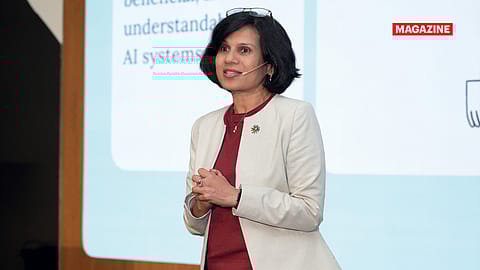
Irina Ghose, managing director of India, Anthropic
Why Anthropic has doubled down on its India plans
Anthropic is intensifying its India push, opening a Bengaluru office and hiring former Microsoft India head Irina Ghose as it positions Claude as a key AI tool for enterprises. CEO Dario Amodei sees India as central to both AI opportunity and risk, with adoption led by tech hubs and a focus on safe, compliant deployment across sectors like education, healthcare, and jobs.
This summary is AI-generated, and Fortune India is not responsible for its content or any associated copyright issues.
With Irina Ghose as the country head, Anthropic is looking at India as the right test bed for AI adoption at scale.
Irina Ghose, managing director of India, Anthropic
This story belongs to the Fortune India Magazine march-2026-indias-biggest-unicorns issue.
ANTHROPIC PBC’S CEO and co-founder Dario Amodei delivered a sharp keynote at the India AI Impact Summit in New Delhi. He didn’t mince words as he listed the risks alongside the potential as AI advances and ventures into the unknown. On the positive side, AI models can help in healthcare, lift billions out of poverty, and create a better world for everyone. But Amodei’s concerns centred on AI models’ autonomous behaviour, plausible misuse by individuals and governments, and their potential for economic displacement.
“India has an absolutely central role to play in these questions, both on the side of the opportunities and on the side of risks. As a sign of our commitment, we just opened an office in Bengaluru and hired Irina Ghose (the former head of Microsoft India), who has spent three decades building businesses in India,” he said.
Ask Ghose what prompted her to take up the new role, and pat comes her reply: the opportunity to work with an AI-native organisation looking to bring in a transformational impact. The domestic factors have also aligned with experimentations picking up pace amid India’s eagerness for AI adoption, Ghose tells Fortune India in her first interview since taking on her new role.
Notably, India has emerged as a key frontier market for Claude.ai, Anthropic’s family of advanced LLMs and AI assistant. It ranks second only to the U.S. in adoption. According to the company’s latest Economic Index report, Claude’s usage in India is currently concentrated in Bengaluru, Hyderabad, Chennai, Mumbai, and Delhi-NCR — cities that house a majority of the technology workforce. Hence, currently, Claude’s popularity is not the result of a mass consumer uptake but is heavily skewed towards software development and engineering roles. As AI companies look at high-impact, real-use cases, and push for enterprise adoption, five-year-old Anthropic, founded by Dario Amodei and his sister Daniela Amodei — both former team members of Sam Altman-led OpenAI — is looking at India as the right test bed for the adoption of AI at scale.
“When you look at enterprises, what they need is safe deployment and compliance. At Anthropic, building technology and infusing safety and trust in the design are fused into one. That resonated closely,” Ghose says. Anthropic sees 50% more software development using AI.
As the San-Francisco-headquartered company looks to shore up local talent across engineering, sales, and other roles to deepen ecosystem partnerships, it has three immediate priorities for India. One, working on core priorities in India. “Education, job and skilling, healthcare, or agriculture are core [areas]. Working on nuanced use cases, which make really definitive outcomes in the last mile, is critical,” Ghose explains. For instance, the company is working with Pratham, one of India’s largest NGOs, to build an ‘Anytime Testing Machine’ (ATM), where Claude is being deployed for self-assessment, curriculum-aligned tests, digitising handwritten student answers, providing automatic grading, and delivering personalised feedback.
Two, work with enterprises to create domain-led contextual use cases, which matter to companies and their customers. The enthusiasm from IT/ITES organisations for Claude’s adoption has been encouraging, Ghose says. For instance, Cognizant uses Claude for internal organisational needs, including coding. Three, the company also wants to build on the vast developer and engineering talent in India to develop a community for greater infusion of Claude.
More Stories from this Issue
AI companies and IT/ITES partnerships
The emergence of new AI tools has induced a general fear about the growth of the IT sector. For instance, the release of Sonnet 4.6, the latest Claude model, fuelled concerns and sent IT vendor stocks worldwide on a downward spiral. The Indian counterparts, too, saw value erosion. However, Ghose argues that these companies are at the centre of AI implementation. “They have always been and will always be, very core in the way the growth will happen,” she says, citing a slew of partnerships with the likes of Accenture, Cognizant, and, more recently, Infosys.
She stresses the criticality of these companies in diffusing AI. The role of IT/ITES companies ranges from internal — using AI models to enhance productivity hand in hand with a human companion — to taking AI tech to enterprises and finally acting as last-mile partners for AI companies. “So, if you look at any large enterprise — banking, telecom, healthcare, anything — the last-mile of the entire implementation, deployment, adoption, scaling, etc., will always be done by the large partnerships. They play a pivotal role in everything that happens,” she explains.
The engineering future
{{#most-powerful-women-snapshot-individual.slug}} {{/most-powerful-women-snapshot-individual.slug}} {{^most-powerful-women-snapshot-individual.slug}} {{/most-powerful-women-snapshot-individual.slug}} {{#showRanking}} {{current-rank}} {{/showRanking}} {{#photo.0.url}}
{{name}}
As tech giants push for AI model adoption, Claude has also seen its fair share of partnerships with enterprises in the past few months. As models evolve quickly with newer versions hitting the market faster than the previous ones, Ghose says what will decide who leads the race will centre around how the models shape outcomes for enterprise customers. “The models that deliver the best and provide performance that caters to whatever India wants [will be the winners]. Those are the things that customers will go in for,” she says.
Ghose also tries to quell apprehensions around job losses triggered by AI adoption. “AI will remain an aid to a human. Decision-making will be with humans.” For young engineers in the software development field, she foresees a rising number of jobs that require deep technical intensity. “People should really invest and continue to invest in this area, and augment whatever they are doing [currently] with the usage or the benefits provided by Claude,” she says. But Ghose is sure about one thing: “We see that it (AI) will continue to remain a companion in the times to come.”
Follow Fortune India
Sign in to read full story
To access our exclusive magazine content, sign in to your Fortune India account.
Sign In NowNEXT STORY