The listing conundrum: Why Tata Sons wants to stay private
/ 12 min read
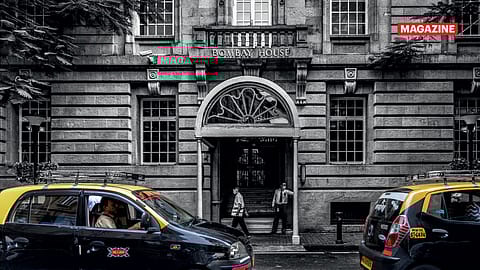
Bombay House, the iconic headquarters of salt-to-software conglomerate Tata Group
The listing conundrum: Why Tata Sons wants to stay private
Tata Sons’ private status underpins the Tata Trusts’ vast philanthropy, from affordable cancer care to nation-building institutions. As RBI rules and capital-hungry bets like Air India, semiconductors and digital ventures strain the balance sheet, Noel Tata insists on staying unlisted, debt-light and dividend-focused, fearing market pressures would erode long-term purpose and social spending.
This summary is AI-generated, and Fortune India is not responsible for its content or any associated copyright issues.
The status of Tata Sons as an unlisted entity is tied to the very soul of what the 158-year-old conglomerate stands for.
Bombay House, the iconic headquarters of salt-to-software conglomerate Tata Group
This story belongs to the Fortune India Magazine april-2026-the-emerging-100 issue.
INDIA IS WAGING a tough battle against cancer, as increasingly over 70% of cases are being diagnosed at the late stage, when the odds of survival dramatically shrink amid narrowing treatment options. What’s worse: the country is projected to hit a record 1.75 million new cases annually by 2030, that is 24% higher than the current rate.
Even as the disease is spreading, the Tata Trusts — since their inception — have made this fight their own. With a 20-hospital cancer care network, the largest in India, with more under construction, the Tata Memorial Centre in Mumbai, annually, sees 75,000 enrollments, including those from remote villages and slums, who receive the same quality of care available at a private hospital without the exorbitant cost. In the U.S., a single course of proton beam therapy — the least damaging radiation therapy with sub-millimetre accuracy — costs between $150,000 and $250,000 (₹1.39 crore and ₹2.3 crore). Tata Memorial Centre is providing it at substantially lower costs, benefitting not just Indians but those from other countries as well. This is one of the many philanthropic initiatives of the Tata Trusts.
Much of these initiatives are, primarily, funded by dividends paid by Tata Sons — the holding company of the $180-billion Tata Group — to the Trusts, the majority owners that hold nearly 66% in Tata Sons (see graphic ‘The Big Trust Factor’). And the Trusts’ ability to receive those dividends has, over the years, thrived on a single structural pillar: the private holding company, free from the quarterly cacophony that the Street thrives on. That moat is now under threat even as the people determined to defend it are caught in an internal debate, last seen when Ratan Tata passed over the reins to his successor, Cyrus Mistry.
On the evening of February 24, Tata Sons chairman Natarajan Chandrasekaran walked out of Bombay House and told media persons clustered on Homi Mody Street that “nothing had changed”.
But the reality is, a lot has.
The Tata Sons board, at its meeting that day, deferred a decision on giving Chandrasekaran a third term — at his own insistence — with his current one due to end in February 2027, after Tata Trusts chairman Noel Tata sought clarity on the group’s finances and current structure, linking these to the extension of his tenure.
The deferral brought to the fore fault lines — succession, strategy, losses — that now run through the group, and coiled beneath it all is a slow fuse: the question whether the holding company will eventually get listed.
More Stories from this Issue
A question of timing
Chandrasekaran, 62, who joined Tata Consultancy Services (TCS), the group’s IT services giant and crown jewel, as an intern in 1987, rose through the ranks to lead it before taking over as chairman of Tata Sons in 2017, following the dramatic dismissal of the late Cyrus Mistry. His record is formidable. Under his tenure, the group’s 17 largest listed companies nearly doubled their size and more than tripled profits and valuation. He channelled ₹5.5 lakh crore in investment in new businesses, including laying the foundation for India’s chip fabrication facility and the takeover of ailing national carrier Air India.
And yet here he was, standing outside his own headquarters at dusk, seeking congruence between the Trusts and the Tata Sons board over his reappointment.
“While there’s no doubt Chandra has done a good job during this tenure, there was no reason to bring it on the agenda since his term ends only next year. In fact, even in the case of RNT (Ratan Tata), his reappointment as chairman would happen days before his term was to end,” says a senior Bombay House veteran.
While Chandrasekaran worked closely with Ratan Tata, he hasn’t had a similar association with Noel, the late Ratan Tata’s half-brother, who took over as chairman within days of Ratan Tata’s demise. Noel, 69, spent decades operating far from the spotlight — building retail company Trent, scaling Tata International from $500 million to over $3 billion in revenue over 2010-21, and serving on the boards of Titan, Voltas, and Tata Steel. Though operationally accomplished and trusted within the group, he had earlier been passed over for the chairmanship of Tata Sons, which went to the late Cyrus Mistry (Noel is married to Mistry’s sister Aloo) and then to Chandrasekaran.
{{#most-powerful-women-snapshot-individual.slug}} {{/most-powerful-women-snapshot-individual.slug}} {{^most-powerful-women-snapshot-individual.slug}} {{/most-powerful-women-snapshot-individual.slug}} {{#showRanking}} {{current-rank}} {{/showRanking}} {{#photo.0.url}}
{{name}}
IN A TANGLE Noel Tata (left), chairman, Tata Trusts; and N. Chandrasekaran, chairman, Tata Sons.
As the 11th chairman of the Sir Dorabji Tata Trust and the sixth of the Sir Ratan Tata Trust, Noel is the custodian not merely of a shareholding but of the philanthropic mission through which the group has always defined its existence: purpose over profits. What Noel thinks about Tata Sons’ strategy is not merely an opinion but, structurally, the most important view in the room. The key points that the Trusts chairman seeks clarity on are: first, Tata Sons must remain unlisted — a firm commitment that he wants from Chandrasekaran. Second, capex on high-risk ventures needs tighter oversight. The losses from major acquisitions, specifically Air India and Tata Digital, must be addressed with a credible roadmap. Third, proactively engaging with the Mistry family of the Shapoorji Pallonji Group, which owns a little over 18% stake in Tata Sons, and has been looking to monetise a part of its holding to tide over its leverage issues.
The conditions aren’t outrageous, but what made them significant is the timing.
Since 2017, the Tata Group has transformed in scale and ambition in ways that would have seemed improbable when Chandrasekaran took over in the immediate aftermath of the Mistry affair. Revenue and profit trajectories across the portfolio have been exceptional by most benchmarks.
But recent years have delivered a sequence of exigencies that no chairman could have entirely foreseen. TCS, the source of 80% of Tata Sons’ dividend income because of its over 71% stake, has lost over $100 billion of its market value since its 2024 peak, squeezed between weak demand and the existential anxiety in an AI era. Tata Motors, already navigating the transition from combustion to electric, was hit by a devastating cyberattack on Jaguar Land Rover’s U.K. operations. Air India suffered a fatal crash in Ahmedabad that added regulatory scrutiny to operational strain. The combined effect amid a volatile geopolitical backdrop has wiped out over ₹5 lakh crore in aggregate market value of the group’s listed entities since 2025.
The challenges
None of this is of Chandrasekaran’s making.
The JLR cyberattack was not foreseeable. The Air India crash was a tragedy, not a governance failure. The AI disruption facing TCS is an industry-wide phenomenon. But the headwinds, precisely when the group’s new-era bets are consuming the most capital and generating the most losses, has made the continuity conversation harder.
But the conversation inside Bombay House is not merely about personalities or even about strategy; it is now a structural trap that the group must navigate carefully.
The Reserve Bank of India’s scale-based regulation framework classified Tata Sons as an Upper Layer NBFC (NBFC-UL) — based on certain qualitative and quantitative parameters and supervisory judgment — triggering a mandatory listing.
In 2024, Tata Sons applied to surrender its Core Investment Company registration, the specific category within the NBFC framework that attracted the listing obligation. To qualify for that, Tata Sons repaid over ₹20,000 crore in debt, reducing its borrowings to a level that would remove it from the regulatory trigger. The company was, however, included in the January 2025 circular of Upper Layer NBFCs (see table ‘The Odd One Out’).
One of the conditions mandatorily requires a listing on the stock exchanges within three years of being classified as an NBFC-UL. Since non-banks were first so categorised in the September 2022 notification, the listing deadline was before September 30, 2025. Though the RBI is yet to approve the deregistration, Governor Sanjay Malhotra during the post-monetary policy press conference in October 2025 said: “Any entity which has a registration, till it is not cancelled, will continue to do its business.”
Tata Sons did not comment on Fortune India’s queries on the nature of its communication with the RBI and whether it had received any response on the status of its application. A Tata Sons spokesperson told Fortune India that “the decision rests with the RBI”.
In other words, Tata Sons exists in a legal and regulatory limbo, and this is the thread that connects Noel’s conditions to Chandrasekaran’s roadmap for the future of the group.
Air India’s turnaround will require years of capital infusion before it generates free cash flow. The fab facility demands sustained investment. Tata Digital’s losses will not reverse without continued funding. If Tata Sons borrows to support these businesses, it risks crossing the threshold that brings the RBI’s listing mandate back into force. The debt-free status Noel aspires to is not a conservative instinct for its own sake but a non-negotiable condition of everything the Trusts exist to do.
The conundrum
Pull back from the boardroom saga, and there is a larger question beneath it all: what does a 158-year-old private institution owe, and to whom?
The Indian Institute of Science (IISc). The Tata Memorial Cancer Centre. The National Centre for the Performing Arts. The several rural development programmes. These are not peripheral but principal activities; they are the reason Tata Sons’ ownership was designed the way it was, and they are one of the reasons Noel is not wrong to treat the private status as a first-order concern rather than a preference.
The steel mill at Jamshedpur — built before India’s independence — was an act of nation-building. So was the funding of the IISc. The Tata Group became India’s most trusted and admired conglomerate by choice and has served obligations that went beyond shareholder interests.
That disposition depends on a structural condition: freedom from public market scrutiny.
Chandrasekaran is trying to build India’s semiconductor industry, rescue a national airline, and protect the country’s largest IT company from the most disruptive technological shift in a generation. That is a tough ask of any executive chairman even as the majority shareholder is worried about debt and losses and the regulatory fuse that connects those two things to a market listing.
The question is whether the architecture that has served the group for 158 years is still the right one for the bets currently underway. From Noel Tata’s perspective, the answer is yes. The design may be robust enough to accommodate patient capital at the scale the new ventures require.
If a listing were to happen, every capital allocation call will become a subject of analyst commentary, proxy advisor recommendation, and quarterly earnings scrutiny. Not to mention the conglomerate discount.
Tata Sons’ portfolio — TCS, Tata Motors, Tata Steel, Titan, Tata Power, and the rest — is already comprehensively accessible to any investor through direct equity purchases. The discount, estimated at 20-40%, would immediately impair over ₹3-6.5 lakh crore of value. At this moment, this is destruction the group can hardly afford. A listed Tata Sons adds no new investment access. Unlike the listed Berkshire Hathaway, where the operational entities are within the holding company, in the case of Tata Sons most of the businesses are already listed.
The irony is acute: at the very moment that Noel and Chandrasekaran are trying to work through questions of capital discipline, strategic priority, and succession structure, a listing would flood the room with shareholders who have no interest in any outcome longer than the next fiscal year. “A public listing would make every board discussion, every capital decision, and every strategic move of the group subject to public disclosure and shareholder scrutiny,” says the CEO of a conglomerate-owned holding company.
A mandatory listing would subject the dividend stream to the logic of public markets. Activist shareholders or proxy advisors could campaign for reduced dividends in favour of share buybacks. A bad quarter — a steel price downturn, a currency hit or falling volumes at JLR, a prolonged demand downturn at TCS — through market pressure could translate into dividend suppression at Tata Sons. And reduced disbursements from the Trusts means less social development funding.
The classification problem
The RBI’s rationale for placing Tata Sons in the NBFC-UL category rests on what regulators call the ‘principal business test’. According to the RBI Act, a company is classified as an NBFC if more than 50% of its assets are financial assets and more than 50% of its gross income derives from those financial assets. The contention here could be that Tata Sons’ equity stakes in group companies constitute financial assets, and that the dividend income from those stakes constitutes financial income.
But the principal business test is, arguably, designed for lenders and deposit-takers, not for strategic holding companies whose income derives from the commercial success of operating businesses. A holding company that owns factories, mines, hotels, and IT campuses through its subsidiaries is not a financial company in any meaningful sense of the term.
“Tata Sons operates like any other promoter holding entity, much like other prominent conglomerates which have promoter vehicles that raise money and deploy it into operating companies below. Tata Sons is no different. The only distinguishing factor is that it is ultimately held by charitable trusts, and that it raises significantly more money compared to its peers, making it more visible. But in essence, the structure is not unique,” says the CEO quoted earlier.
The RBI’s own circular states that if there are companies engaged in agricultural operations, industrial activity, purchase and sale of goods, providing services or purchase, sale or construction of immovable property as their principal business and are doing some financial business in a small way, they will not be regulated. Interestingly, this test is also known as the 50-50 test, to determine whether or not a company is into financial business.
Tata Sons receives dividends from industrial and technology subsidiaries and not from any financial intermediation activity. The central bank’s NBFC framework is for a specific category of entities that Tata Sons demonstrably is not. “Forcing Tata Sons into that framework, and then applying the listing consequence of that framework, is the regulatory equivalent of using a tool designed for one job to perform a fundamentally different one,” says a senior executive of the Big Four.
The SP Group saga
There is a third party in this story that has been waiting for long to be heard, and whose interests cut directly across the listing question in a direction opposite to Noel’s.
The Shapoorji Pallonji Group holds the largest minority stake, acquired for approximately ₹69 crore, and now worth, by any reasonable estimate, many tens of thousands of crores (see graphic ‘The Minority in Question’).
The SP Group’s wealth is substantially locked in Tata Sons shares that it cannot sell. The group has wanted to monetise at least a portion of this holding to fund its own construction and real estate businesses which have faced financing pressures of their own, including raising private credit at nearly 20%. A listing of Tata Sons would give a market price and an exit path. This is precisely why the SP Group has been in favour of a listing and precisely why Noel views it as an alignment of regulatory compulsion and minority shareholder interest against the Trusts’ structural control.
One of the conditions Noel raised for Chandrasekaran’s extension is finding a way early to give the SP Group an exit from Tata Sons that does not require a listing. This is a genuine problem with no obvious solution: it is not easy to create liquidity for an 18% stake in a private company without either listing the company, engineering a buyback at a price that would be extraordinary, or finding a buyer willing to take on a minority position with no clear exit.
Noel’s dilemma
Noel is asking the right questions. The concerns about debt, capital discipline, and the concentration risk on TCS are legitimate. But the most important question is: what is the long-term capital model of a group that aspires to build semiconductors, run airlines, and compete in digital commerce but cannot raise equity without listing and must not raise debt without risking the listing mandate?
If the answer to every capital allocation question lies in internal accruals and sans debt, then the group’s new-era ambitions must be scaled to fit a much smaller funding envelope than Chandrasekaran’s vision implies. While not necessarily wrong, it will become a strategic choice that the Trusts, given the constraint, must also own.
“Some of the digital ventures may need to see a pullback. On semiconductors and EVs, there is much less optionality — those commitments have already been made. You cannot easily walk away from those,” says a former director of Tata Sons.
Hence, Chandrasekaran’s request for a deferral of a decision on his third term is also an acknowledgement that the questions being asked of him are also questions being asked of the structure. He is right in thinking that the group functions best when Tata Sons and the Trusts are fully aligned on strategy.
“The capital bets made were Chandra’s calls — and the person who makes a commitment of that scale needs to be the one who sees it through. Walking away mid-course would be disruptive. Pertinently, there aren’t many with the experience and capability to manage a conglomerate of this complexity. Sometimes the best decision is to do nothing… let continuity prevail,” says the CEO mentioned earlier.
For now, there is a dissonance.
If Tata Sons lists, the private empire ends. The February 24 meeting, for all its public spectacle, was still a private affair but future ones may not be.
But more than any regulatory deadline or board condition or succession debate, what is truly at stake is whether India’s oldest private empire can stay faithful to what its founder believed was a non-negotiable — that Humata (good thoughts), Hukhta (good words) and Hvarshta (good deeds) were never an insignia to be displayed but a promise to be honoured.
And lest we forget: an oncologist’s first obligation is to the patient. So, the Trusts would argue, is theirs.
Follow Fortune India
Sign in to read full story
To access our exclusive magazine content, sign in to your Fortune India account.
Sign In NowNEXT STORY