Why the India-New Zealand FTA is a booster shot for trade ties
The deal opens a level-playing field for Indian products in the highly competitive foreign market.
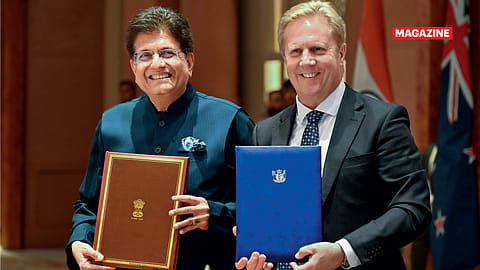
This story belongs to the Fortune India Magazine may-2026-biocon-next issue.
THE INDIA–NEW ZEALAND FTA, signed on April 27, has been termed as a ‘once-in-a-generation’ pact. The ninth bilateral deal signed by India in five years promises to double the trade between the two partners to $5 billion by 2031. “This forward-looking agreement will facilitate $20 billion of investment into India, deepening our cooperation in trade, services, investment, innovation, mobility, agriculture productivity, and education, and creating pathways for skilled talent and students,” commerce minister Piyush Goyal said after signing the pact. “It expands market access across 118 sectors, strengthens MSMEs, exports, and the innovation agenda.”
The pact has multiple first-time initiatives, including 100% duty-free access for India’s exports, fast-track in pharma, agri-productivity partnership, talent mobility, AYUSH, and stronger intellectual property. With 100% duty-free access to the island country across 8,284 tariff lines, India’s domestic industry stands to gain significantly, including in sectors such as apparel, pharmaceuticals, machinery, and auto components. Earlier, New Zealand had tariffs of up to 10% on key Indian exports, including ceramics, carpets, automobiles, and auto components. “[The] duty-free access will strengthen India’s competitiveness across key manufacturing and labour intensive sectors in textiles, leather, footwear, engineering goods, plastics, and processed foods,” says Gautam Khattar, principal, Price Waterhouse & Co LLP. Gulzar Didwania, partner, Deloitte India, says the FTA is designed to deliver steady economic gains by expanding goods and services trade.
India also secured duty-free inputs for its manufacturing sector, including wooden logs, coking coal, and waste and scraps of metals, lowering production costs and enhancing the global competitiveness of the domestic industry. However, the market access excludes the dairy sector to protect farmers and rural economies. India has offered liberalisation of 70.03% tariff lines covering 95% of bilateral trade value, while excluding 29.97% tariff lines, states the Ministry of Commerce.
Key agricultural products are outside the deal’s ambit to protect sensitive sectors. “The FTA has been carefully calibrated by introducing tariff rate quotas as well as minimum import prices. Further, both countries have agreed to collaborate on productivity action plans for apples, kiwi fruit, and honey with a focus on yield enhancement and farm-level competitiveness,” Didwania adds.
In short, the deal underscores India’s FTA strategy: the search for new markets will continue, but the interest of sensitive sectors will be paramount.