Zee bets beyond cricket for future growth
/ 4 min read
With FIFA rights, a growing sports portfolio, and a long-term distribution strategy, Zee is making a calculated wager that India’s next media growth story will come from beyond cricket.
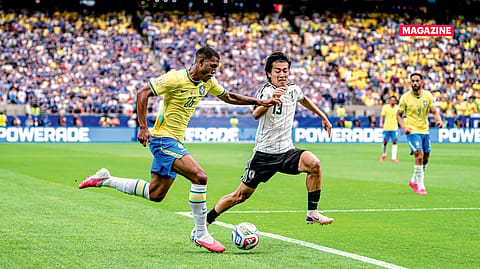
Zee’s FIFA investment will not be measured by World Cup ratings alone, but by its ability to convert one marquee tournament into a durable sports ecosystem. | Credits: Getty Images
This story belongs to the Fortune India Magazine july-2026-mpw-100-most-powerful-women issue.
LESS THAN TWO WEEKS before the 2026 FIFA World Cup kick-off at Estadio Azteca in Mexico City, a big media story was unfolding thousands of miles away. India, one of the world’s largest consumer markets, did not have a confirmed broadcaster for football’s biggest spectacle. For previous editions, rights had typically been closed well in advance, allowing broadcasters to build programming, advertising inventory, and consumer anticipation months before the kick-off.
At the centre of the deadlock was a disagreement over economics. FIFA initially sought close to $100 million for combined India rights across the 2026 and 2030 world cups before subsequently lowering its ask to around $60 million, nearly what Viacom18 paid for the previous cycle. JioStar, the Reliance-Disney joint venture that holds IPL and Premier League rights in India, reportedly placed a final offer of around $15-20 million before withdrawing from discussions. Sony, too, explored its options before eventually stepping back.
The hesitation stemmed not from a lack of demand but from questions about the commercial viability of late-night viewing windows, limiting television audiences, and weakening advertiser appetite. Broadcasters also pointed to structural pressures, including mandatory sharing requirements under Indian regulations, constraints around monetisation, and slowing advertising growth. Off the record, senior executives questioned whether global rights valuations reflected Indian market realities.
Then Zee Entertainment entered the chat. To the relief of football fans, it secured the rights for nearly $40 million. To broadcast the tournament, the company launched Unite8 Sports, a dedicated sports channel network, signalling that this was not a one-off acquisition but the foundation of a larger ambition.
The economics of rights
The deal arrives at a fascinating moment for Indian media. In a cricket-crazy nation, sports broadcasting revolved around the dominant economics that the willow delivered scale, subscriptions, and advertiser confidence. But it also created concentrated risks. Rights became expensive, competition intensified, and returns became harder to justify.
But Zee’s new playbook poses a different question: what if the next phase of growth comes from beyond cricket? Bavesh Janavlekar, chief business officer at Unite8 Sports, says that India’s sports landscape remains underdeveloped. “The future for non-cricket sports is quite good,” he emphasises, explaining that India already possesses sporting heroes but often lacks the platform and packaging necessary to convert achievement into audience scale. Broadcasters, he argues, have been underinvesting in creating sustained engagement.
More Stories from this Issue
Unite8 Sports aims to change that by building an ecosystem spanning football, cricket, kabaddi, badminton, wrestling, boxing, and combat sports. Zee has acquired exclusive broadcast rights for India’s T20I tour of Zimbabwe in July. Janavlekar describes it as part of the diversification strategy to scale Unite8 Sports into a premium global sports destination. Four dedicated sports channels were also launched — Unite8 Sports 1 and Unite8 Sports 1 HD in Hindi, and Unite8 Sports 2 and Unite8 Sports 2 HD in English — that have secured distribution across more than 500 cable and platform operators nationwide.
On the economics of the deal, Janavlekar says, “We didn’t explore 2026 as an individual thing. The objective was to have a long-term thing because if planned and executed right, India has massive football potential.” That matters because consumers no longer think in categories; they discover sports through streaming, return through highlights, engage through social content, and build loyalty through communities.
Zee’s financial position sharpens the significance of the wager. It is entering sports not from excess capital but under genuine pressure, with annual revenue hovering around ₹8,100 crore and market capitalisation at nearly ₹10,800 crore. Net profit has been under strain, with the company reporting a loss in its most recent quarter.
The attention business
{{#most-powerful-women-snapshot-individual.slug}} {{/most-powerful-women-snapshot-individual.slug}} {{^most-powerful-women-snapshot-individual.slug}} {{/most-powerful-women-snapshot-individual.slug}} {{#showRanking}} {{current-rank}} {{/showRanking}} {{#photo.0.url}}
{{name}}
Zee’s agreement includes rights to 39 FIFA properties extending through 2034, including the FIFA World Cup 2030, FIFA Women’s World Cup 2027, youth tournaments, futsal competitions, and associated documentary content. The football federation’s premium inventory strengthens broadcaster credibility beyond cricket, believes Yasin Hamidani, director at Media Care Brand Solutions. Delphin Varghese, co-founder and chief revenue officer at AdCounty Media, sees FIFA as part of a broader transition in sports monetisation where brands increasingly seek engagement ecosystems spanning OTT, television, and social participation. Prasanth Shanthakumaran, partner and head of the sports sector at KPMG in India, concurs. Securing FIFA signals the diversification of Indian sports broadcasting beyond cricket, he says.
With FIFA and future properties feeding into the platform, Zee believes it can attract new consumers, particularly Gen Z and younger viewers. Ramkishen Y., professor of marketing at K. J. Somaiya Institute of Management, believes FIFA’s combination of prestige and audience engagement creates strategic value for Zee by strengthening its TV network and ZEE5. Early indicators back the thesis. According to the company, the World Cup opening weekend had more than 100 million viewers across TV, digital, and social platforms of Zee. ZEE5 alone attracted nearly 6 million viewers between June 11 and June 14. Average per-viewer engagement on live matches exceeded 190 minutes across the four-day opening period — a figure that challenges the conventional assumption that Indian audiences are casual viewers, and not committed fans, of football.
Meanwhile, ahead of the tournament, Zee announced partnerships with more than 12 brands, including Mahindra, Diageo, Apple, Pernod Ricard, and Mondelez. Sandeep Mehrotra, COO of advertisement revenue at Zee, describes the response as evidence of football’s growing potential as a commercial property in India.
The company has also moved beyond broadcasting. Public viewing partnerships across cinemas, clubs, restaurants, educational institutions, and hospitality venues have extended the experience beyond households, while infrastructure upgrades to ZEE5 and strengthened anti-piracy measures were completed ahead of the tournament.
Ultimately, Zee’s FIFA investment will not be measured by World Cup ratings alone, but by its ability to convert one marquee tournament into a durable sports ecosystem. Only time will tell if its decision to commit meaningful capital to sports rights is either a sign of misplaced confidence or a carefully considered pivot that the market has not yet fully priced in.
Follow Fortune India
Sign in to read full story
To access our exclusive magazine content, sign in to your Fortune India account.
Sign In NowNEXT STORY