Anthropic effect? IBM loses $31 bn as tech stock logs worst single-day crash in 25 years
/ 3 min read
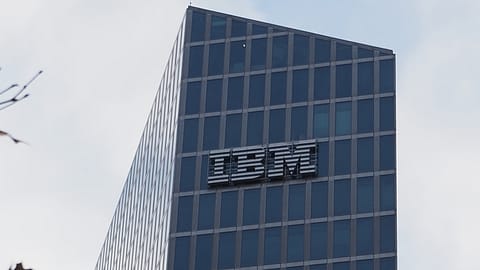
IBM shares ended 13.15% lower at $223.35 on February 23 | Credits: Shutterstock
Anthropic effect? IBM loses $31 bn as tech stock logs worst single-day crash in 25 years
IBM's stock plummeted by $31 billion in a single day, marking its worst crash in 25 years, following Anthropic's announcement about AI's potential to modernize COBOL systems. This has raised investor concerns over IBM's reliance on legacy systems and consulting services, as AI tools could streamline processes traditionally handled by IBM's infrastructure and consulting businesses.
This summary is AI-generated, and Fortune India is not responsible for its content or any associated copyright issues.
IBM shares plunged 13.15% to $223.35 on February 23, registering their steepest single-day fall in over two decades, wiping out more than $31 billion in market value.
IBM shares ended 13.15% lower at $223.35 on February 23 | Credits: Shutterstock
International Business Machines Corporation (IBM) has become the latest casualty of rising artificial intelligence (AI) disruption after leading AI research firm Anthropic published a blog post about how its “Claude Code” tool can be used to modernize software written in COBOL - the decades-old programming language that handles large-scale batch transactions across critical industries.
Anthropic, the creator of the Claude family of large language models, said its Claude Code tool can automate significant portions of the modernisation process for COBOL (Common Business-Oriented Language).
The announcement rattled investors because a vast number of mission-critical systems, including those used by the U.S. federal government, major banks and global airlines, are written in COBOL, and most of these systems continue to run on IBM mainframes. Investors are also reassessing the long-term defensibility of the company’s mainframe and consulting franchises in an era of rapid AI advancement.
IBM loses $31bn in single session
Weighed down by the developments, IBM shares plunged 13.15% on February 23, 2026, to close at $223.35, marking the stock’s steepest single-day decline in more than two decades and its worst performance since March 12, 2020, according to Dow Jones Market Data.
The sell-off wiped out over $31 billion in market value in a single session as investor turned jittery about the disruptive potential of artificial intelligence in legacy technology services.
IBM share price has fallen nearly 27% in February alone, putting it on track for its worst monthly performance since at least 1968 and its weakest month since December 1992. The decline also made IBM the worst-performing constituent of the S&P 500 on the day. On the year-to-date, the technology heavyweight has tumbled over 23%, while it lost over 6% in six months, and nearly 15% in a year.
What triggered the sell-off?
Anthropic’s claim that AI can streamline - or partially automate - COBOL modernisation has sparked fears that enterprises may increasingly rely on AI-driven tools rather than large, multi-year consulting engagements.
For decades, IBM has generated substantial revenue from maintaining and upgrading legacy systems, particularly through its consulting and infrastructure businesses. COBOL-based systems, though old, remain deeply embedded in enterprise technology stacks because of their reliability in handling high-volume, large-scale batch transactions such as payroll processing, insurance claims and financial settlements.
Modernising these systems has traditionally been complex, time-consuming and expensive - dynamics that have long supported IBM’s services-led model.
If AI tools meaningfully reduce the cost and effort involved, investors worry that it could pressure IBM’s long-term services revenue streams.
Fundamentals remain steady
Despite the market turmoil, IBM’s latest financial results suggest operational stability. For the fourth quarter ended December 2025, the company reported revenue of $19.7 billion, up 12% year-on-year. Software revenue rose 14%, consulting revenue increased 3%, and infrastructure revenue jumped 21%.
{{#most-powerful-women-snapshot-individual.slug}} {{/most-powerful-women-snapshot-individual.slug}} {{^most-powerful-women-snapshot-individual.slug}} {{/most-powerful-women-snapshot-individual.slug}} {{#showRanking}} {{current-rank}} {{/showRanking}} {{#photo.0.url}}
{{name}}
Profitability also improved. Fourth-quarter gross profit margin stood at 60.6% on a GAAP basis, up 110 basis points, while operating (non-GAAP) gross margin expanded 120 basis points to 61.8%.
For the full year 2025, IBM generated revenue of $67.5 billion, up 8%. GAAP gross margin improved 150 basis points to 58.2%. Net cash from operating activities came in at $13.2 billion, while free cash flow stood at $14.7 billion.
AI shockwaves hit Indian IT stocks
The ripple effects of Anthropic’s announcement were felt beyond the U.S., with Indian technology stocks also witnessing sharp selling pressure.
Foreign institutional investors (FIIs) stepped up selling in the sector, pulling out nearly ₹11,000 crore from Indian IT shares in the first half of February. This dragged their sectoral holdings to a four-year low.
According to data from National Securities Depository Limited, foreign portfolio investors were net sellers of ₹10,956 crore in IT stocks between February 1 and 15, following ₹1,835 crore of outflows in January. As a result, the total value of FII holdings in the sector dropped nearly 16% to ₹4.49 lakh crore as of mid-February.
The Nifty IT index has declined over 15% this month and more than 21% year-to-date. Heavyweights such as Infosys, Tata Consultancy Services, HCL Technologies, Wipro and Tech Mahindra have fallen 13-17%, amid concerns that generative AI could disrupt the traditional outsourcing model.
(DISCLAIMER: The views and opinions expressed by investment experts on fortuneindia.com are either their own or of their organisations, but not necessarily that of fortuneindia.com and its editorial team. Readers are advised to consult certified experts before taking investment decisions.)
Follow Fortune India
NEXT STORY