
The FAQs are AI-generated, and Fortune India is not responsible for its content or any associated copyright issues.
Axis Bank shares slip after Q4 despite strong analyst backing; cuts 3,000 jobs amid tech push
/ 2 min read
Axis Bank shares declined 4.83% to an intraday low of ₹1,299.9 apiece on the NSE today, reflecting investor concerns around margin pressure and elevated provisioning despite stable headline profit.
THIS STORY FEATURES
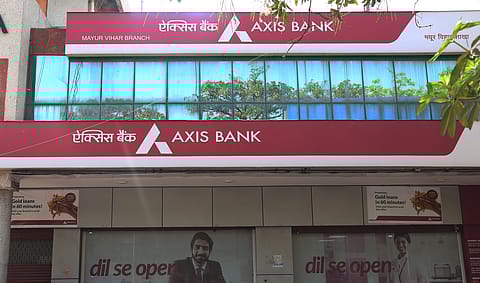
Asset quality improved, with gross NPAs declining to about 1.23%. | Credits: Sanjay Rawat
Shares of Axis Bank came under pressure on Monday after the lender reported a mixed set of March quarter earnings over the weekend, even as analysts remained overwhelmingly bullish on the stock. The bank has also reduced its workforce by about 3,000 employees over the past year as part of a technology-led efficiency drive.
Stock reaction reflects margin concerns
Axis Bank shares declined 4.83% to an intraday low of ₹1,299.9 apiece on the NSE today, reflecting investor concerns around margin pressure and elevated provisioning despite stable headline profit.
The stock saw selling pressure as markets digested weaker-than-expected core operating metrics, particularly net interest income and margins.
The reaction stresses a familiar pattern: while the bank’s long-term story remains intact, near-term earnings quality failed to excite the street.
Prudence defines Q4 performance
The lender reported a net profit of ₹7,071 crore for Q4 FY26, broadly in line with expectations. However, net interest margin came in at 3.62%, declining both sequentially and year-on-year.
A key highlight was the sharp jump in provisions, which rose to ₹35,222 crore, including a one-time standard asset buffer of about ₹20,010 crore.
“The bank has made an excess one-time standard asset provision… entirely prudent and does not indicate any concerns regarding asset quality,” according to a YES Securities report.
Asset quality improved, with gross NPAs declining to about 1.23%.
Even as margins softened, business growth remained robust.
Loan growth stood at 18.5% year-on-year, led by corporate and SME segments, while deposits grew 13.9%.
The bank maintained its through-the-cycle margin guidance of around 3.8%, suggesting confidence in eventual normalisation.
{{#most-powerful-women-snapshot-individual.slug}} {{/most-powerful-women-snapshot-individual.slug}} {{^most-powerful-women-snapshot-individual.slug}} {{/most-powerful-women-snapshot-individual.slug}} {{#showRanking}} {{current-rank}} {{/showRanking}} {{#photo.0.url}}
{{name}}
Despite the muted market reaction, sentiment among analysts remains firmly positive.
About 94% of analysts maintain a ‘buy’ rating from current levels.
Workforce reduction linked to tech efficiency
Separately, Axis Bank’s workforce declined by around 3,000 employees in FY26, with headcount falling to roughly 1.01 lakh.
Subrat Mohanty, executive director at Axis Bank attributed this to productivity gains driven by technology investments.
“We have been investing in technology for the last three to four years. As productivity improves, it does have an impact on the number of people we need in certain roles,” Mohanty said.
He added that hiring continues in select areas alongside branch expansion.
Technology-related spending now accounts for about 10% of operating costs, reflecting the bank’s increasing reliance on automation and digital processes.
Follow Fortune India
Frequently Asked Questions
NEXT STORY