Budget 2026: Key market themes, sectors and stocks to watch
/ 3 min read
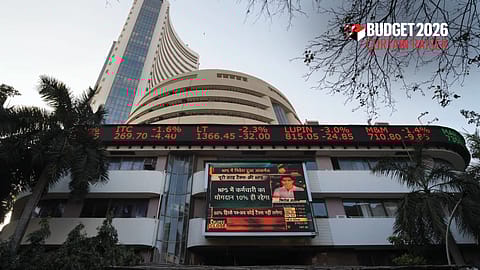
Finance Minister Nirmala Sitharaman to present Budget 2026 on February 1 | Credits: Fortune India
Budget 2026: Key market themes, sectors and stocks to watch
As Budget 2026 approaches, investors are keenly observing potential announcements on capex and credit support, with a focus on fiscal prudence over fresh stimulus. Key sectors like defence, infrastructure, and housing are expected to benefit, while stocks in these areas, along with financials and energy, are highlighted as potential gainers.
This summary is AI-generated, and Fortune India is not responsible for its content or any associated copyright issues.
Infrastructure, defence, financials and consumption stocks dominate Budget 2026 sectoral themes.
Finance Minister Nirmala Sitharaman to present Budget 2026 on February 1 | Credits: Fortune India
As Union Finance Minister Nirmala Sitharaman gears up to present Budget 2026 on February 1, 2026, investors will closely track announcements on capex, capital market measures, and credit support, even as brokerages expect a largely neutral market impact. With major income tax cuts and GST reforms already announced, the focus is seen shifting towards fiscal prudence rather than fresh stimulus.
According to Motilal Oswal, the Budget is likely to focus on higher capex across sectors such as defence, infrastructure, affordable housing, power and capital goods, alongside a few capital market measures aimed at improving investor sentiment. The brokerage also expects steps to aid credit flows to microfinance institutions (MFIs), MSME loans and housing finance, along with procedural reforms to improve ease of living and ease of doing business.
Key stock calls from Motilal Oswal
Brokerage Motilal Oswal said stocks and sectors that could benefit if these expectations play out span infrastructure, defence, financials and consumption-linked themes. Infrastructure and capital goods names such as Larsen & Toubro, ABB, Siemens, Hitachi, Siemens Energy and KEC International are seen as key beneficiaries, alongside defence players Bharat Electronics, Bharat Dynamics and HAL.
Cement and building material stocks, including UltraTech Cement and JK Cement, could also gain, while electricals and cables players such as Polycab, KEI Industries, and Crompton Greaves remain in focus. On the consumption side, jewellery and discretionary names like Titan and PN Gadgil are expected to benefit.
In financials, Motilal Oswal highlighted Niva Bupa, asset management companies, registrar and transfer agents, most housing finance companies and microfinance institutions. Within energy, city gas distributors such as IGL, Mahanagar Gas and Gujarat Gas, along with Petronet LNG and GAIL, are seen as potential beneficiaries.
The brokerage also sees upside in renewable energy and power names including Waaree, Premier Energies, NTPC, Tata Power, Acme and NTPC Green. Real estate developers such as Brigade Enterprises, Prestige Group, Sobha, Lodha and Godrej Properties were also flagged as stocks to watch.
Nuvama bets on telecom, internet, IT
Despite these pockets of optimism, Nuvama expects the Budget to be largely neutral from the market’s standpoint. While FY27 may see some growth-supportive measures, the brokerage believes the recovery is likely to remain modest and insufficient to halt the earnings downgrade cycle.
The brokerage said margin mean reversion, rather than topline growth, remains the key risk to earnings in FY27, and maintained a defensive bias with overweight positions in telecom, internet, IT, consumer, cement and chemicals, while remaining underweight on BFSI, industrials, autos and power.
SBI Securities: Banks, autos and consumption-linked stocks to lead
Sunny Agrawal, Head of Fundamental Research at SBI Securities, said the importance of the Union Budget as the sole trigger for reforms has diminished, with policy actions now taking place throughout the year. “Budget documents help investors get an idea of the broader areas where the focus of the government is likely to be over the next 12 months,” Agrawal said.
Agrawal said sectors likely to remain in focus include NBFCs, public sector banks, mid-sized private banks, auto and auto ancillaries, metals, oil marketing companies and consumer discretionary, driven by expectations of strong December-quarter results. He added that real estate, housing finance, railways and defence typically see a pre-Budget uptrend due to their sensitivity to government spending and policy signals.
On defence, analysts expect continued emphasis despite the sector’s share of GDP remaining below recommended levels. While defence spending peaked at around 2.9% of GDP in 2009, it has since hovered between 1.9% and 2.0%, below the 3% level recommended by a parliamentary committee. In the FY26 Budget, total defence allocation stood at ₹6.81 lakh crore, including a capital outlay of ₹1.8 lakh crore.
{{#most-powerful-women-snapshot-individual.slug}} {{/most-powerful-women-snapshot-individual.slug}} {{^most-powerful-women-snapshot-individual.slug}} {{/most-powerful-women-snapshot-individual.slug}} {{#showRanking}} {{current-rank}} {{/showRanking}} {{#photo.0.url}}
{{name}}
Agrawal added that any post-Budget market rally will depend on factors such as the December-quarter earnings season, whether Budget measures meet market expectations, the absence of negative developments, and the easing of external headwinds such as trade-related uncertainties. He said equity markets could see a positive reaction if measures are announced to attract capital from both FIIs and domestic investors.
(DISCLAIMER: The views and opinions expressed by investment experts on fortuneindia.com are either their own or of their organisations, but not necessarily that of fortuneindia.com and its editorial team. Readers are advised to consult certified experts before taking investment decisions.)
Follow Fortune India
NEXT STORY