No proposal from NSE to trade on own platform after listing: Sebi chief Pandey
/ 2 min read
Pandey says Sebi will look into industry concerns over UPI MDR and explore ways to ease the impact.
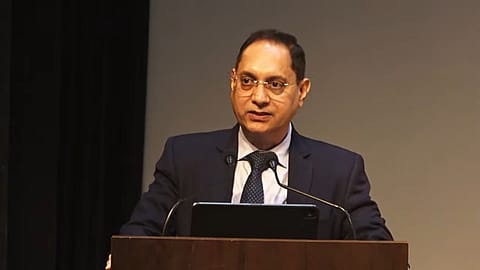
Tuhin Kanta Pandey, Chairman, Sebi.
Securities and Exchange Board of India (Sebi) Chairman Tuhin Kanta Pandey on Thursday said the regulator has not received any proposal from the National Stock Exchange (NSE) seeking approval to trade on its own platform after its listing.
“No, there is no such letter, and there is no such requirement,” Pandey said while adding that such trading cannot be permitted at present. He was speaking at the National Bank for Financing Infrastructure and Development (NaBFID) Infrastructure Conclave 2026.
The NSE’s much-awaited ₹22,569-crore initial public offering (IPO) opened for subscription on Thursday. The three-day issue will close on September 21.
The IPO is entirely an offer for sale (OFS) of 12.64 crore equity shares by existing shareholders. The price band has been fixed at ₹1,700–1,785 per share. Since the issue is entirely an OFS, NSE will not receive any proceeds. All proceeds, excluding issue expenses, will accrue to the selling shareholders.
Sebi to examine concerns over UPI MDR
On concerns raised by some brokers and asset management companies over the new UPI Merchant Discount Rate (MDR) framework, Pandey said Sebi would examine the issues. “I think there are some important issues there. We will certainly look into it and see how we can ease them,” he said.
The government has exempted UPI transactions of up to ₹2,000 to merchants from charges. On Tuesday, it introduced a framework for large digital merchant payments, setting a 0.4% charge on UPI payments above ₹2,000 to merchants and capping the fee at ₹300 for payments of ₹75,000 and above.
The move marks a shift from the zero-MDR regime in place since January 2020. The regime was introduced to promote digital payments but has faced criticism from banks and fintech companies over its sustainability.
F&O study flags persistent losses
On Sebi’s study on futures and options (F&O) trading, Pandey said the findings showed that many traders continued to incur losses even after three to four years of trading.
The study also provides research findings on trading behaviour, he said. “Even after 3-4 years of trading, there are many people in continued losses,” Pandey said, adding that investors need to assess whether they are suited for the F&O market.
Municipal bonds: Governance, repayment capacity key concerns
On the municipal bond market, Pandey identified municipal governance and the repayment capacity of municipalities as key issues.
“One of the important issues is municipal governance and municipal capacity to repay... now the regulations are in shape,” he said. Pandey said an escrow mechanism had been put in place to provide recourse, while greater use of pooled vehicle financing was also being proposed.
{{#most-powerful-women-snapshot-individual.slug}} {{/most-powerful-women-snapshot-individual.slug}} {{^most-powerful-women-snapshot-individual.slug}} {{/most-powerful-women-snapshot-individual.slug}} {{#showRanking}} {{current-rank}} {{/showRanking}} {{#photo.0.url}}
{{name}}
According to Pandey, greater participation by municipalities in raising funds through municipal bonds could encourage others to tap the market. The Centre is also providing incentives to municipalities that raise money through municipal bonds, he added.
Follow Fortune India
NEXT STORY