Market ends two-day gaining streak; Sensex drops 456 pts, Nifty slips below 24,600
/ 3 min read
Bajaj Finance, Bajaj Finserv and ICICI Bank fell up to 6% as financial stocks emerged as the biggest laggards after the RBI proposed tighter norms for certain revolving credit products offered by NBFCs.
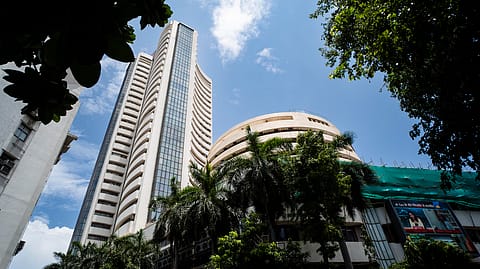
The BSE Sensex and NSE Nifty ended lower on Friday | Credits: Getty Images
Snapping a two-session winning streak, Indian equity benchmarks ended lower on Friday amid a spike in crude oil prices, renewed uncertainty over the Strait of Hormuz negotiations, and broad-based weakness in financial stocks. Investor sentiment also remained cautious following the Reserve Bank of India's draft framework proposing tighter norms for certain revolving credit products offered by non-bank financial companies (NBFCs).
The BSE Sensex declined 455.59 points, or 0.58%, to close at 78,499.17, while the NSE Nifty50 fell 65.35 points, or 0.27%, to settle at 24,570.65. During the session, the Sensex dropped as much as 578 points to an intraday low of 78,377.07, while the Nifty slipped 113 points to 24,522.75.
Financial stocks emerge as top laggards
Financial stocks remained the biggest drag on the market as investors assessed the potential impact of the RBI's proposed regulations on the NBFC sector. Bajaj Finance was the worst performer on the Sensex, plunging 5.9%, followed by Bajaj Finserv (-4.18%), ICICI Bank (-3.72%), Trent (-3.54%), Axis Bank (-1.20%) and Asian Paints (-1.02%).
The weakness in financials was partly offset by gains in IT stocks following upbeat quarterly earnings. TCS rallied 3.53% to emerge as the top gainer on the Sensex after reporting its results, while Mahindra & Mahindra advanced 2.53%. Other gainers included SBI (+1.03%), Tech Mahindra (+0.91%), BEL (+0.74%), Infosys (+0.68%) and HCLTech (+0.59%).
On the sectoral front, Nifty Auto outperformed with a gain of 1.84%, followed by Nifty IT (+1.42%), Nifty PSU Bank (+0.65%) and Nifty Metal (+0.50%). Defensive sectors remained largely subdued, with Nifty FMCG, Nifty Healthcare and Nifty Oil & Gas posting marginal gains. On the other hand, financials remained under pressure, with Nifty Financial Services 25/50 falling 1.43% and Nifty Private Bank declining 1.04%. Nifty Consumer Durables, Realty and Pharma also ended modestly lower.
Market volatility edged higher, with India VIX rising as much as 3.2% to 12.55, marking its strongest advance since the third week of July amid persistent concerns over the U.S.-Iran conflict.
Ponmudi R, CEO of Enrich Money, said financial stocks bore the brunt of the sell-off after the RBI's draft guidelines on revolving credit products raised concerns over loan growth, product flexibility and profitability for NBFCs.
He said crude oil continued to trade with a geopolitical risk premium as uncertainty surrounding negotiations over the Strait of Hormuz kept energy markets on edge. While prices remain below their recent peaks, any setback in negotiations could quickly revive volatility, posing a risk for India given its heavy dependence on crude imports.
Crude oil surge weighs on sentiment
Investor sentiment deteriorated after Brent crude jumped more than 2% to reclaim the $84-a-barrel mark after Iran published a draft proposal to bar U.S. and Israeli vessels from the Strait of Hormuz and impose steep penalties on violators. The move reversed optimism earlier in the week that had pushed Brent towards $75 on hopes of an Iran-Oman agreement to reopen the key shipping route.
"A broader U.S.-Iran agreement, which the Trump administration had signalled could be reached by Thursday, now looks unlikely in the near term," said Devarsh Vakil, Head of Prime Research at HDFC Securities.
Ponmudi said that although oil prices remain well below their recent highs, they continue to reflect a residual geopolitical risk premium and are likely to remain highly sensitive to developments in the Middle East. Any setback in negotiations could quickly reignite volatility, with India remaining particularly vulnerable given its dependence on crude oil imports.
{{#most-powerful-women-snapshot-individual.slug}} {{/most-powerful-women-snapshot-individual.slug}} {{^most-powerful-women-snapshot-individual.slug}} {{/most-powerful-women-snapshot-individual.slug}} {{#showRanking}} {{current-rank}} {{/showRanking}} {{#photo.0.url}}
{{name}}
Looking ahead, investor attention will turn to the U.S. non-farm payrolls report, which is expected to provide fresh guidance on the Federal Reserve's policy trajectory and influence the outlook for the U.S. dollar, global capital flows and broader market sentiment, he added.
(DISCLAIMER: The views and opinions expressed by investment experts on fortuneindia.com are either their own or of their organisations, but not necessarily that of fortuneindia.com and its editorial team. Readers are advised to consult certified experts before taking investment decisions.)
NEXT STORY