NSE IPO nears Sebi nod; CAS to stay unchanged, says Tuhin Kanta Pandey
/ 2 min read
The introduction of CAS was followed by what Pandey had earlier described as “teething troubles”. He had urged market participants to undertake greater efforts to understand the new framework and migrate to technology systems that support CAS.
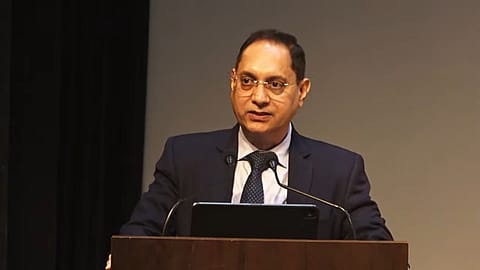
Tuhin Kanta Pandey, Chairman, Sebi
Securities and Exchange Board of India (Sebi) chairman Tuhin Kanta Pandey on Thursday said the regulator is “very close” to approving the National Stock Exchange’s (NSE) draft red herring prospectus (DRHP), bringing the long-awaited IPO closer to the market.
Pandey also said Sebi currently has no plans to alter the newly introduced closing auction session (CAS), despite concerns among market participants over the mechanism since its rollout on August 3.
NSE IPO approval nearing
Speaking on the sidelines of the 30th Anniversary Celebration of NSE Clearing, Pandey said Sebi was close to clearing NSE’s IPO draft papers.
“We are very close to approving” the NSE IPO DRHP, Pandey said.
The approval would mark a key regulatory milestone for NSE’s proposed public listing, which has been in the works for years.
On reports that NSE could eventually allow its shares to trade on its own platform, Pandey said Sebi would examine the matter if the proposal is formally submitted.
“No proposal received yet from NSE; we will assess when it comes,” he said.
No changes to CAS for now
On CAS, Pandey said Sebi is not currently considering changes to the framework.
“We are not seeing any changes right now to CAS, and the system is running as it is,” Pandey said.
He added that participation in the closing auction is expected to rise as brokers integrate the system into their trading applications.
“Participation will increase and everyone, brokers, will enable it in their apps,” he said.
{{#most-powerful-women-snapshot-individual.slug}} {{/most-powerful-women-snapshot-individual.slug}} {{^most-powerful-women-snapshot-individual.slug}} {{/most-powerful-women-snapshot-individual.slug}} {{#showRanking}} {{current-rank}} {{/showRanking}} {{#photo.0.url}}
{{name}}
Sebi introduced CAS on August 3 as part of efforts to prevent market manipulation and increase transparency. Under the framework, buy and sell orders are pooled without immediate execution during a designated window toward the end of trading, with orders matched through an auction-style process.
The introduction of CAS was followed by what Pandey had earlier described as “teething troubles”. He had urged market participants to undertake greater efforts to understand the new framework and migrate to technology systems that support CAS.
Pandey had also warned on August 19 that any attempt to “defame” CAS through manipulation would be dealt with sternly by the regulator. Within hours, Sebi passed orders against two entities for manipulation.
Amid concerns raised by market participants since CAS was introduced, Pandey said Sebi’s ability to detect manipulation under CAS is higher than under the older volume-weighted average price (VWAP) system that it replaced.
Focus shifts to system-wide risks
In his address at the NSE Clearing event, Pandey said risk management in financial markets needs to evolve as markets become increasingly interconnected.
“Risk can no longer be understood only by looking at individual institutions. We must also understand the relationships between them,” he said.
Pandey identified technology failures, liquidity shocks, common exposures and failures at technology service providers as potential sources of systemic risk.
Artificial intelligence could add another layer of risk even as it improves surveillance, risk analytics and decision-making, he said.
“Therefore, risk management must evolve. We must move from measuring risk to anticipating risk. We must move from entity-level risk management to network-level and system-wide risk management,” Pandey said.
NEXT STORY