NSE self-listing remains ‘a possibility’ in future: Chairperson Srinivas Injeti
/ 2 min read
NSE has become the world’s sixth-largest exchange by market capitalisation, reaching ₹4.47 lakh crore (approximately $47 billion).
THIS STORY FEATURES
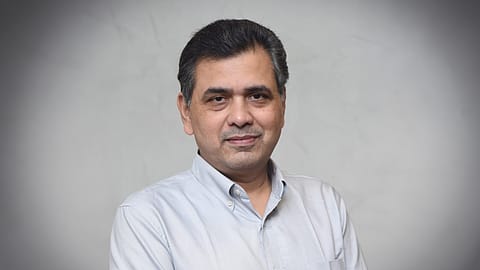
Srinivas Injeti, Chairperson, NSE.
The National Stock Exchange (NSE) has not ruled out the possibility of self-listing at some point in the future. As per current regulations, it is not permitted.
The NSE, which made its listing debut at competing exchange BSE on Thursday, with shares ending their first session at ₹1,818 on the BSE, up 1.85% over the ₹1,785 IPO price.
On Friday, NSE shares were trading at ₹1,801, down 0.96% over the previous close.
"Self-listing may not be permitted today but may be permitted tomorrow. Now, it is something which is the regulator's prerogative," NSE Chairperson Srinivas Injeti told the media.
"This is something which is in the realm of feasibility, but it depends on the comfort of the regulator and the concerns of the regulator. If the exchange is able to meet them adequately to the satisfaction of the regulator, it may become a reality, " Injeti added.
"Regulations have been evolving, things which are not permitted in the past are now permitted. Things which are not permitted today may be permitted tomorrow" he said.
"That in turn will depend upon what is the framework to manage conflict of interest, " he said.
Self-listing had become a debate in the media, prior to its listing.
NSE has become the sixth largest exchange in the world, based on market capitalisation. Its market cap reached ₹4.47 lakh crore (approx. $ 47 billion). NSE's public-market debut was preceded by a substantial reduction in the size and valuation of its IPO.
The exchange had initially reportedly been targeting a valuation above $50 billion, with an indicative price range of ₹2,000-2,100 per share. It subsequently cut the price band to ₹1,700-1,785 and reduced the shares offered from 14.89 crore to 12.64 crore. The issue size consequently came down to around ₹22,562 crore, making it India's second-largest IPO after Hyundai Motor India's ₹27,870-crore issue in 2024.
The entire issue was an offer for sale (OFS), meaning NSE itself did not receive the IPO proceeds. Existing shareholders, including SBI and Canada Pension Plan Investment Board, sold shares.
{{#most-powerful-women-snapshot-individual.slug}} {{/most-powerful-women-snapshot-individual.slug}} {{^most-powerful-women-snapshot-individual.slug}} {{/most-powerful-women-snapshot-individual.slug}} {{#showRanking}} {{current-rank}} {{/showRanking}} {{#photo.0.url}}
{{name}}
Despite the lower valuation, the IPO received strong demand, with the issue subscribed 5.71 times and attracting bids worth more than ₹90,000 crore.
NSE was incorporated in 1992, received recognition from Sebi in 1993 and commenced operations in 1994. It became India's first exchange to implement electronic or screen-based trading and has since grown into the country's largest exchange by trading activity.

Follow Fortune India
NEXT STORY