Steel stocks rally up to 6% as govt imposes safeguard duty; NMDC Steel, Tata Steel, JSW Steel lead
/ 3 min read
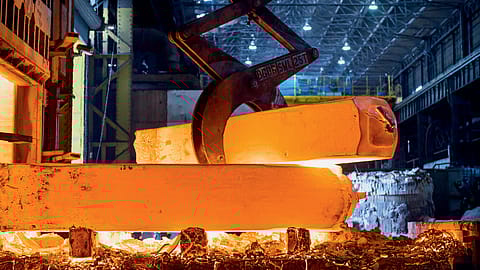
Tata Steel shares rise 2.5% to ₹180 on the BSE | Credits: Photograph by Getty Images
Steel stocks rally up to 6% as govt imposes safeguard duty; NMDC Steel, Tata Steel, JSW Steel lead
Steel stocks surged as the Indian government imposed a safeguard duty on steel imports, aiming to protect domestic producers from cheap imports. Major players like Tata Steel, JSW Steel, and NMDC Steel saw significant gains, with NMDC Steel rallying up to 6.2%. The duty, ranging from 11% to 12%, targets imports from countries such as China and Vietnam.
This summary is AI-generated, and Fortune India is not responsible for its content or any associated copyright issues.
India has imposed a three-year import tariff ranging between 11% and 12% on select steel products to shield domestic players from rising imports from China and Vietnam.
THIS STORY FEATURES
Tata Steel shares rise 2.5% to ₹180 on the BSE | Credits: Photograph by Getty Images
Shares of steel heavyweights such as Tata Steel, JSW Steel, and Jindal Steel & Power rose up to 4% in early trade on Wednesday, in sync with the positive broader market, as sentiment was lifted after the government announced a safeguard duty on steel imports.
India has imposed a three-year import tariff ranging between 11% and 12% on select steel products, according to an order issued by the Ministry of Finance on Tuesday. The move aims to protect domestic players from surge in imports from countries such as China and Vietnam.
Cheering the news, shares of Tata Steel, the country’s largest steel player, rose as much as 2.5% to ₹180, while JSW Steel advanced 5% to ₹1,167. Jindal Steel & Power gained 4.3% to ₹1,065, Jindal Stainless rose 3.65% to ₹867, while NMDC Steel shares rallied up to 6.2% to ₹46.
Meanwhile, the equity benchmarks BSE Sensex was trading higher by 0.25% at 84,884 and the NSE Nifty climbed 0.33% to 26,025 level.


Imposes tariff to curb cheap imports
The rally was driven by the government’s decision to impose a graded safeguard duty on non-alloy and alloy flat steel products - set at 12% in the first year, 11.5% in the second, and 11% in the third. The levy applies to imports from countries including China, Vietnam and Nepal, while specialty products such as stainless steel have been excluded from the measure.
Earlier in April this year, the central government had imposed a 12% safeguard duty on the import of certain non-alloy and alloy steel flat products.
The government takes such steps from time to time to protect domestic steel manufacturers from the adverse impact of import surges and to ensure fair competition in the market.
ICRA flags near-term challenges
According to a ICRA report, operating conditions for domestic steel producers are expected to remain challenging in the coming quarters, weighed down by weak steel prices, elevated input costs and an uncertain global environment.
ICRA expects operating margins to remain flat at around 12.5% in FY2026, lower than earlier expectations of a 100–120 basis point improvement. With limited earnings growth, industry leverage (TD/OPBDITA) is projected to rise to 3.4x in FY2026, from 3.1x estimated earlier and 3.5x in FY2025.
This was attributed to sharp increase in capacity, with about 15 metric tonnes (MT) added over the past few quarters and another 5 MT expected by the end of the current fiscal, creating a temporary surplus. While steel demand is forecast to grow by around 8% in FY2026, excess supply continues to weigh on prices. Domestic HRC prices, which rose to ₹52,850 per tonne after the safeguard duty in April 2025, fell to around ₹46,000 per tonne by November and are currently below import parity, ICRA said.
Global headwinds add to the strain, with China’s steel exports hitting a record 88 mt in 9M CY2025, while weak demand in major consuming regions is limiting any near-term recovery in global prices. Chinese HRC export prices averaged $465 per tonne in 7M FY2026, down from $496 a year earlier.
{{#most-powerful-women-snapshot-individual.slug}} {{/most-powerful-women-snapshot-individual.slug}} {{^most-powerful-women-snapshot-individual.slug}} {{/most-powerful-women-snapshot-individual.slug}} {{#showRanking}} {{current-rank}} {{/showRanking}} {{#photo.0.url}}
{{name}}
ICRA’s baseline outlook pegs domestic HRC prices at around ₹50,500 per tonne in FY2026, with some cost relief expected from softer coking coal prices. Overall, the sector outlook remains stable, though sustained low earnings could strain balance sheets as steelmakers plan 80–85 MT of capacity additions by FY2031, requiring investments of $45–50 billion.
(DISCLAIMER: The views and opinions expressed by investment experts on fortuneindia.com are either their own or of their organisations, but not necessarily that of fortuneindia.com and its editorial team. Readers are advised to consult certified experts before taking investment decisions.)
Follow Fortune India
NEXT STORY