The FAQs are AI-generated, and Fortune India is not responsible for its content or any associated copyright issues.
The global recalibration: Why India’s GCC boom and Middle East resilience are not mutually exclusive
/ 3 min read
The dominant narrative frames this as a binary shift, with capital and operations moving out of the Middle East into India.
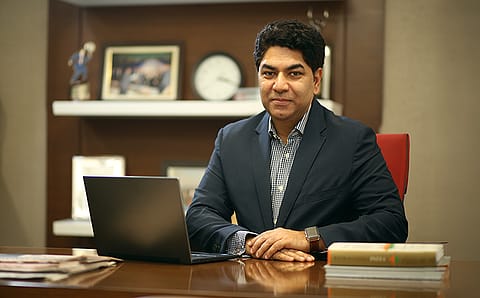
Anshuman Magazine, Chairman & CEO, India, South-East Asia, Middle East & Africa, CBRE.
Global markets dislike a vacuum. They are equally uncomfortable with geopolitical volatility. With tensions rising across West Asia, multinational corporations are clearly stress-testing operational resilience. The dominant narrative frames this as a binary shift, with capital and operations moving out of the Middle East into India.
That reading is overly simplistic. To treat the current phase as a zero sum game, where the Arab world’s loss directly becomes India’s gain, is to misunderstand how global capital is actually deployed. What is unfolding is not displacement. It is recalibration.
India is, without question, capturing a larger share of global operations, particularly through the rapid expansion of Global Capability Centres (GCCs). But this is not merely a reaction to instability in West Asia. It is a conscious shift toward India’s depth in technology talent, its digital backbone, and a regulatory environment that offers consistency. Companies today are actively diversifying risk across geographies.
In that process, India has moved well beyond its earlier identity as an outsourcing hub. It is now a central node for innovation, research, and complex problem solving.
At the same time, away from the headlines, the Middle East continues to show underlying stability. Markets such as Dubai are functioning with notable steadiness. Sentiment may have softened in the short term, but the fundamentals remain intact.
Markets, by nature, react first and assess later. Some investors have chosen to adopt a wait and watch stance in the current environment. That pause should not be mistaken for weakness or a long term retreat. What we are seeing is a shift in sentiment, not a structural break.
The numbers bear this out. Even amid geopolitical noise, Dubai’s transaction activity remains deep. After a record 2025, where residential transactions rose 31% year on year to AED 395 billion, the momentum has carried forward. So far in 2026, transaction values have reached AED 125 billion, ahead of the AED 110 billion seen during the same period last year.
A look back helps put things in perspective. After the 2008 Lehman collapse and the sub prime crisis, Dubai’s real estate market went through a sharp correction. Prices declined significantly between 2009 and 2011. Yet by 2012 and 2013, the recovery was underway. Capital returned. Regulations became tighter Transparency also improved further. The reset ultimately strengthened the market.
A similar pattern played out during COVID-19. In early 2020, activity dropped sharply as mobility froze. But by the end of that year, and through 2021 and 2022, Dubai witnessed one of the strongest real estate rebounds globally. Demand for luxury housing and villas surged, driven by global wealth movement, remote work trends, and effective pandemic management. Prices did not just recover but moved past pre-pandemic levels.
The core drivers remain unchanged. Policy clarity, tax efficiency, strong rental yields, and a globally competitive lifestyle continue to anchor demand. Sentiment may move up and down, but these structural advantages endure.
India and the UAE, in that sense, are not competing stories. They are complementary corridors. Each plays a distinct role in the global economic system. India is scaling as a hub for execution, talent, and GCC growth. Dubai, meanwhile, continues to operate as a centre for capital, wealth, and global command functions.
{{#most-powerful-women-snapshot-individual.slug}} {{/most-powerful-women-snapshot-individual.slug}} {{^most-powerful-women-snapshot-individual.slug}} {{/most-powerful-women-snapshot-individual.slug}} {{#showRanking}} {{current-rank}} {{/showRanking}} {{#photo.0.url}}
{{name}}
Capital flows follow a familiar pattern in uncertain times. They rarely disappear. They pause, reassess, and return once visibility improves. Some investors, however, do not wait. Indian investors, shaped by their own cycles of reform and recovery, have often been among the earliest to step back in. They tend to be conviction driven, particularly during phases of temporary weakness in Dubai’s market. A wait and watch phase should not be read as an exit.
The current slowdown falls in that category. It reflects caution, not deterioration. History suggests that Dubai’s real estate market does not just recover—it returns stronger and more global in character. This time, the India–Dubai corridor is deepening even as other capital sources reassess exposure. That is not incidental. It reflects India’s rising economic weight, a growing base of globally mobile capital, and Dubai’s position as a bridge between East and West.
In the end, markets are driven by fundamentals. Momentum may fluctuate, but direction tends to hold. As volatility eases, companies will continue to use India for scale and capability, and the Middle East for capital efficiency. In a multipolar world, success across regions is rarely a zero sum outcome.
(The author is Chairman & CEO, India, South-East Asia, Middle East & Africa, CBRE. Views are personal.)
Follow Fortune India
Frequently Asked Questions
NEXT STORY