The FAQs are AI-generated, and Fortune India is not responsible for its content or any associated copyright issues.
Why India’s green economy needs fewer breakthroughs and more value chains
/ 4 min read
India’s green transition hinges not on breakthrough innovation alone, but on building deep, reliable value chains that turn climate ideas into scalable, economy-wide solutions.
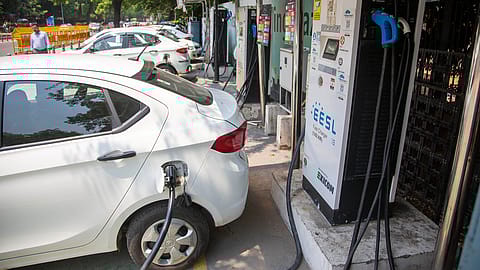
In areas where battery supply, technicians, financing options and servicing networks have evolved equally, the adaptation to electric mobility has accelerated. | Credits: Sanjay Rawat
For over a decade, India has produced a steady stream of climate-related innovations. The groundwork was laid in 2008 with the launch of India’s National Action Plan on Climate Change, outlining eight national missions to address the country’s climate challenge.
Since then, electric mobility platforms have matured, recycling technologies have become commercially viable and bio-inputs and resource-efficient farming practices are no longer fringe ideas. On paper, many of the technical ingredients for a green transition are already in place.
Yet, adoption has been uneven. Costs have fallen more slowly than expected and scale has emerged in pockets, but not consistently. Outside a handful of success stories, progress has required more support, for longer, than early forecasts suggested. As India moves from setting targets to executing at scale, these gaps are becoming harder to ignore.
It’s easy to misinterpret the gap between technical readiness and realistic assimilation and this is often seen as a dearth of entrepreneurship or risk capital. However, when certain technical aspects scale rapidly in some contexts and stagnate in others, the reason cannot be positioned within the idea itself.
Major economic transitions usually depend on structured frameworks rather than sudden breakthroughs. In order to manufacture trust, distribution reach, service infrastructure and workforce skills, norms often prevail over the novelty of a product. When these elements are aligned, it becomes easier to innovate. When they don’t, pre-existing solutions struggle to move beyond early adopters.
Why value chains decide what actually scales
An example of this could be observed within the instance of electric mobility. There has been rapid growth in the usage of electric two-wheelers and three-wheelers that are driven by policy and entrepreneurial support. The outcomes, however, vary with regard to region. In areas where battery supply, technicians, financing options, and servicing networks have evolved equally, the adaptation to electric mobility has accelerated. In areas where these elements are missing, the adoption of electric vehicles has been slower, regardless of how attractive the prospects of electric mobility are.
Waste management shows a similar pattern.
While recycling and processing technologies like biomethanation are widely available, less than 5% of wet waste in cities is either sent to landfills or for composting. What differs across cities is the depth of the surrounding system. In the case of biomethanation separation of waste at source, collection quality, aggregation mechanisms, contract stability, service accountability and offtake of the resulting energy and fertiliser determine whether facilities operate at scale or below capacity. The same equipment can produce very different outcomes depending on whether the value chain around it is robust. For example, cities such as Indore and Surat achieved high waste processing efficiency by combining source segregation, contract enforcement, aggregator models, and accountability measures.
Sustainable agriculture exemplifies this clearly: bio-inputs and chemical-free techniques are created, farmers are informed, and manufacturers can scale. However, adoption is dependent not on availability, but on consistent distribution, aggregated demand, and predictable procurement. Where these factors match, uptake is sustained; where they do not, progress is uneven, exposing a common thread.
Innovation isn’t the bottleneck; systems are
Value chains enable consistent private capital, confidence, and cheaper costs, while innovation creates opportunities. High-growth enterprises and higher valuations indicate momentum, but they do not reflect how simple a sector is for the next entrant; a company can scale even if the surrounding system is weak.
Value-chain depth, however, offers a different perspective. It enquires about the inputs and if they are available at a predictable quality and price, if logistics work at scale, if skills are widespread rather than concentrated and whether financing terms improve over time.
{{#most-powerful-women-snapshot-individual.slug}} {{/most-powerful-women-snapshot-individual.slug}} {{^most-powerful-women-snapshot-individual.slug}} {{/most-powerful-women-snapshot-individual.slug}} {{#showRanking}} {{current-rank}} {{/showRanking}} {{#photo.0.url}}
{{name}}
From a development perspective, value chains also shape who benefits from growth. Deep value chains create jobs across manufacturing, logistics, maintenance, and services. They support skill development and income stability. They allow smaller firms to participate and workers to move into more productive roles. Shallow value chains tend to concentrate gains and amplify volatility. Manufacturing ecosystems, service networks, workforce institutions, standards, and aggregation platforms are less visible, but often more decisive.
Historically, numerous large-scale transformations were accomplished this way. Energy expenditures in grid infrastructure, procurement procedures, and standards enabled private capital to flow. As systems developed, innovation accelerated and costs decreased. The same principle applies to other industries undergoing transition. However, the environment in which they operate has a significant impact on their effectiveness. Strong value chains amplify entrepreneurial effort while weak ones seem to absorb it.
This can be observed within India’s solar power sector. Although early solar firms operated for years, significant scaling occurred only following government investments in grid infrastructure, the standardisation of power-purchase agreements, transparent auctions, and the establishment of long-term procurement frameworks.
This aspect also changes how progress might be measured. Instead of counting the number of new ventures or the volume of venture capital deployed, it becomes useful to track indicators such as service coverage, cost trajectories, skill availability, and reliability of supply. These metrics are less headline-friendly, but they are closer to the mechanics of scale. India’s green economy represents a significant opportunity.
In order to understand this, we may take the instance of waste-water management and re-use. Indian cities such as Bengaluru experience periodic water crises, while fragmented supply systems and inadequate wastewater reuse highlight critical gaps in urban water resilience. Despite thousands of decentralised STPs (sewage treatment plants), only a percentage of treated water gets reused, demonstrating that the true difficulty is large-scale execution and viable reuse pathways, not just technology. Models from Bengaluru-based sustainability company Boson Whitewater show how upgrading treated water for industrial purposes can enable circularity, generate economic value for all stakeholders and create economically viable water ecosystems.
Value chains are not built quickly, and they are rarely built by a single actor. They emerge through coordination, patient investment, and repeated iteration. The question is whether the everyday conditions for scale are improving for everyone else who follows. When value chains deepen, success becomes less exceptional and more repeatable. That shift, more than any individual company or valuation, will determine how far and how fast India’s green economy ultimately goes.
(The writer is the author of ‘Back to Bharat: In Search of a Sustainable Future; Partner, Acumen; Resident Mentor, NSRCEL IIMB; and Co-founder Nativelead Foundation. Views are personal.)
Follow Fortune India
Frequently Asked Questions
NEXT STORY