HDFC Bank: Post Jagdishan’s exit, a successor from the outside?
/ 4 min read
RBI may want to look at successor from the outside. Restoring credibility, reducing the trust deficit and bringing the bank on the front foot critical for the new successor, say experts.
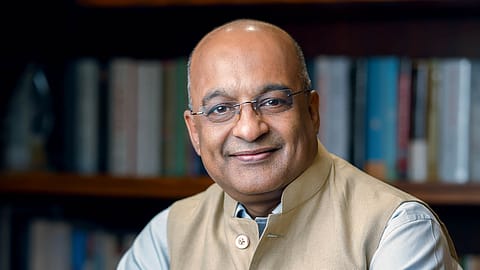
Sashidhar Jagdishan, CEO & MD, HDFC Bank | Credits: Narendra Bisht
The year 2026 is one which HDFC Bank managing director and CEO Sashidhar Jagdishan would like to forget. Just under two months before the closure of his second term Jagdishan has communicated to the bank's board that he will not seek re-appointment for the third term.
This situation — similar to that of Kotak Mahindra Bank — puts the onus on HDFC Bank’s board and the regulator, the Reserve Bank of India, to quickly finalise and announce a successor to Jagdishan, whose second term ends on October 26, 2026.
Within the bank, the role and stature of HDFC Bank veteran Kaizad Bharucha, deputy managing director, who has been the longest serving executive board member at the lender, might come into focus.
But there is a possibility that RBI may want an ‘outsider’, possibly a veteran of other private sector banks or a financial institution, to take charge and start the journey as a new CEO, on a clean slate. The name of ICICI Prudential Life Insurance managing director and CEO Anup Bagchi might also be considered, though some say it is a far shot.
“The biggest challenge for the new successor at HDFC Bank will be to restore credibility, reduce the trust deficit and improve communication of the bank to all its stakeholders and bring the bank back to its growth path,” a banking veteran told Fortune India, on condition of anonymity.
Shriram Subramanian, founder and managing director of InGovern, India’s first independent corporate governance research and proxy advisory firm, said,” A new successor will have to go with the perception that HDFC Bank currently faces and put the bank back on the front foot and take on rivals to strengthen the competitive edge, which it had earlier.”
On July 18, HDFC Bank reported a standalone net profit of ₹19,059.72 crore for the June-ended quarter (Q1FY27), up 4.98% from a year earlier. Its top line or net interest income (NII) rose 6.7% year-on-year to ₹33,535.95 crore, the bank said.
But the net interest margin was at one of its lowest in recent times at 3.25% of total assets, and 3.53% based on interest earning assets.
Shareholders asked tough questions
On August 5, at the HDFC Bank’s board meeting, the bank board faced a barrage of questions which related to expansion plans to boost income, corporate governance, succession plans for a new CEO, the financial drag on the Bank after HDFC's merger with the Bank in July 2023 and how to improve margins and CASA.
Shareholders also asked for AI initiatives, CSR details, sustainable projects and details of the findings of the law firms relating to the exit of former, part-time chairman Atanu Chakraborty in March.
While the former, part-time chairman Atanu Chakraborthy had, in March, said that "certain happenings and practices within the bank" over the previous two years were "not in congruence" with his "personal values and ethics", two recent developments had probably made it difficult for Jagdishan to carry on.
{{#most-powerful-women-snapshot-individual.slug}} {{/most-powerful-women-snapshot-individual.slug}} {{^most-powerful-women-snapshot-individual.slug}} {{/most-powerful-women-snapshot-individual.slug}} {{#showRanking}} {{current-rank}} {{/showRanking}} {{#photo.0.url}}
{{name}}
These were direct questions which Jagdishan had to face. At an earlier media call, Jagdishan had said that he was excited that the bank will see “new energy” in the coming years.
Some of the recent developments possibly made it difficult for Jagdishan to continue to a third term.
The first was on July 27, when the HDFC Bank in a rare action had slapped Jagdishan, CFO Srinivasan Vaidyanathan and the head of retail banking Arvind Vohra with a ₹1 lakh penalty each for what was called “a business overreach”. It also announced warning letters.
The action was based on the findings and recommendations of the special disciplinary committee of independent directors, following the completion of an internal review into the arrangements with the Maharashtra state road development corporation (MSRDC) for garnering deposits in 2017 and 2021.
This was the same case which has had an impact on the latest lawsuit complaint filed in the US District Court for the Southern District of New York, against Jagdishan and CFO Vaidyanathan by investor Jwalant Natvarlal Soneji in August.
The complaint filed is on behalf of a group of investors, seeking compensation due to losses they suffered after buying HDFC American Depository Shares (ADS) between 2023 and 2026.
The complaint filed specifically says the defendants failed to disclose to investors that HDFC Bank camouflaged payments as marketing spend to pay higher interest to the Maharashtra State Road Development Corporation (MSRDC) in order to induce deposits and that these activities were approved by senior management.
In June, HDFC Bank said it concluded an external legal review, carried out by Wilson Sonsini Goodrich & Rosati and Wadia Ghandy. The report said “contemporaneous evidence reviewed was inconsistent” with Chakraborty’s statements—that “happenings and practices” were not in congruence with his “personal values and ethics”—as mentioned in his resignation letter to the bank’s board.
Equity markets lost faith
For much of 2026, and even since the past two years, Jagdishan and the top management have spent their time firefighting these issues rather than building HDFC Bank 2.0, beyond the Aditya Puri legacy.
Jagdishan’s biggest concern was to fill the large shoes of Puri. The HDFC Bank stock has fallen 27.41% year-to-date, pulling the Nifty 50 index down with it, which has fallen just nearly 4% in the same period.
From the period when Chakraborty quit, the HDFC bank stock has fallen nearly 15%. Hence there is much that the new successor will need to work on. The advantage will be that he/she will be starting on a clean slate.
NEXT STORY