The FAQs are AI-generated, and Fortune India is not responsible for its content or any associated copyright issues.
Agnikul successfully fires four semi-cryogenic engines simultaneously in cluster test
/ 2 min read
The Chennai-based startup said the test involved calibrating 8 pumps, 8 motors and 8 speed-control algorithms to ensure uniform startup, steady-state operation and shutdown across the system.
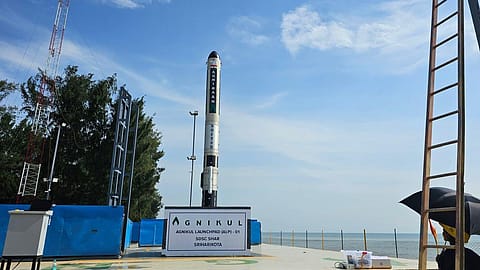
The company had earlier demonstrated a three-engine cluster test in February 2026, which it said was the first such test in India at that time. (File image)
Agnikul Cosmos on Tuesday said it has successfully test-fired four semi-cryogenic rocket engines simultaneously as a cluster, marking another step in the development of its private launch vehicle stack. The company said all four engines were 3D-printed as single pieces of hardware, designed and manufactured in-house at Rocket Factory-1, and powered by electric motor-driven pumps.
Latest propulsion test
The Chennai-based startup said the test involved calibrating 8 pumps, 8 motors and 8 speed-control algorithms to ensure uniform startup, steady-state operation and shutdown across the system. Agnikul said this was, to the best of its knowledge, the first semi-cryogenic cluster test of this kind in India. The company had earlier demonstrated a three-engine cluster test in February 2026, which it said was the first such test in India at that time.
The new four-engine test extends a propulsion architecture that Agnikul says is built around a single-piece 3D-printed engine, electric-pump feed and in-house additive manufacturing. Its product page says the engine, Agnilet, has a thrust capacity of 6.2 kN.
Agnikul background
Agnikul was founded in 2017 by Srinath Ravichandran, Moin SPM and S. R. Chakravarthy at IIT Madras. The startup is developing the Agnibaan launch vehicle for small-satellite missions and has repeatedly positioned its manufacturing model around rapid engine production, modularity and lower launch costs. In 2024, it completed a launch of its rocket, and since then has focused on propulsion qualification and scaling the engine cluster architecture.
Funding so far
Agnikul has raised multiple rounds of capital as it has built out its propulsion stack, starting with an $11 million Series A in March 2021 and a $26.7 million Series B in October 2023 from investors including Celesta Capital and Rocketship.vc, alongside Mayfield, Artha Venture Fund, Pi Ventures, and Speciale Invest. Later, in November 2025, the company secured a $17 million Series C round at a $500 million valuation from investors including Advenza Global, Atharva Green Ecotech, HDFC Bank, Artha Select Fund, Prathithi Ventures, and 100X.VC. This was followed by a $2.65 million (250 million rupee) investment from Tamil Nadu's TIDCO in March 2026. Currently, Agnikul is in early discussions to raise an additional $50 million to $75 million in a Series C extension—with interest from backers like Avataar Ventures—to scale its rocket production capabilities.
Why it matters
Agnikul’s latest test matters because cluster firing is a key step toward scaling thrust for orbital missions, especially for a small-satellite launch company. The company says it is building original space technology “from India, for the world,” with support from IIT Madras, ISRO and IN-SPACe. If the four-engine cluster can be turned into a flight-ready system, it would strengthen Agnikul’s pitch as one of India’s most advanced private launch startup.
Frequently Asked Questions
NEXT STORY