The FAQs are AI-generated, and Fortune India is not responsible for its content or any associated copyright issues.
From pilot to production: Anthropic highlights 'trust' as the next key shift in AI
/ 3 min read
India is the second-largest user of Claude in the world, with technical and development work at one of the highest rates globally.
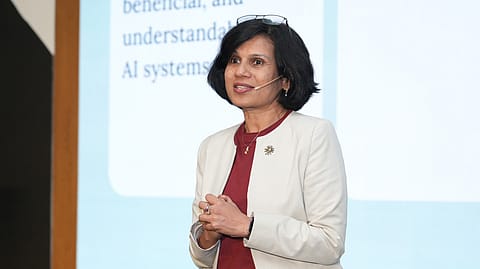
Irina Ghose, Managing Director, India for Anthropic.
Anthropic highlights trust as the next key shift when it comes to AI, especially with agentic AI. Irina Ghose, Managing Director, India for Anthropic, said that the challenge is moving from pilot projects to production systems built on trust.
“What is happening now is that people are no longer asking only, ‘Can AI do the task?’ The real question is, ‘Can AI do the task with the highest level of trust?’ That is the key shift,” she said at the Mumbai Tech Week on Friday.
India is the second-largest user of Claude in the world, with technical and development work at one of the highest rates globally. “With that level of technology intensity, our goal is to ensure that we are building from India, for India, and for the global landscape. We want to create solutions that not only push the boundaries of innovation but also reach the last mile, serve large populations, and become a model for the rest of the world,” Ghose said.
She said that understanding the behaviour of models, both pre and post-deployment, along with how they perform across different situations, is becoming increasingly important. “You need procedural thinking around how work gets done. More importantly, you need to become a judge.”
Meanwhile, Anthropic launched its latest model—Opus 4.8, which reflects similar sentiments and highlights Ghose’s point on trust. “One of the most prominent improvements in Opus 4.8 is its honesty. We train all our models to be honest—for instance, to avoid making claims that they can’t support. But a general problem with AI models is that they sometimes jump to conclusions, confidently claiming to have made progress in their work despite the evidence being thin. Early testers report that Opus 4.8 is more likely to flag uncertainties about its work and less likely to make unsupported claims.”
Ghose emphasised that being able to judge whether the output is correct or not is becoming critical to ensuring that failures are minimised. “The pace at which things are moving today means that issues can emerge much faster, and therefore, systems need to be built to identify and prevent those issues before they happen.”
“We believe there will continue to be improvements in model quality, reducing the probability of errors over time, but trust and governance remain fundamental,” said Ghose.
Security is integral to Anthropic
According to Ghose, the Claude parent focuses heavily on security. She explained that as AI models and architectures are becoming more sophisticated, the question of how to ensure that security boundaries are not crossed becomes crucial. “One way to think about security is through pattern matching and rule-based systems. But today’s architectures are becoming much more sophisticated. One important capability is the ability to analyse code and identify vulnerabilities automatically. I would strongly encourage all developers to adopt these approaches,” she said.
The other important aspect is training systems to challenge assumptions, which is a fundamental part of product development and research. Talking about a feature called “Plans”, she explained how the model actually plans processes to reach the required desired results, without one needing to monitor every step, thereby shifting focus on the outcome itself, as it will self-correct.
The second feature to ensure security and trust is sandboxed agents. “Many customers want agents to operate in regulated environments where content, information, and data never leave approved boundaries. We now provide sandbox environments where agents can work securely while connecting to external systems through MCP connectors and other integrations,” Ghose said.
The third capability is learning, where the systems they build are continuously improved. While the underlying model may remain the same, the system should learn recursively over time and become better at accomplishing tasks. “As an extension of this, we have introduced dynamic workflows and multi-agent orchestration,” she said.
RANK
COMPANY NAME
REVENUE
(INR CR)
(INR CR)
{{#current-rank}} {{current-rank}} {{/current-rank}} {{^current-rank}} {{rank}} {{/current-rank}} {{name}} {{#revenue}} {{revenue}} {{/revenue}} {{^revenue}} {{noi}} {{/revenue}}
Ghose said that Anthropic has monitoring and observability capabilities that allow you to track whether everything is functioning as intended in an automated manner. “When you bring all these capabilities together, they become much more powerful than individual features. They help create agents that are secure, reliable, autonomous, and capable of delivering meaningful outcomes at scale.”
OpenAI’s Codex sees 27x usage in India in 2026
OpenAI was also present at the event, stating that India is soon becoming the world’s largest and fastest-growing developer ecosystems, and is the top country for coding for OpenAI. Pragya Misra, Head of Strategy & Global Affairs, India at OpenAI, said India is becoming a hot market for Codex, as its usage has increased by 27 times in 2026 alone. “AI is also becoming a major productivity tool. In a report, one finding stood out: by 2035, AI could contribute $1 trillion to India’s GDP. That opportunity will be realised through enterprises, developers, startups, and users deploying intelligence across the economy,” she said.
Frequently Asked Questions
NEXT STORY