Here’s a list of all things tech that disrupted 2025
/ 4 min read
Here’s Fortune India’s roundup of the most influential technology trends of 2025.
Here’s a list of all things tech that disrupted 2025
In 2025, technology saw groundbreaking advancements with tri-fold phones and AI integration in daily life. Samsung, Google, and Apple led the foldable phone market, while AI tools like ChatGPT reshaped internet searches. Creative generative AI trends and smart glasses also gained traction, marking a year of significant tech disruptions.
This summary is AI-generated, and Fortune India is not responsible for its content or any associated copyright issues.
In 2025, technology saw groundbreaking advancements with tri-fold phones and AI integration in daily life.
Here’s Fortune India’s roundup of the most influential technology trends of 2025.
From smart glasses to tri-fold phones, this year had no shortage of shiny gadgets. But one cannot miss out on how AI is getting embedded not only in gizmos but in everyday life. Here’s Fortune India’s roundup of the most influential technology trends of 2025.
Foldable phones:
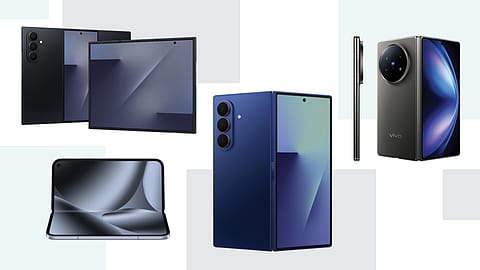
2025 was a turning point for foldable smartphones, as almost every major smartphone brand—Samsung, Google and Xiaomi and even new players have expanded or refined their foldable line-ups. From book-style and flip to early tri-fold designs, companies are now offering unique flagship phones.
Samsung Galaxy Z TriFold – Samsung’s first tri-fold phone, following the footsteps of Huawei Mate XT Tri-fold, comes with a 10″ interior display and dual-hinge design, launched in select markets in December 2025.
Samsung Galaxy Z Fold7 – Samsung’s 2025 flagship foldable with an 8.0″ main display and Snapdragon 8 Elite was widely regarded as the best overall foldable of the year.
Vivo X Fold 5 5G – Premium foldable from Vivo with big AMOLED panels and a strong camera setup, which was a runner-up in many 2025 foldable rankings.
Google Pixel 10 Pro Fold – Google’s third iteration of the durable foldable with an IP68 rating and a clean Android experience.
Apple:
Apple’s latest offering was the iPhone 17 series, with the launch leading to a scuffle in front of the Bandra Kurla Complex store in Mumbai, which saw a shortage during the soaring Diwali demand. The iPhone 17 Pro and Pro Max models, in particular, have fuelled this year's record-breaking demand. Despite Foxconn and Pegatron's manufacturing in India, supply for flagship models remains limited, highlighting Apple's persistent distribution and logistics challenges in the Indian market.
AI changed the way we search on the internet:
Before ChatGPT entered in 2022, searching on the internet meant asking Google, which would give us a list of clickable links. Now, as per a report by HigherVisibility, which tracked user behaviour in between February and August this year, the dominance of Google has started to fade, with the share of general information searches dropping from 73% to 66.9%. AI adoption accelerated dramatically, as daily AI tool usage more than doubled from 14% to 29.2%. ChatGPT usage tripled, rising from 4.1% to 12.5% for general searches, aligning with OpenAI’s reported 12% market share.
Agentic AI models were made free in India:
Artificial intelligence companies raced to present their generative AI models for free to the Indian masses, not to get more customers, but to have more users to train their AI models. Google and Perplexity AI are providing free services for 12 to 18 months through collaborations with local telecom carriers Reliance Jio and Bharti Airtel, respectively, while OpenAI's ChatGPT Go plan is free countrywide for a year.
Red flagging this movement, former NITI Aayog CEO Amitabh Kant said, “It is neo-colonisation in very stealth mode." Speaking at an event, Kant warned that global AI companies are gaining easy access to Indian data through telecom operators and universities. "All these models are getting better and better with your data. Indian data, and many other developing countries' data," he said. "All these models are getting better, and then they will be selling their AI products back to you using your data, selling it back to you at very high prices."
{{#most-powerful-women-snapshot-individual.slug}} {{/most-powerful-women-snapshot-individual.slug}} {{^most-powerful-women-snapshot-individual.slug}} {{/most-powerful-women-snapshot-individual.slug}} {{#showRanking}} {{current-rank}} {{/showRanking}} {{#photo.0.url}}
{{name}}
Creative gen-AI got better
This year’s iconic trend, which used creative generative AI, was the Ghibli trend, where users uploaded real-world photos to get the dreamy, distinctive Studio Ghibli aesthetic version. The trend blew up soon after OpenAI introduced the “Images” tool in ChatGPT. Google’s Gemini did not hold back and launched the Nano Banana in August, which came with Gemini 2.5. The model attracted over 10 million new users and over 200 million image edits in weeks.
As per a blog on Adobe, creators use AI to not only experiment with tools during editing, but also it is now deeply embedded in creators' workflows, helping them ideate, improve quality, and “unlock new creative possibilities that help them stand out.” The report surveyed over 16,000 creators across the U.S., U.K., France, Germany, South Korea, Japan, India, and Australia. It found that 86% of them use creative gen-AI, while 76% of them say that creative generative AI has helped grow their business and personal brand.
Wearable tech—Smart glasses:
Mark Zuckerberg, at Meta’s Q2 2025 earnings call at the end of July, said, “If you don’t have glasses that have AI, you’re probably going to be at a pretty significant cognitive disadvantage compared to other people.” With that, Facebook’s parent company partnered with Ray-Ban in 2023 to release smart glasses, which have been a surprise hit in 2025. Revenue from sales of Ray-Ban Meta smart glasses more than tripled year over year, EssilorLuxottica revealed in its recent earnings report. The company said that the success of the Ray-Ban Meta glasses contributed to its first-half overall sales of 14.02 billion euros (US$16.25 billion), which represents a 7.3% year-over-year jump.
Lenskart, seeing potential in wearable tech, did not hold back and launched audio-first glasses—the Phonic, which offers built-in audio and hands-free calling in a familiar eyewear form at a far more accessible price point.
Follow Fortune India
NEXT STORY