The FAQs are AI-generated, and Fortune India is not responsible for its content or any associated copyright issues.
‘Make servers in India’: IT minister Ashwini Vaishnaw urges Google as ₹1.35 lakh cr, 1 GW Vizag AI hub takes shape
/ 2 min read
Union IT Minister pushes server localisation, chip packaging and green data centre norms as ₹1.35 lakh crore, 1 GW Vizag project positions India as a trusted AI supply chain hub
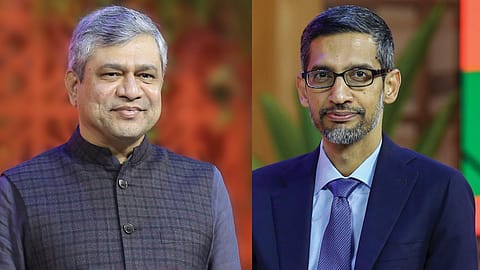
India’s push to become a global artificial intelligence (AI) infrastructure hub moved a step forward on Tuesday, with Union Minister for Electronics & IT and Railways Ashwini Vaishnaw using the launch of Google’s mega data centre in Visakhapatnam to lay out a clear industry mandate: build locally, scale sustainably, and anchor global supply chains in India.
The $15 billion (₹1.35 lakh crore), 1 gigawatt (GW) facility—among the largest digital infrastructure investments in the country—brings together Google, Adani Group and Bharti Airtel. Beyond the scale, the project signals a shift in how India is approaching the AI opportunity: from services-led growth to building core infrastructure. “When the world is moving into a new technology cycle, we should take the lead… we missed earlier cycles, we should not miss this one,” Vaishnaw said.
‘Make servers in India’: Hardware push gains urgency
With hyperscale capacity coming online, the minister made a direct pitch for localisation. “Please focus on manufacturing your servers in India,” he said, pointing to the sheer volume of hardware such data centres will require. India, he added, already has the capability to produce “absolutely high-quality” servers, backed by globally benchmarked processes and competitive costs.
On semiconductors, Vaishnaw outlined a near-term pathway even as advanced chip manufacturing evolves. “Manufacturing GPUs is still a bit away, but we can do at least the OSAT work in India,” he said, flagging chip packaging and testing as immediate opportunities. The broader aim: reduce import dependence while building depth across the electronics value chain.
Vizag as ‘AI-Patnam’, backed by global connectivity
Positioning Visakhapatnam as a new digital gateway, the minister said, “Like Cyberabad, it will become AI-Patnam,” drawing a parallel with Hyderabad’s IT-led transformation. The shift is underpinned by subsea infrastructure, with three major cable systems set to land in the city, connecting India to the US, Europe, the Middle East, Africa and Australia.
“These cables will be a big, big, big thing for our country,” he said, highlighting their role in reducing latency and enabling large-scale AI workloads. For Andhra Pradesh, the project feeds into a broader multi-gigawatt ambition, positioning Vizag as a credible alternative to legacy hubs such as Mumbai and Chennai.
Trusted supply Chains, sharper sustainability goals
Framing India’s geopolitical advantage, Vaishnaw said, “The world is looking for a trusted partner where IP rights will be respected… that kind of supply chain is possible only in India.” He urged global firms to “consider India as your trusted value chain and supply chain partner,” citing policy stability and execution focus.
He also set clear expectations on sustainability. “Let us take some research projects… to improve power efficiency,” he said, adding, “Please make it a mission to reduce water consumption—we will fully support you.”
Follow Fortune India
Frequently Asked Questions
NEXT STORY