Fragile U.S.-Iran ceasefire buoys markets, even as tensions simmer—but is the calm temporary?
/ 3 min read
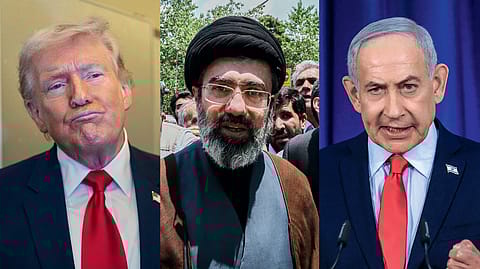
(From left) U.S. President Donald Trump, Iran’s Supreme Leader Mojtaba Khamenei, and Israel’s Prime Minister Benjamin Netanyahu
Fragile U.S.-Iran ceasefire buoys markets, even as tensions simmer—but is the calm temporary?
A fragile two-week US-Iran ceasefire tied to reopening the Strait of Hormuz has sparked a sharp rally in global equities and a slide in oil prices, even as tensions flare after Israeli strikes in Lebanon. Trump calls Iran’s 10-point plan a workable basis for long-term peace, but conflicting regional signals and ongoing attacks leave markets potentially ahead of reality.
This summary is AI-generated, and Fortune India is not responsible for its content or any associated copyright issues.
The situation has deteriorated again within hours, with Iranian state media reporting that passage through the Strait of Hormuz has been halted following Israeli strikes in Lebanon, effectively putting the ceasefire under immediate stress.
(From left) U.S. President Donald Trump, Iran’s Supreme Leader Mojtaba Khamenei, and Israel’s Prime Minister Benjamin Netanyahu
A two-week ceasefire between Washington and Tehran was announced late April 7 and was described by the White House as a bilateral “double-sided” pause, conditional on the “complete, immediate and safe” reopening of the Strait of Hormuz. President Donald Trump publicly framed the pause as a window to finalise longer-term terms, after accepting Iran’s 10-point proposal as a negotiating basis.
However, the situation deteriorated again within hours, with Iranian state media reporting that passage through the Strait of Hormuz has been halted following Israeli strikes in Lebanon, effectively putting the ceasefire under immediate stress.
In a post on X, Iran’s foreign minister Araghchi said, “The Iran–U.S. Ceasefire terms are clear and explicit: the U.S. must choose—ceasefire or continued war via Israel. It cannot have both.”
“The world sees the massacres in Lebanon. The ball is in the U.S. court, and the world is watching whether it will act on its commitments”, he added.
What are the terms of the ceasefire?
Trump said the US had “already met and exceeded all military objectives” and that both sides were “far along with a definitive agreement for long-term peace,” while describing Iran’s proposal as “a workable basis.”
The truce is already under strain. United States Vice President JD Vance called it a “fragile truce” on April 8, flagging contradictory signals from Iran’s leadership and warning the US could resume military and economic pressure if talks stall.
Regionally, the ceasefire is not comprehensive. Israel says it backs the pause on Iran strikes but explicitly excludes Lebanon, where it carried out heavy strikes on April 8. Reuters reported continuing attacks on regional infrastructure and an incident involving Saudi Arabia’s east-west pipeline even after the ceasefire was agreed.
Markets react, but supply chains remain stressed
Oil markets reacted immediately, with Brent and WTI falling sharply below $100 on ceasefire news, easing fears of supply disruptions through the Strait of Hormuz.
Global equities rallied in tandem, while Indian benchmark indices logged their strongest single-day gains in over a year as easing crude prices lifted sentiment. Risk assets broadly firmed, with cryptocurrencies rebounding alongside equities, while safe-haven demand for gold stabilised after recent volatility.
However, analysts indicate physical supply chains will remain stressed for weeks to months, suggesting the market reaction may be running ahead of ground realities.
Ceasefire terms highlight deep divide
The ceasefire described by US and Iranian officials is a two-week suspension of US strikes, conditional on reopening Hormuz. Trump’s statement says the US agreed to “suspend the bombing and attack of Iran for a period of two weeks”, calling it a “double sided ceasefire”.
{{#most-powerful-women-snapshot-individual.slug}} {{/most-powerful-women-snapshot-individual.slug}} {{^most-powerful-women-snapshot-individual.slug}} {{/most-powerful-women-snapshot-individual.slug}} {{#showRanking}} {{current-rank}} {{/showRanking}} {{#photo.0.url}}
{{name}}
The pause was brokered through Pakistan, which described it as “immediate” and “everywhere”, including Lebanon—an assertion challenged by Israel.
Iran's foreign minister Abbas Araghchi said Iran would halt “defensive operations” if attacks stop, and that safe passage would be possible for two weeks via coordination with Iran’s armed forces, with “technical limitations” noted.
Iran’s 10-point framework includes far-reaching demands—non-aggression, continued Iranian control over Hormuz, acceptance of enrichment, sanctions lifting, US force withdrawal, and cessation of war “on all fronts”, including Lebanon.
Shipping and military risks persist
Maritime normalisation remains tentative. Major carriers have said they need clarity and proof that the ceasefire holds before resuming services, with timelines for full restoration stretching weeks.
Iran has warned ships sailing without permission could be “targeted”, while insurers and shipping bodies have flagged continued risks across the wider corridor, including the Red Sea and Bab al-Mandeb. As of now, according to Iranian media, the Strait of Hormuz remains shut in response to Israel's attack on Lebanon.
On the ground, hostilities have not fully subsided. Israel continues operations in Lebanon, while Iran has warned it could withdraw from the ceasefire if attacks persist.
India welcomes truce, flags energy risks
India struck a cautious but supportive note, welcoming the pause in hostilities while flagging concerns around energy and trade disruptions.
“We welcome the ceasefire reached and hope that it will lead to a lasting peace in West Asia. As we have continuously advocated earlier, de-escalation, dialogue and diplomacy are essential to bring an early end to the ongoing conflict,” the MEA said.
“The conflict has already caused immense suffering to people and disrupted global energy supply and trade networks. We expect that unimpeded freedom of navigation and global flow of commerce would prevail through the Strait of Hormuz", the statement added.
The past 24 hours show that the conflict has not ended but merely shifted form. Markets may be pricing in relief, but the underlying risks—from unresolved demands to active theatres of conflict—remain firmly in place.
Follow Fortune India
NEXT STORY