The FAQs are AI-generated, and Fortune India is not responsible for its content or any associated copyright issues.
Quad moving from strategic dialogue to action-driven Indo-Pacific partnership: Rubio
/ 2 min read
Quad Foreign ministers stress maritime security, supply chain resilience, and practical cooperation as grouping expands focus on regional stability and economic security
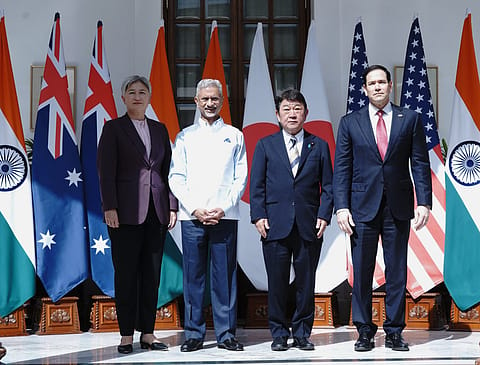
Quad foreign ministers during a visit in New Delhi on Tuesday.
The Quad grouping is evolving from being primarily a dialogue platform into an action-oriented partnership focused on delivering tangible outcomes, US Secretary of State Marco Rubio said on Tuesday after the Quad Foreign Ministers’ Meeting.
Addressing a joint press conference alongside External Affairs Minister S. Jaishankar, Japanese Foreign Minister Toshimitsu Motegi, and Australian Foreign Minister Penny Wong, Rubio said the grouping’s objective over the past year has been to operationalise cooperation and convert shared concerns into coordinated action.
“Quad is moving beyond being a platform for discussions to one focused on delivering concrete action,” Rubio said, adding that the relevance of the grouping had grown amid recent global developments.
He also highlighted the strength of the four-nation grouping, saying it brings together “four strategic partners with complementary capabilities” that can be used to address global challenges.
Indo-Pacific remains central focus
Jaishankar described the meeting as “very substantive and productive”, with discussions largely centred on the current global situation and issues concerning the Indo-Pacific region.
“We've just concluded a very substantive and productive meeting of the Quad foreign ministers. Much of the discussions and indeed the bilateral exchanges were devoted to the current state of the world,” Jaishankar said at the post-meeting press conference.
“Being Quad, we naturally focused on issues of particular relevance to the Indo-Pacific. Because we are four maritime democracies located at different ends of the Indo-Pacific, the exchange of perspectives was an exercise of considerable value,” he added.
Earlier, while outlining the agenda for the talks, Jaishankar said the meeting would focus on advancing shared activities while addressing global challenges and emerging opportunities.
He said the Indo-Pacific remained the “specific limit” and central focus of the Quad, while discussions also covered issues such as supply chain resilience, connectivity bottlenecks, concentration risks in manufacturing and gaps in critical infrastructure.
According to Jaishankar, these challenges underline the need for “stronger partnerships, deeper collaboration and greater use of emerging technologies”.
He further said the Indo-Pacific faces strategic concerns that require stronger maritime security, greater economic choices and increased strategic confidence supported by “trusted and transparent partnerships”.
RANK
COMPANY NAME
REVENUE
(INR CR)
(INR CR)
{{#current-rank}} {{current-rank}} {{/current-rank}} {{^current-rank}} {{rank}} {{/current-rank}} {{name}} {{#revenue}} {{revenue}} {{/revenue}} {{^revenue}} {{noi}} {{/revenue}}
Focus on resilience and practical cooperation
The minister noted that officials from the four countries had already advanced cooperation in areas including maritime security, critical technologies, economic resilience and humanitarian assistance and disaster relief (HADR).
Japanese Foreign Minister Motegi said the meeting sends a strong message that the Quad will continue promoting cooperation towards a “free and open Indo-Pacific”.
He stressed that Indo-Pacific nations must strengthen resilience and build the capability to determine their own future, particularly in economic security.
Australian Foreign Minister Penny Wong said the Quad was increasingly producing tangible outcomes while working to ensure a “free, open and stable Indo-Pacific”.
Describing India as a key power shaping the Indo-Pacific and the wider world, Wong said the grouping is united by a shared vision despite the members having different histories and interests.
She noted the Quad’s cooperation in areas such as disaster response, infrastructure development, undersea cables, maritime security, and critical minerals, saying these initiatives demonstrate the grouping’s growing practical role in the region.
Frequently Asked Questions
NEXT STORY