U.S.-Iran talks fail, Trump hardens Hormuz line: what changed in the last 24 hours
/ 3 min read
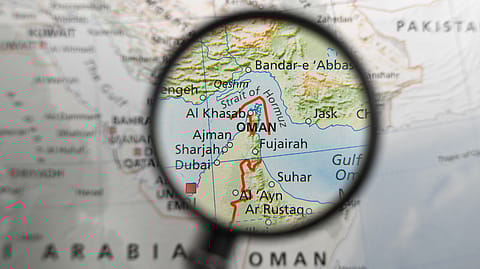
According to Balasundaram, from an insurance perspective, safe passage for vessels through the Strait of Hormuz assured by Iran, will bring some relief to insurers. | Credits: Shutterstock
U.S.-Iran talks fail, Trump hardens Hormuz line: what changed in the last 24 hours
US-Iran talks in Islamabad collapsed after 21 hours, with Vice President JD Vance calling Washington’s proposal its “final and best offer.” Iran rejected the terms as excessive, and President Trump has now threatened a naval blockade of the Strait of Hormuz. Tanker traffic is slowing, oil prices are rising, and India faces renewed risks via crude, trade and remittances.
This summary is AI-generated, and Fortune India is not responsible for its content or any associated copyright issues.
Saudi Arabia’s east-west pipeline, which bypasses Hormuz, is reportedly running at full capacity of about 7 million barrels a day, offering an alternative route. But that does not replace the strategic importance of the strait.
According to Balasundaram, from an insurance perspective, safe passage for vessels through the Strait of Hormuz assured by Iran, will bring some relief to insurers. | Credits: Shutterstock
The U.S.-Iran peace talks stalled diplomacy to a harder military signal on Sunday. Talks in Islamabad collapsed after nearly 21 hours, with U.S. vice president JD Vance saying Washington had presented its “final and best offer” but was leaving without a deal. Iran pushed back, calling the US position “excessive” and indicating no immediate plans to resume talks.
While Pakistan prime minster Shehbaz Sharif claims it will continue to mediate, but for now, the diplomatic track is effectively on hold. While Trump raises stakes with blockade threat the sharper shift comes after the talks failed.
In a Truth Social post, US President Donald Trump says that the US Navy will begin blockading any and all ships trying to enter or leave the Strait of Hormuz. He added, "any Iranian who fires at us, or at peaceful vessels, will be blown to hell.”
These statements matter because they move the situation from failed negotiations to a potential enforcement scenario around one of the world’s most critical oil routes.
Why Hormuz is the real story?
The Strait of Hormuz handles a major share of global oil flows. Any disruption here feeds directly into prices, shipping costs and insurance.
Saudi Arabia’s east-west pipeline, which bypasses Hormuz, is reportedly running at full capacity of about 7 million barrels a day, offering an alternative route. But that does not replace the strategic importance of the strait.
Some tanker movement is being continued, implicating flows have not completely stopped, but the risk premium is back.
For India, this is not just about whether oil spikes.
Crisil has already flagged that a prolonged disruption could:
Bring F27 growth down to 6.8% from 7.1%
Push the current account deficit to 2% of GDP
Raise inflation to 4.7%
India’s exposure to West Asia is broader with 40–50% of oil imports, 13% of exports and 38% of remittances. This implicated that any escalation feeds through multiple channels such as oil, trade, freight and remittances.
Tanker movement indicates disruption
Visuals emerging over the last few hours show oil tankers slowing, rerouting or holding position near the Strait of Hormuz, pointing to immediate disruption in shipping flows after the collapse of US-Iran talks.
{{#most-powerful-women-snapshot-individual.slug}} {{/most-powerful-women-snapshot-individual.slug}} {{^most-powerful-women-snapshot-individual.slug}} {{/most-powerful-women-snapshot-individual.slug}} {{#showRanking}} {{current-rank}} {{/showRanking}} {{#photo.0.url}}
{{name}}
The movement suggests operators are reacting in real time to rising military risk and uncertainty over safe passage, reinforcing concerns that the situation is shifting from diplomatic deadlock to on-ground disruption of a key global oil route.
Buffers exist, but don’t remove price risk
India has built some cushion. The country has about 60 days of oil supply has been secured through diversification and stockpiling. Saudi pipeline flows also reduce the risk of a complete physical disruption.
But these do not protect against higher global crude prices as rising freight and war-risk insurance.
Till a few days ago, markets were pricing in de-escalation but that view has now reversed.
With talks failing and the US indicating a blockade, the story shifts back to how long the uncertainty lasts, how much crude moves and how quickly costs rise. Brent Crude ended at $94.45 per barrel on Friday. WTI Crude ended above Brent at $96.57, and according to analysts US oil prices are now expected to surge above $115/barrel this month as US-Iran talks fail and President Trump announces a "blockade" on the Strait of Hormuz.
The next few hours will say how markets are responding to the latest geopolitical developments. For India, the focus is back where it usually lands in such situations; crude, costs and how long the disruption lasts.
Follow Fortune India
NEXT STORY