
Can the Tata Sierra be the saviour that Tata Motors has been waiting for since the Nexon?
ADVERTISEMENT
It hasn’t been an easy time for Tata Motors.
After a much-needed lucky break for the automaker in the early part of the decade, the Mumbai-based automaker had been stuck in something of a quagmire for a few years now.
Of course, there have been wonders such as the Punch and Altroz, which have brought in numbers for the automaker, but there is no doubt that it has missed the bus in the compact SUV segment, the fastest-growing segment in India’s automotive landscape.
In the meantime, homegrown automaker Mahindra has leapfrogged the automaker, in a storied reversal of fortunes, to emerge as India’s second-largest automaker, something that Tata Motors has long been attempting to do. While Tata has managed to reverse its fortunes in recent times, particularly after the GST cut, its once-dominant position in the electric vehicle segment has also withered, with its market share dropping from about 80 percent three years ago to a little over 40 percent now.
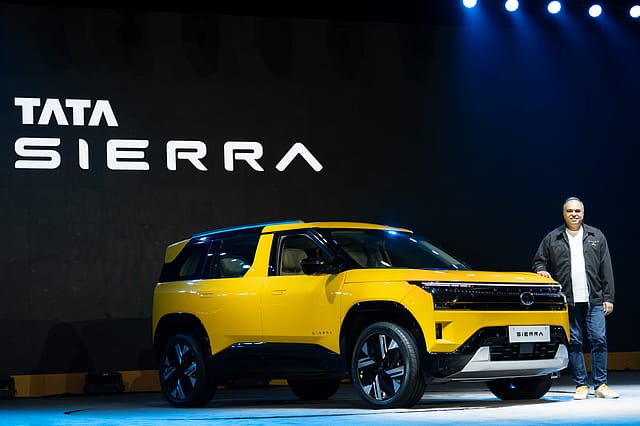
That’s where Tata Motors hopes its new launch, the Tata Sierra, a compact SUV, will pull off a magic trick to drive sales for the Mumbai-based automaker. Already, with competitive pricing (a little more expensive than Maruti Suzuki’s Victoris), and packed with features and an impeccable safety record, the Sierra has turned heads.
“The Sierra is set to compete in the big and fastest growing volume segment, which is the compact SUV segment,” Puneet Gupta, the Director at S&P Global Mobility of India & ASEAN region at S&P Global, tells Fortune India. “To compete in this market, you need a competitive product with cutting-edge features and technology, with strong credibility and contemporary styling.
Tata Motors opened bookings for the vehicle on Tuesday (December 16) with deliveries starting in January 2026. The Tata Sierra is available in seven variants, priced from Rs 11.49 lakh to Rs 21.29 lakh.
In many ways, the automaker will also be hoping to repeat its success with the Tata Nexon, a product once designed as a bridge in its transformation journey. Nexon has been among Tata Motors’ best-selling vehicles over the last decade, and in November this year, it once again emerged as the country's best-selling vehicle.
The Nexon’s success had also helped Tata Motors to expand its electric vehicle portfolio, after the company began offering an electric variant of the Nexon.
“It could emerge as the next Nexon,” adds Gupta of S&P Global. “The Rs 10 lakh to Rs 20 lakh is a sweet spot, both in terms of scale and profitability. Tatas have a track record of offering models with aggressive pricing options and offer multiple power train options, which strengthens the position for the carmaker.”
Unlike many automakers that focus on one or two powertrains per model, Tatas have been steadily expanding powertrain options across multiple models. For instance, the Tata Nexon currently offers EV, petrol, diesel, and CNG powertrains, a factor instrumental to its success. The Tata Punch too is sold across multiple powertrains. Multiple powertrains coupled with a diverse variant strategy have been critical to Tata Motors’ success.
The Nexon was launched in 2017 as a bridge product to help the automaker transform its automobile business. At Rs 5.85 lakh, with the top-spec diesel variant costing Rs 9.45 lakh and the top-end petrol costing Rs 8.6 lakh, the Nexon soon found takers, especially with features such as dual front airbags on base variants, multiple drive modes, and an 8-speaker, 6.5-inch touchscreen Harman infotainment system.
The success also prompted Tata to introduce an electric variant, which soon became the country's largest-selling EV, helping the company dominate the EV market. The automaker is on track to sell a million Nexons after surpassing 900,000 units in October.
It was into this mix that the automaker took a gamble with the Curvv, a sporty coupe compact crossover SUV, which, however, failed to drive large volumes for the automaker, despite high expectations. But sales have remained passable. “With the new Sierra, we are setting a new benchmark for what Indian mobility can be,” Shailesh Chandra, the MD & CEO of Tata Motors Passenger Vehicles, said during the launch of the Sierra. “The Tata Sierra stands as a testament to our belief that customers deserve more than the ordinary: they deserve innovation that inspires, design that resonates emotionally, and a premium experience that elevates every journey.”
“What makes the Sierra different is also the category that it appeals to,” adds Gupta. “A large number of the buyers today are under the age of 45 years, and while products like Suzuki Victoris might bring volumes even cannibalizing the sales of Grand Vitara, Tata is also well positioned to deliver strong performance given the features and styling it offers in Sierra, and clearly, its offering is differentiated from the traditional styling of compact SUV's”
All that means, it’s wait-and-watch now for the Sierra.