
Delhi EV Policy 2.0 can become a template for states, boost India's electric mobility ambitions: ASSOCHAM President Nirmal Minda
ADVERTISEMENT
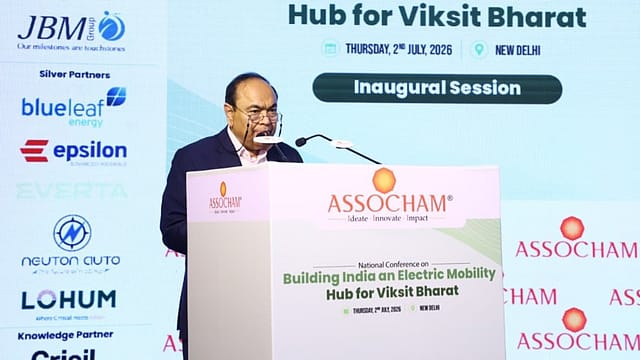
Delhi's newly unveiled Electric Vehicle (EV) Policy 2.0 has the potential to emerge as a blueprint for other states seeking to accelerate clean mobility adoption, ASSOCHAM President Nirmal Minda said on Thursday , while urging closer collaboration between industry and policymakers to strengthen India's electric vehicle ecosystem.
Speaking at ASSOCHAM's National Conference on Building India an Electric Mobility Hub for Viksit Bharat, Minda said the transition to electric mobility goes beyond replacing conventional vehicles and presents a strategic opportunity to strengthen manufacturing, improve energy security and enhance India's global competitiveness.
"The Delhi EV Policy 2.0 has the potential to position the national capital as a leading green mobility hub and can serve as a model for other states pursuing sustainable transportation," Minda said.
Policy push gathering momentum
Minda credited the Centre with creating a supportive policy environment for the EV industry through initiatives such as the PM E-DRIVE scheme, the Production Linked Incentive (PLI) schemes for automobiles and Advanced Chemistry Cell (ACC) batteries, and the rapid rollout of charging infrastructure.
According to him, these initiatives are laying the foundation for a globally competitive electric mobility ecosystem while encouraging investments across the value chain.
"Electric mobility is far more than a technological transition. It is an opportunity to drive industrial growth, innovation, energy security, environmental stewardship and global competitiveness as India advances towards the Viksit Bharat 2047 vision," he said.
The Delhi EV Policy 2.0 proposes purchase incentives for eligible electric vehicles, expansion of charging infrastructure and a phased ban on registrations of select new internal combustion engine vehicle categories beginning as early as next year.
Industry-government partnership critical
Minda emphasised that sustaining the sector's growth will require deeper cooperation between government and industry to build a resilient domestic manufacturing ecosystem and improve India's competitiveness in global EV supply chains.
He said ASSOCHAM has aligned its priorities under "ASSOCHAM 2.0" with the government's Viksit Bharat 2047 roadmap by focusing on Make in India, ease of doing business, MSME development, digitalisation and sustainability.
Calling for continued policy stability and industry participation, Minda said India's electric mobility journey must be supported by sustained investments in manufacturing, innovation and infrastructure. Such coordinated efforts, he noted, would not only accelerate EV adoption but also help establish India as a global hub for electric mobility and clean automotive technologies over the coming decades.