
EV retail sales touch 2.98 lakh units in August, up 52.9% YoY; West Asia war bolsters shift to electric: FADA
ADVERTISEMENT
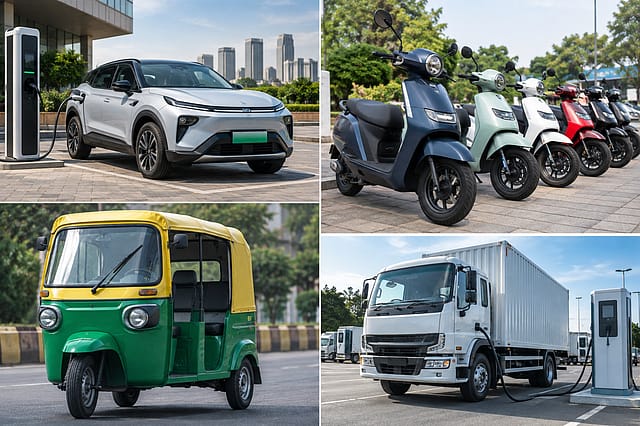
Electric Vehicle (EV) retail sales in India rose 52.9% year-on-year to 2,98,448 units in August 2026, taking overall EV penetration to 12.3% from 9.5% a year ago, according to the Federation of Automobile Dealers Associations (FADA). All four EV categories — two-wheelers, three-wheelers, passenger vehicles and commercial vehicles — recorded their highest-ever August retail volumes.
The strong performance comes against a backdrop of elevated oil prices amid the West Asia conflict, adding to the running-cost case for electric and other alternative-fuel vehicles. FADA President Sai Giridhar has linked the broader shift towards alternative powertrains to oil prices, while also pointing to wider model availability, improving EV range and the gradual expansion of charging infrastructure.
Electric passenger vehicle (PV) retail sales rose 51.89% YoY to 30,696 units in August, taking EV penetration in the segment to 7.6% from 5.8% a year earlier. Tata Motors led with 13,158 units, followed by Mahindra & Mahindra with 6,464 units and JSW MG Motor India with 4,622 units.
Giridhar said August was the biggest-ever August for electric mobility in India, with retail across the four categories reaching nearly 3 lakh units. He said the fact that every category set a fresh August record showed that the growth was broad-based.
Electric two-wheelers drive volumes
Electric two-wheelers remained the largest contributor to overall EV retail, with sales rising 67.05% YoY to 1,83,204 units. Penetration stood at 10.7%, compared with 7.7% a year earlier. TVS Motor led with 48,938 units, followed by Bajaj Auto at 41,114 units and Ather Energy at 28,757 units.
Giridhar said the segment's ability to remain above 10% penetration was particularly significant given that August is a seasonally soft, non-festive month. Electric two-wheelers now account for more than 60% of all EV retail.
Electric three-wheeler retail sales increased 25.28% YoY to 79,846 units, taking penetration to 65.3% from 56.6% a year ago. Bajaj Auto led the segment with 13,833 units, followed by Mahindra Group with 12,819 units and TVS Motor with 4,415 units.
Electric CVs hit record high
Electric commercial vehicles were the fastest-growing EV category in August, with retail sales surging 188.3% YoY to 4,702 units from 1,631 units a year earlier. Penetration rose to 5.18% from 2.06%. Tata Motors led with 1,416 units, followed by Euler Motors at 849 and Sany Heavy Industry India at 605 units.
Giridhar called electric CVs the clear standout, with 4,702 units marking the segment's all-time monthly high. He said the near-tripling in sales pointed to fleet electrification moving beyond pilot projects towards actual purchase orders.
The broader trend, according to Giridhar, is also significant. Despite overall auto retail remaining below last year's festive peaks, each EV category is still close to a record achieved within the past nine months. This indicates that electric mobility is consolidating at a higher level rather than simply recovering from an earlier peak.
He said the market was increasingly being driven by running-cost economics, expanding charging infrastructure and improving consumer confidence, rather than subsidies alone. PM E-DRIVE and progressive state policies are providing further support to the transition, while higher oil prices linked to geopolitical tensions in West Asia are strengthening the economic case for alternative powertrains.
The shift is part of a broader change in India's passenger-vehicle fuel mix. In August, alternative-fuel vehicles — including CNG, hybrids and EVs — collectively accounted for 41.95% of PV retail, edging past petrol/ethanol at 40.85% for the first time, according to FADA data.