
India’s auto component industry targets $200 bn by 2030 as exports, OEM supplies accelerate: ACMA
ADVERTISEMENT
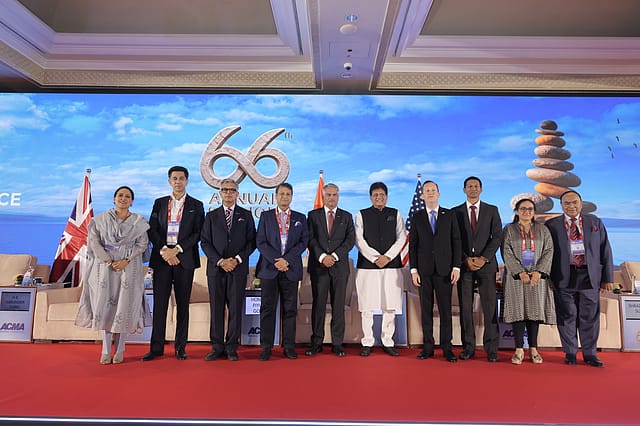
India’s auto component industry is targeting $200 billion in annual turnover by 2030, building on a sharp acceleration in OEM supplies, exports and domestic demand that has strengthened the sector’s growth outlook, the Automotive Component Manufacturers Association of India (ACMA) said at its 66th Annual Session in New Delhi on Wednesday.
The industry clocked ₹7.6 lakh crore ($85.9 billion) in turnover in FY26, registering 12.7% growth, while supplies to original equipment manufacturers (OEMs) increased 16.3% and exports touched around $24 billion.
An ACMA-BCG report released at the session found that nearly 90% of component makers across large, medium and small companies believe they are “in the right place at the right time”, signalling confidence in the sector’s next phase of expansion.
Auto demand puts component makers on a stronger footing
Speaking at the inaugural session, Shailesh Chandra, President, SIAM and Managing Director, Tata Motors Passenger Vehicles and Tata Passenger Electric Mobility, said the implementation of GST 2.0 last year triggered a significant acceleration in automobile demand, with growth exceeding 15-20% across categories during the second half of the year and culminating in record annual volumes across major segments.
He said the momentum had carried into FY27, with both domestic demand and exports remaining robust. According to Chandra, the component industry played a critical role in enabling this acceleration by rapidly expanding its capacity and capabilities to keep pace with rising requirements from vehicle manufacturers.
Chandra said the component sector had itself evolved into a “formidable force”, with FY26 turnover reaching ₹7.60 lakh crore, including exports of around $24 billion, according to ACMA estimates.
The industry’s expansion is also being supported by a broader shift in global sourcing, as automakers increasingly look for reliable suppliers capable of delivering quality, scale and cost competitiveness.
From resilience to technology-led growth
The annual session, themed “Beyond Resilience”, focused on how component manufacturers can move from merely absorbing disruptions to shaping the next phase of automotive growth.
ACMA President and Managing Director, JK Fenner, Vikrampati Singhania, said the sector had demonstrated resilience through the pandemic, supply-chain disruptions, geopolitical uncertainty and commodity volatility, but argued that the next challenge was to convert that resilience into leadership.
Industry leaders also flagged technology, skills and Industry 5.0 as critical enablers, with artificial intelligence, automation, robotics and connected manufacturing expected to increasingly work alongside human expertise.
The focus is simultaneously shifting towards energy-efficient operations, circular manufacturing and more responsible production as global customers raise sustainability requirements.
Trade agreements widen global opportunity
Policy and trade were another major theme at the session. Commerce and Industry Minister Piyush Goyal said the component industry would remain an important pillar of India’s free trade agreements and highlighted the country’s ability to maintain its growth trajectory amid global uncertainty.
Heavy Industries and Steel Minister H.D. Kumaraswamy underlined the role of government-backed initiatives, including the production-linked incentive schemes for automobiles and components, in encouraging investment, domestic value addition and advanced technology manufacturing.
The international opportunity was reinforced by US Ambassador to India Sergio Gor, who described the two countries as natural partners and identified the automotive sector as a key area for deeper market access, investment and supply-chain integration.
Harjinder Kang, His Majesty’s Trade Commissioner for South Asia and British Deputy High Commissioner for Western India, highlighted the India-UK CETA as a platform for greater automotive collaboration, including MSME integration, advanced mobility and sustainable manufacturing.
The session also featured R Mukundan, President, CII and Managing Director & CEO, Tata Chemicals, and Hisashi Takeuchi, Managing Director & CEO, Maruti Suzuki India, underscoring the cross-industry focus on technology, sustainability and competitiveness as the component sector seeks to more than double its scale by 2030.