
Piyush Goyal to auto industry: Think global as India emerges as next big manufacturing hub
ADVERTISEMENT
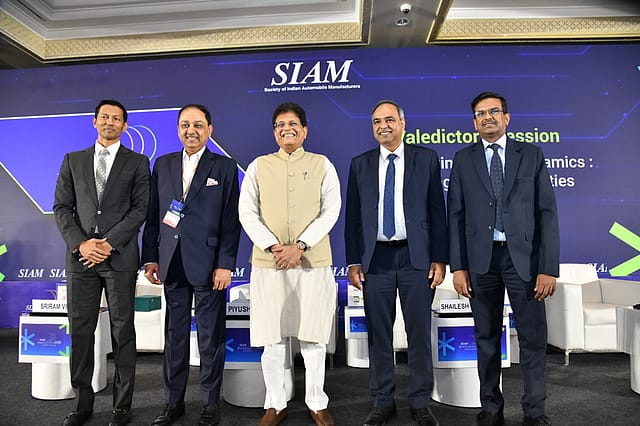
Union Commerce and Industry Minister Piyush Goyal on Thursday urged India’s automobile industry to look beyond the domestic market and aggressively pursue global opportunities, saying rising costs, regulatory pressures and demographic challenges in developed economies could accelerate the shift of manufacturing to India.
Addressing the valedictory session of the Society of Indian Automobile Manufacturers’ (SIAM) 66th Annual Convention, Goyal said Indian automakers had a major opportunity to use the country’s manufacturing scale to serve both domestic and overseas markets. Companies that continue to operate within the comfort of the domestic market, however, risk being left behind as global competition intensifies.
“Gone are the days when we could look at the domestic market,” Goyal said, urging the industry to “think globally”.
The valedictory session of this year's convention, themed “Changing Global Dynamics: Leveraging Opportunities”, brought together industry leaders to deliberate on the changing global automotive landscape and the opportunities for India to strengthen its position as a competitive manufacturing and export hub.
Goyal said manufacturing in several developed economies was becoming increasingly expensive because of regulatory burdens, high operating costs and shortages of young workers and skilled talent. India, he said, was well placed to capture a greater share of global production.
“I can clearly see before my eyes. Production has to shift out on many of these developed countries. They are just unaffordable,” he said.
The minister said Indian companies that were prepared to invest ahead of the curve, adopt new technologies and build global capabilities could benefit significantly from this shift.
“The agile, the nimble companies will gain. The people who remain laggards will miss the bus,” Goyal said.
Exports emerge as the next growth lever
Goyal highlighted India’s growing automobile exports as an indication of the sector’s changing global position, pointing to around one million vehicles exported by the country last year.
He specifically cited Maruti Suzuki’s growing exports, including supplies to Japan, and said Tata Motors and Mahindra & Mahindra had also begun developing electric vehicles with global potential.
The minister urged more companies to follow that path, saying exports could significantly expand the growth opportunity available to the industry.
“If I was in your place, I would truly be looking at this space,” Goyal said, referring to the export opportunity.
He also pointed to India’s expanding network of trade agreements as a major advantage for domestic manufacturers. According to Goyal, nine trade agreements concluded over the past four-and-a-half years cover economies representing around $60 trillion in GDP.
The agreements, he said, provide Indian businesses with greater access to international markets while opening opportunities for exports, technology absorption and partnerships.
Goyal also said India’s expanding trade footprint was creating a more favourable environment for automotive companies to build global partnerships and raise their export ambitions. He called for the industry to leverage India’s scale and the opportunities created by trade agreements to develop stronger links with international markets.
Goyal's message to automakers was not merely to increase exports, but to build products capable of competing globally.
He cautioned companies against producing products of different quality for domestic and international markets, saying Indian manufacturers needed to raise their global competitiveness.
“I am only trying to encourage you to now think globally,” he said.
India needs genuine indigenisation
Goyal also called for deeper localisation in the automotive value chain, questioning practices where companies import products into India, undertake limited value addition and classify the resulting output as indigenised.
He said such an approach could not provide sustainable economic benefits over the long term.
“Sustainability is not only environment. Environment is one end of the sustainability story. And of course there is also the economic overlay,” Goyal said.
The minister also highlighted the need for greater investment in research and development, innovation and domestic technology capabilities.
He cited Mahindra’s India-developed electric vehicles as an example of how domestic design capabilities and international engineering partnerships could work together to create products with global potential.
AI will reshape jobs, not shrink them
Goyal also pushed back against concerns that artificial intelligence would trigger widespread job losses in the automobile industry.
He said AI would help companies improve efficiency, competitiveness and customer service while creating new capabilities and changing existing job roles.
“Job roles may change, but jobs will grow,” he said.
Goyal said companies would need to invest in reskilling and talent development as technology changes the nature of work.
He also broadened the definition of resilience for the automobile industry, saying it should encompass not only supply chains but also business strategy, technology adoption, investment in innovation and R&D, and the ability to attract and develop talent.
“We can't have an inclusive and sustainable growth pathway without adopting and embracing technology,” he said.
EV transition must also strengthen energy security
On sustainable mobility, Goyal argued that the transition should not be reduced to a simple shift from petrol and diesel vehicles to EVs.
He acknowledged the competing positions around electric vehicles, hybrids, CNG and conventional powertrains, but said India needed to pursue a broader strategy focused on sustainability, economic viability and energy security.
The minister also recalled the government’s efforts to build domestic capabilities in permanent magnets and reduce vulnerabilities in critical supply chains. He said the government had brought together automobile companies, startups, research institutions and multiple ministries to work on the challenge.
Goyal also pointed to the growing momentum around the Bharat Mobility Global Expo as evidence of the automotive sector’s resilience and its ability to showcase the direction of technological change. He said the platform had generated strong momentum for the industry and reflected the growing interest in India’s automotive ecosystem.
“Bharat Mobility Global Expo has sparked strong momentum, and that reflects the resilience of our automotive industry highlighting where technology is headed,” Goyal said.
He said India’s reforms and strengthening ecosystem were being noticed worldwide, making it an opportune time for the industry to reshape itself, strengthen self-sufficiency and contribute to the broader objective of building a developed India by 2047.
Goyal said India’s growing incomes, consumer aspirations and expanding road infrastructure could support strong growth in vehicle demand. For automakers, however, he said the bigger opportunity lay in combining that domestic demand with a much stronger global footprint.