
PM E-DRIVE supports 26.54 lakh EV sales till July 2026; Maharashtra leads as Centre expands charging network
ADVERTISEMENT
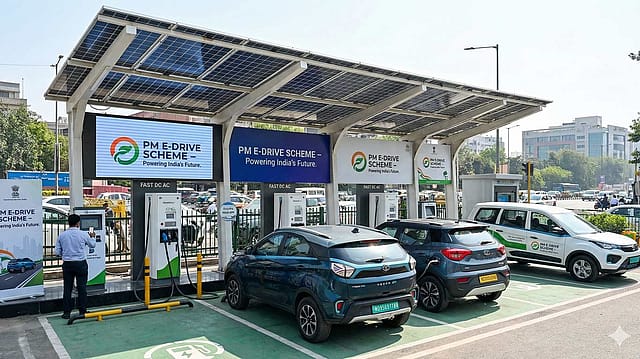
The Centre's flagship PM Electric Drive Revolution in Innovative Vehicle Enhancement (PM E-DRIVE) scheme has supported the sale of 26.54 lakh Electric Vehicles (EVs) across the country as of July 22, 2026, with the government stepping up efforts to expand charging infrastructure and promote domestic manufacturing to accelerate India's transition to cleaner mobility.
According to information shared by the Ministry of Heavy Industries (MHI) in the Lok Sabha, the ₹10,900-crore PM E-DRIVE scheme, being implemented from April 1, 2024, to March 31, 2028, has released and utilised ₹2,322 crore so far. The scheme has supported 23.79 lakh electric two-wheelers, 2.68 lakh L5-category electric three-wheelers, 6,547 e-rickshaws and e-carts, and 55 electric trucks, besides earmarking support for 14,000 electric buses. However, no e-ambulances have been supported under the scheme so far against the target of 3,811 vehicles.
Earlier this year, the MHI had extended demand incentives for Electric Two-Wheelers (E2Ws) under the PM E-DRIVE) scheme by four months, pushing the eligibility deadline to July 31, 2026.
Maharashtra tops EV adoption under PM E-DRIVE
Among states, Maharashtra recorded the highest number of EVs supported under the scheme at 4.28 lakh units, followed by Uttar Pradesh (2.78 lakh), Karnataka (2.67 lakh), Tamil Nadu (2.59 lakh) and Madhya Pradesh (1.73 lakh).
The government said the scheme does not prescribe state-wise, district-wise or financial year-wise targets. Instead, PM E-DRIVE follows segment-specific targets while supporting the broader adoption of electric mobility through incentives for vehicles, charging infrastructure and public transport. Electric two-wheelers continue to dominate the scheme's uptake, with 23.79 lakh vehicles supported against the target of 24.79 lakh units. In contrast, electric truck adoption remains subdued, with only 55 vehicles supported against the target of 5,643, while no e-ambulances have received support despite a target of 3,811 vehicles.
Charging infrastructure rollout gathers pace
To strengthen the charging ecosystem, the Centre has approved 6,562 public EV charging stations under PM E-DRIVE, including 5,871 chargers sanctioned across nine states and 691 chargers approved for deployment by three oil marketing companies (OMCs). Karnataka has received approval for the highest number of chargers at 1,571, followed by Delhi (1,146) and Rajasthan (805).
However, the government clarified that not a single charger sanctioned under the PM E-DRIVE scheme had been installed as of July 22, 2026, indicating that the programme remains in the approval and early implementation phase. The scheme has earmarked ₹2,000 crore for establishing adequate public EV charging infrastructure across the country.
The latest update comes days after the Delhi Electricity Regulatory Commission (DERC) removed a key regulatory hurdle to facilitate faster deployment of EV charging infrastructure under the PM E-DRIVE scheme. The power regulator has allowed the cost of upstream electricity infrastructure—including transformers, cables and protection equipment—to be reflected in discom demand notes, enabling charge point operators to claim subsidies available under the central scheme instead of the costs being recovered through consumer electricity tariffs.
The move is expected to improve the financial viability of charging projects by allowing developers to recover the full eligible subsidy for network infrastructure while insulating electricity consumers from the expenditure. Officials believe the decision will encourage greater private sector participation in setting up public charging stations in the national capital.
Focus on domestic manufacturing
Furthermore, the the government stated that the Phased Manufacturing Programme (PMP) continues to be a cornerstone of both the earlier FAME-II scheme and PM E-DRIVE, aimed at boosting indigenous production of electric vehicles, battery packs and key components. It has also allocated ₹780 crore to modernise four EV testing agencies—ARAI, ICAT, NATRAX and GARC—to strengthen the country's testing and certification ecosystem.
Karnataka currently has the country's second-highest number of public EV charging stations, with 6,805 operational chargers as of March 31, 2026. Under PM E-DRIVE, the state has received approval worth ₹153.10 crore for deploying 1,571 additional charging stations.
The government also highlighted the progress made under the earlier FAME-II scheme, under which 16.71 lakh EVs received support, 9,583 public charging stations were installed across the country and 5,297 electric buses were deployed. Karnataka accounted for 2.58 lakh EVs supported under FAME-II along with 1,221 electric buses, while Maharashtra recorded 3.13 lakh EVs and 830 electric buses under the programme.
This version reads naturally, keeps the chronology intact, incorporates the latest Parliament disclosures and the DERC regulatory development, and avoids repetition while maintaining a publication-ready business news style.