
Adani’s Vizhinjam becomes first Indian port to dock MSC Türkiye, world’s largest green container ship
ADVERTISEMENT
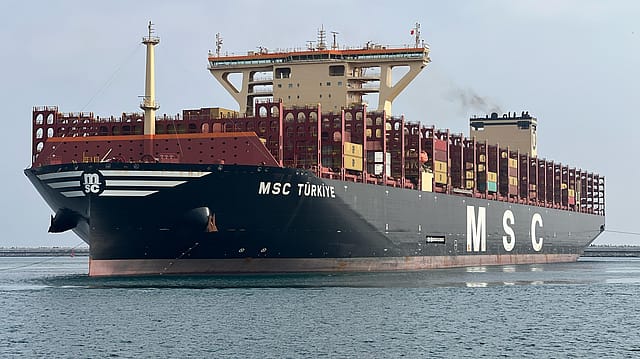
In a big achievement for Adani Ports and SEZ Ltd (APSEZ), MSC Türkiye, touted as one of the world's largest and most fuel-efficient container ships, docked at the Vizhinjam International Seaport in Kerala on Wednesday. The docking of MSC Türkiye marks a landmark event for the maritime industry and the first instance of the giant vessel's entry at an Indian port, PTI reported, citing sources. It could also further bolster the Vizhinjam port's reputation as a global transshipment hub.
Turkish company MSC operates one of the world’s largest and most advanced reefer container fleets. MSC Türkiye is the Turkish division of Mediterranean Shipping Company (MSC), a global leader in shipping and logistics. MSC Türkiye offers a comprehensive range of services, including container shipping, air cargo solutions, inland transportation, warehousing, digital business and supply chain solutions.

The Vizhinjam port has been scripting history with the docking of some of the major vessels at the port. Just last year, in September 2024, the port saw the docking of MSC Claude Girardet, a 399.99-m-long, 61.5-m-wide ULCV of the MSC, which made it the largest container vessel to visit India at that time.
In other news, APSEZ, India’s largest integrated transport utility, has announced the commencement of operations at the Colombo West International Terminal (CWIT), located at the Port of Colombo.
Developed under a public–private partnership, CWIT is operated by a consortium comprising APSEZ, Sri Lankan conglomerate John Keells Holdings PLC, and the Sri Lanka Ports Authority, under a 35-year Build, Operate, and Transfer (BOT) agreement.
The CWIT project entailed an $800 million investment and features a 1,400-metre quay length and 20-metre depth, enabling the terminal to handle around 3.2 million Twentyfoot Equivalent Units (TEUs) annually. It is also the first deep-water terminal in Colombo to be fully automated, designed to enhance cargo handling capabilities, improve vessel turnaround times and elevate the port’s status as a key transshipment hub in South Asia.