
AGNIT Semiconductors raises $2.6 million, bets on gallium nitride chips for telecom and defence
ADVERTISEMENT
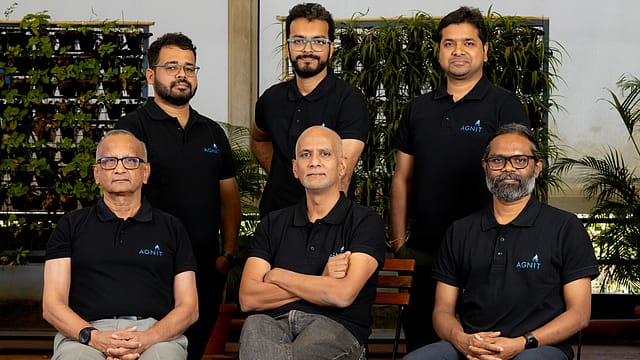
Bangaluru-based deep-tech startup AGNIT Semiconductors raised $2.6 million in a seed extension equity round led by Shastra VC, marking the fund’s first investment in India’s semiconductor sector. The round also witnessed participation from existing investors 3one4 Capital and Zephyr Peacock, which had invested $3.5 million in the seed round. The company, backed by former Cognizant CEO Lakshmi Narayanan, did not disclose the latest valuation after this round.
Incubated at the Indian Institute of Science (IISc), the seven-year-old startup describes itself as India’s first vertically integrated gallium nitride semiconductor manufacturer. The company designs and manufactures GaN materials, chips and electronic components primarily for radio-frequency applications. With the latest round, AGNIT has raised a total of $7.47 million so far and is now focused on transitioning its pilot products into volume manufacturing.
In an interaction with Fortune India, Hareesh Chandrasekar, CEO and co-founder of AGNIT Semiconductors, said India has historically played a limited role in semiconductor manufacturing despite having a strong design talent base.
“What we have seen historically is that about 20% of the world’s chip design talent sits in India. Most of that talent has been building IP and products for global semiconductor companies. Manufacturing is where India has not really played a significant role, and that is what is beginning to change now,” he said.
Why is gallium nitride gaining importance?
As per a Precendence Research, the global GaN semiconductor devices market size is calculated at $5.32 billion in 2025 and is predicted to increase from $6.70 billion in 2026 to approximately $51.35 billion by 2035, expanding at a CAGR of 25.45% from 2026 to 2035. At the same time, the same research firm estimates that the global silicon carbide semiconductor devices market size is accounted at $3.64 billion in 2025 and predicted to increase from $4.51 billion in 2026 to approximately $24.95 billion by 2034, expanding at a CAGR of 23.83% from 2025 to 2034.
While silicon continues to dominate traditional semiconductors used in processors and memory, gallium nitride is increasingly being used in applications that require handling high amounts of power efficiently.
“Silicon has reached its limits when it comes to handling high amounts of power efficiently in a compact, power-dense footprint. That is what gallium nitride does really well,” Chandrasekar said.
One of the most visible applications of GaN technology today is in fast-charging adapters used for smartphones and laptops. “The first consumer product where gallium nitride became visible was fast chargers. Earlier chargers delivered about 12 or 15 watts and were bulky. Today, you have 65-watt chargers with roughly the same footprint because the power switching is happening on gallium nitride devices,” he said.
The technology is also widely used in telecom infrastructure. “Every 5G base station in the world runs gallium nitride-based power amplifiers,” Chandrasekar added.
Where is AGNIT deploying its technology?
The startup is currently focusing on strategic sectors such as defence, space and aerospace, where radio-frequency semiconductor components are critical. “Today we are primarily working with the strategic sector. By strategic, I mean defence, space and aerospace. They are mainly looking at radio-frequency applications for gallium nitride,” Chandrasekar said.
The company currently has multiple pilots underway with the strategic sector customers and expects at least two of these to move into volume production. “We have about three pilots running, and the fourth one should start this month. At least two of those we want to see wrap up into volume production,” he said.
AGNIT currently operates at pilot production levels but plans to significantly increase output over the next two years. If the company reaches its production target, it expects to cross the $10 million revenue mark. “If we manage to hit our 100,000 chips target, I think that we will be close to slightly over $10 million in revenue,” he said.
Commenting on the investment, Ashis Nayak, Founding Partner at Shastra VC, said, “Gallium Nitride is becoming a foundational technology for modern high-performance electronics. AGNIT is one of India’s most compelling IP-led semiconductor stories, with a strong patent portfolio across GaN materials, wafer processes, and RF device design, built on over a decade of research at IISc. We are proud to partner with the team as they scale this capability and position India as a serious player in GaN-based semiconductors.”