
As Modi meets Carney, India-Canada ties to regain lost ground
ADVERTISEMENT
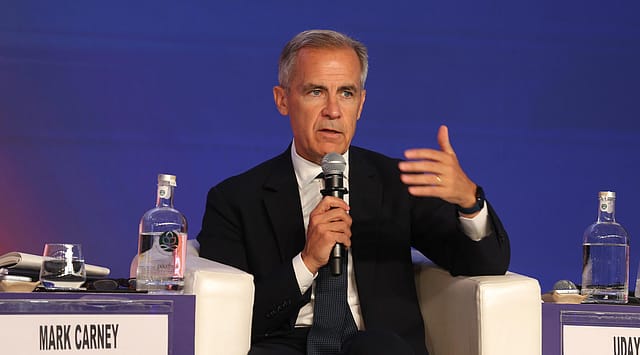
As Canadian Prime Minister Mark Carney meets Prime Minister Narendra Modi in New Delhi on 2nd March during his four-day India visit that began with interactions with the leaders of Indian industry and business in Mumbai on 27th February, it will not just be his first official visit to India, but the continuation of calibrated and constructive measures both the leaders had taken to strengthen the bilateral relationship during the G7 Summit in June last year.
Its significance lies on two fronts. One, it aims to restore Indo-Canadian relationship that was at its lowest for some time before Carney took charge as Prime Minister last year. Two, it aims to foster a relationship that bypasses the uncertainties and unpredictability both the countries have to undergo in their bilateral relationship with their biggest trade and diplomatic partner, the United States.
Officially, on 2nd March, the two Prime Ministers will hold delegation-level talks at Hyderabad House where both leaders will review the progress achieved till date across diverse areas of the India – Canada Strategic Partnership, building on their earlier meetings in Kananaskis (June 2025) and Johannesburg (November 2025). They will also take stock of ongoing cooperation in key pillars including trade and investment, energy, critical minerals, agriculture, education, research, and innovation, and people-to-people ties. The two leaders will also exchange views on regional and global developments.
Restoration of India-Canada bilateral ties
The restoration of India-Canada bilateral ties became necessary after Canada charged India of meddling in its internal affairs couple of years ago. By October, 2024, India had withdrawn some of its diplomats from Canada, some Canadian diplomats were expelled from India, and the relationship was at its lowest. A change of guard in Canada did matter as the current regime had put strengthening of India-Canada ties as a priority. What followed as an understanding between the political leadership of both the countries to pursue a constructive and balanced partnership grounded in mutual respect for each other’s concerns and sensitivities, strong people-to-people ties, and growing economic complementarities. The forthcoming meeting between the leaders is expected to provide an opportunity to reaffirm this positive momentum.
Similarly, a strong bilateral partnership with Canada leading to talks of free trade agreement (FTA), investment partnerships, critical mineral supply chain discussions etc. are also important for both the countries in the context of the unilateral policy stance taken by the US against its trade partners including India and Canada. The harm, the tariff policies of US President Donald Trump, has inflicted upon trade relationships and continuity of business among its partners is still fresh.
Diversifying trade beyond the US
Increased bilateral trade and investment partnership between Canada and India can to some extent de-risk the uncertainties associated with trade with the US and ensure stable flow of critical raw materials and investment opportunities from long term investors like Canadian Pension Funds for India. Major items of India's exports to Canada include pharmaceutical products, electronic goods, jewelry, gems & precious stones, seafood (shrimps), engineering goods and auto parts.
India's major imports from Canada include minerals, pulses, potash, paper & paperboard, wood pulp, iron & aluminium scrap and gemstones. The sectors that have already been identified for bilateral collaboration include civil nuclear energy, space exploration, security cooperation and science and technology.
With an estimated 1.8 million Indo-Canadians and estimated 1 million non-resident Indians, Canada hosts one of the largest Indian Diaspora abroad and is a country that is too big to ignore.