
“We’re 2-3x cheaper, 10x faster than GPUs”, d-Matrix Founder Sid Sheth bets on inference to democratise AI
ADVERTISEMENT
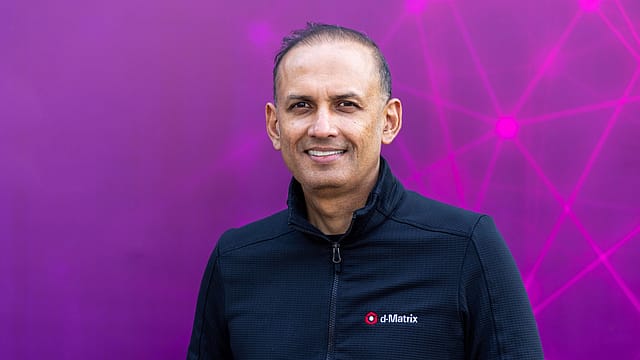
During the gold rush its a good time to be in the pick and shovel business.
The global AI race of today is very much similar to the stories of gold rush we've heard before. As that race intensifies, and chip dominance remains concentrated around GPU giants, Silicon Valley-based d-Matrix is positioning itself as a serious challenger — not in training large models, but in running them efficiently at scale.
Speaking to Fortune India on the sidelines of the India AI Impact Summit 2026, founder and CEO Sid Sheth said the company’s inference-focused architecture is designed to fundamentally change AI economics.
“Our solution is about two to three times more cost effective, five to ten times more power efficient, and almost ten times faster than the GPU,” Sheth said.
The inference bet
For over a decade, AI hardware has revolved around GPUs — particularly from Nvidia — optimised for training large AI models using high-bandwidth memory (HBM).
But Sheth believes the next wave belongs to inference — the stage where trained models actually respond to user queries.
“Everybody doesn’t want to train AI. Everybody wants to use AI,” he said. “Every ChatGPT query, every AI search result — that’s inference.”
Unlike GPU-heavy architectures built around HBM, d-Matrix has built its platform around SRAM-based memory (Static Random Access Memory) and a custom digital in-memory compute architecture tailored for transformer workloads.
The result, Sheth claims, is considerably lower energy consumption and much faster response times — two variables that become critical when AI usage scales to billions of daily interactions.
“If humanity is constantly interacting with AI, energy efficiency becomes non-negotiable,” he said.
Backed by Microsoft, valued at $2 billion
Founded in 2019 and headquartered in Santa Clara, d-Matrix has quietly built strong institutional backing.
The company has raised approximately $450 million to date across multiple funding rounds.
In 2022, it raised $44 million in Series A funding, with participation from M12, the venture arm of Microsoft, along with Playground Global and semiconductor players including SK Hynix and Marvell.
In 2023, it secured a $110 million Series B, again with Microsoft participation.
In 2025, it closed a $275 million Series C round, bringing total funding to roughly $450 million and valuing the company at about $2 billion.
Microsoft’s continued participation through its venture arm is seen as a strong endorsement. The tech giant has indicated it would evaluate d-Matrix’s inference chips for potential future deployment.
Sheth, however, stressed independence. “We are building for the long term. The opportunity in front of us is too big to think short term,” he said, adding that an IPO remains an option if it aligns with long-term strategy.
d-Matrix also maintains a growing presence in India, with a development hub in Bengaluru focused on expanding local engineering talent and supporting AI deployments tailored to the Indian market.
Democratising AI compute
Nvidia’s GPUs are widely regarded as powerful — and expensive. That pricing structure, Sheth argues, risks concentrating AI capabilities in wealthy enterprises and countries.
“Our mission from day one was to democratise AI compute,” he said. “We want 50% of the world’s AI decisions to run through d-Matrix solutions. That only happens if AI is broadly affordable.”
By focusing on inference efficiency, d-Matrix aims to lower operational costs for enterprises deploying AI at scale — especially in emerging markets like India.
“If there is ever a consolidation or an AI bubble correction because companies cannot see returns, our solution becomes even more relevant,” Sheth said. “We enable customers to operationalise AI profitably.”
India’s window of opportunity
Sheth said the current AI reset presents India with a rare strategic opening.
“When the world order is fixed, it’s hard to break in. But when everything is being rebuilt, that’s when new leadership can emerge,” he said.
He sees opportunities across chip design, AI applications, deployment infrastructure and energy systems.
However, on semiconductor manufacturing, he was clear: “It’s a scale and capital problem. It requires deep, persistent government commitment. You cannot have a start-stop mentality.”
Drawing parallels with Taiwan and South Korea, he noted that semiconductor leadership is built over decades of consistent policy backing.
Market volatility and the AI hype cycle
With global tech stocks reacting sharply to breakthroughs from players like Anthropic, Sheth believes volatility is part of the innovation cycle.
“Stocks have crashed before and come back. SaaS is not disappearing overnight,” he said. “Every breakthrough unleashes new potential — and new fear.”
For d-Matrix, however, efficiency is the hedge against hype.
“If customers ever question ROI because compute costs are too high, that’s when our value proposition becomes strongest,” he said.