
Eternal better placed than Swiggy to navigate rising fuel costs and protect margins
ADVERTISEMENT
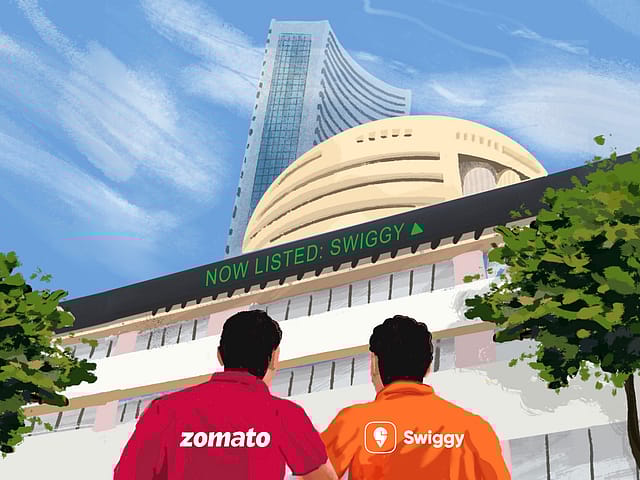
India’s food delivery and quick commerce companies may face some pressure from rising fuel prices, but the impact is unlikely to significantly disrupt profitability in the near term, according to brokerage firm Elara Capital.
Karan Taurani, EVP at Elara Capital, told Fortune India that the recent increase of nearly ₹4 per litre in fuel prices remains a “manageable near-term headwind” for both Eternal and Swiggy , even if delivery partners push for higher payouts.
According to the brokerage, under a worst-case scenario where the fuel prices rise further to around ₹10 per litre over the next three to six months, the net EBITDA impact for the two companies would still remain limited after accounting for electric vehicle (EV) and cycle penetration in deliveries.
EV and cycle penetration will be around 30-40% in quick commerce and about 20% in food delivery, reducing the effective fuel-linked impact to nearly 70% of total orders.
Elara estimates the impact could be around ₹100-200 crore, translating into a 4-5% hit to FY27 estimated adjusted EBITDA for Eternal and 10-12% for Swiggy, assuming companies do not pass on any costs to consumers.
“We believe the impact would be higher for Swiggy, as it is still working towards contribution break-even in quick commerce, while Eternal is better placed due to stronger scale, higher ad revenue base and better ability to recover costs from a relatively premium and less price-sensitive customer base,” Taurani said.
The brokerage has retained its ‘Buy’ ratings on both companies, with target prices of ₹400 for Eternal and ₹360 for Swiggy, while maintaining a preference for Eternal.
Delivery economics remain under watch
According to Elara, Eternal and Swiggy are expected to process nearly 2.7 billion and 1.4 billion orders, respectively, across food delivery and quick commerce platforms in FY27.
Any rise in fuel prices directly affects delivery economics because it reduces delivery partner earnings and increases the possibility of payout revisions. However, the brokerage believes the burden is likely to be distributed across customers, delivery partners and the platforms themselves.
Elara estimates average delivery costs at ₹35-50 per order for quick commerce and ₹55-60 per order for food delivery. On a blended basis, delivery costs work out to nearly ₹45 per order for Eternal and ₹55 for Swiggy.
Assuming fuel contributes about 20% of delivery costs, the implied fuel expense stands at roughly ₹9-10 per order. Based on this, the recent 4% rise in fuel prices would result in a per-order impact of around ₹0.44.
If fuel prices climb further to ₹10 per litre, the impact could rise to ₹1-1.2 per order.
Why is Eternal better positioned
The brokerage believes Eternal has stronger levers to manage fuel-led inflation than Swiggy.
“Our view is that Eternal’s customer base is more premium and less price-sensitive, which gives the company a higher propensity to recover cost rise through platform fees, delivery fee optimisation and handling charges,” Taurani noted.
He also highlighted Eternal’s larger advertising revenue base and stronger scale advantages as additional buffers against margin pressure.
By contrast, Swiggy may face relatively higher stress because of lower profitability cushions in quick commerce and a more price-sensitive customer base.
“Hence, while both platforms have pass-through levers, Eternal's ability to absorb and recover fuel-led cost inflation is stronger,” Taurani added.
Still, Elara said the more significant risk may not be the direct increase in fuel costs, but the broader impact on consumer spending and advertising demand. Sustained fuel inflation could reduce discretionary spending, affect order frequency in food delivery and quick commerce, and pressure restaurant as well as direct-to-consumer brand marketing budgets.
“The broader consumption and ad-revenue impact is the key risk to monitor,” Taurani said.