
Explained: How India’s first hydrogen train works and why it matters
ADVERTISEMENT
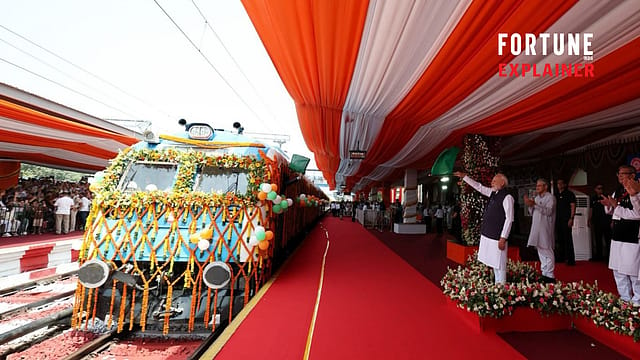
Prime Minister Narendra Modi on Friday flagged off India’s first hydrogen fuel cell-powered train between Jind and Sonipat in Haryana, marking the country’s entry into an exclusive group of countries operating hydrogen-powered passenger trains. The launch is being seen as a significant milestone in the country's efforts to make rail transport cleaner while reducing dependence on fossil fuels.
Sharing the development on social media platform X, Modi said, "I am proud to have flagged off the country's first hydrogen train in Jind, Haryana. This is a major achievement in the direction of building a clean, green, and self-reliant India. This train, built with cutting-edge technology, is not only a symbol of India's technical capability but also an example for the entire world."
What makes this train different?
Unlike diesel trains that burn fuel to run the engine or electric trains that depend on overhead power lines, the hydrogen train produces electricity onboard. Hydrogen stored inside the train reacts with oxygen in a fuel cell to generate electricity, which powers the traction motors.
The only by-products of this process are water vapour and heat. Since there is no combustion, the train produces virtually zero carbon emissions during operation and is significantly quieter than diesel-powered trains.
The train consists of two hydrogen-powered driving cars and eight passenger coaches, making it one of the world's longest hydrogen-powered passenger trainsets. With a 3,200 horsepower propulsion system, it is also among the most powerful hydrogen-powered trains currently in service.
Why is it important?
Indian Railways has already electrified more than 99% of its broad gauge network, sharply reducing diesel consumption. Hydrogen trains are aimed at taking the next step in decarbonising rail transport, particularly on routes where full electrification may not always be practical.
Besides reducing carbon emissions, hydrogen trains lower dependence on imported fossil fuels and support India's National Green Hydrogen Mission. They also eliminate the need for continuous overhead electric infrastructure because electricity is generated within the train itself.
The Jind-Sonipat train will cover the 89-km route in around two hours, stopping at 12 intermediate stations.
Is hydrogen safe?
Hydrogen is highly flammable, making safety a key concern. Indian Railways says multiple layers of protection have been built into both the train and the supporting infrastructure.
The train is equipped with sensors that continuously monitor hydrogen leaks, heat, smoke and flames. If any abnormality is detected, the hydrogen supply is automatically shut off. Continuous ventilation systems prevent hydrogen from accumulating, while the driver's cabin provides real-time monitoring of the train's health.
The hydrogen storage and refuelling facility at Jind has also been fitted with leak detectors, fire suppression systems and automatic shutdown mechanisms. The project complies with international safety standards and has undergone independent third-party safety assessments before entering passenger service.
How is the train refuelled?
Indian Railways has developed India's first integrated hydrogen railway ecosystem at Jind. Hydrogen is produced through electrolysis, compressed to high pressure for storage and then dispensed into the train through dedicated refuelling systems.
The facility can store around 3,000 kg of hydrogen and has the capacity to refuel both power cars simultaneously, reducing turnaround time.
Where does India stand globally?
Germany was the first country to introduce commercial hydrogen passenger trains, while France, Italy, Japan and China have been testing the technology on a limited scale. Most of these trains have only two to four coaches and primarily serve regional routes.
India's 10-coach hydrogen train, combined with a dedicated production, storage and refuelling ecosystem, represents one of the largest hydrogen rail deployments so far. Indian Railways is also exploring the use of similar technology on heritage routes, including the Kalka-Shimla railway, as it expands hydrogen-powered mobility across the network.