
Fortune India Boardroom | Beyond the metros: How tier-2 India and global trends are redefining the country’s beauty market
ADVERTISEMENT
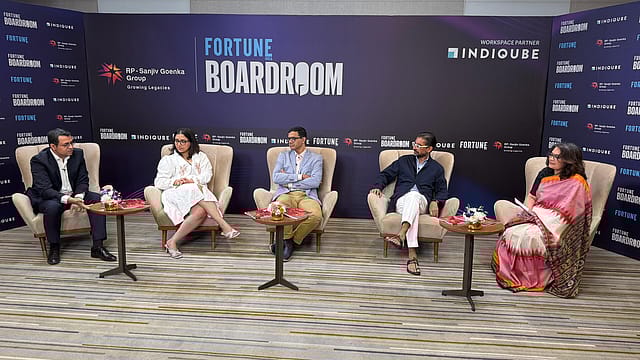
India’s beauty market is no longer a metro-led narrative. As ecommerce, quick commerce and offline retail penetrate deeper into the country, tier-2 and tier-3 cities are emerging as the sector’s most consequential growth engines—distinct in consumption behaviour, yet increasingly aligned in aspiration.
These shifts, and their implications for Indian brands with global ambitions, were discussed at a recent Fortune India Boardroom featuring Romita Mazumdar, Founder and CEO of Foxtale; Shankar Prasad, Founder of Plum; Manish Taneja, CEO and Managing Director of Purplle; and Rohan Vazirali, Country General Manager at The Estée Lauder Companies.
Tier-2 and tier-3 India: No longer catch-up markets
Beauty consumption outside India’s largest cities is accelerating faster than anticipated, driven not by imitation of metro behaviour but by a blend of aspiration, access and rising confidence. According to Taneja, tier-2 and tier-3 markets are no longer laggards.
“India is still winning in many Indias,” he says, pointing to Purplle’s performance in the South. “We do more orders in Trivandrum than in Mumbai. We have 12 stores in Kochi, and we could easily have 50.”
The difference, he argues, lies in execution rather than intent. Regional-language engagement, hyperlocal influencer ecosystems and dense offline presence play a disproportionately large role. Supply, in many cases, is creating demand. “If access is difficult, demand doesn’t surface,” Taneja notes, explaining why store density and faster delivery are unlocking latent consumption in smaller cities.
Prasad adds that consumer behaviour outside metros has matured rapidly. “The biggest barrier earlier was trust. Today, there is a hunger to experiment,” he says, adding that scientific credibility is now as important in tier-2 towns as it is in large urban centres.
K-beauty’s pull—and India’s own global play
Korean beauty’s influence on Indian consumers, especially Gen Z, is unmistakable. But Mazumdar argues that Indian brands are not competing with Korean culture as much as with Korean science.
“K-beauty has built trust through its lab culture and scientific credibility,” she says. “What appears to be a cultural battle is actually a science battle.”
Indian brands, she believes, have two inherent advantages: cost-efficient R&D and proximity to Indian skin and climate needs. “We don’t just do science—we do science at a price India can afford,” Mazumdar says, underlining the importance of affordability in scaling innovation.
Vazirali reinforces the opportunity, noting that less than 2% of global beauty research focuses on Indian skin tones. “India-specific innovation—whether in undertones, ingredients or formulations—is no longer optional,” he says, adding that this research gap also represents a global opportunity if Indian brands invest in proprietary intellectual property.
The shared view: for Indian beauty brands to gain global relevance, they must combine deep scientific credibility and owned IP with culture-led storytelling—much like K-beauty did over the past decade.
Premium dominates attention, mass drives scale
While most new-age beauty brands skew premium, panellists agree that the mass and mass-premium segments continue to offer the largest volume opportunity.
Prasad points out that many categories once considered niche are rapidly scaling. “These segments may be small by percentage, but in India they can still be very large businesses,” he says, citing derma-backed skincare and baby care as examples.
Taneja adds that ecommerce and quick commerce are narrowing the access gap between premium and mass consumers. “Instant gratification is becoming table stakes,” he says, pointing to strong adoption of two-hour delivery even in tier-2 cities.
Mazumdar, however, cautions that mass does not mean compromising on brand. “There are many companies in beauty, but very few brands,” she says. “Even at the mass end, trust, consistency and delivery experience are non-negotiable.”
A market expanding outward—and maturing
India’s beauty market is expanding in two directions at once—outward into smaller towns and upward in consumer expectations around science, speed and experience. Tier-2 and tier-3 consumers are no longer defined solely by affordability, while global influences such as K-beauty and J-beauty are pushing Indian brands to raise the bar.
As Vazirali puts it, sustainable growth will belong to brands that consistently deliver “quality, efficacy and desirability.” Whether serving consumers in Kochi or competing on the global stage, India’s beauty narrative is becoming more confident, more scientific—and unmistakably its own.