
From generics to innovation: India pharma’s next growth story takes centre stage on Nikhil Kamath’s WTF
ADVERTISEMENT
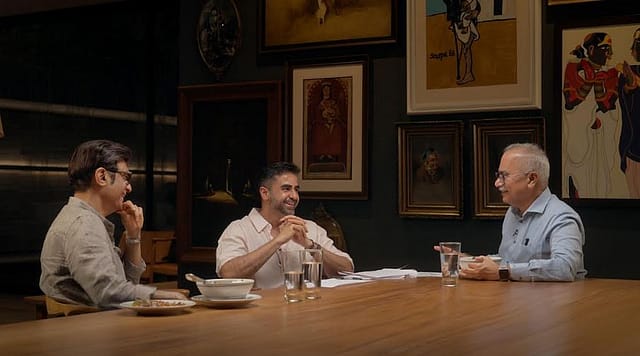
India’s pharmaceutical industry has earned its reputation as the “pharmacy of the world”, supplying affordable medicines at scale across global markets. But the next chapter of growth may not come from producing more drugs—it may come from discovering them.
That was among the key themes discussed in the latest episode of entrepreneur and investor Nikhil Kamath’s podcast WTF, featuring Rajeev Juneja, co-founder and managing director of Mankind Pharma, and GV Prasad, co-chairman and CEO of Dr. Reddy’s Laboratories.
The conversation brought together two leaders whose companies represent different phases of India’s pharmaceutical evolution—from building access-led businesses to pursuing global competitiveness through innovation and research.
Reflecting on Mankind Pharma’s journey, Juneja recounted how the company was built after being founded in 1995 with just ₹69,000 in capital. Rather than competing directly in metros, Mankind focused on smaller markets across northern India, prioritising deeper distribution and affordability.
The company’s early strategy centred on pricing medicines significantly below established competitors and building presence in regions that larger pharmaceutical players had overlooked.
Juneja also spoke about lessons from his early years in the business, saying, “What you hate becomes your biggest lesson.” Recalling time spent working at a pharmacy and understanding supply chains firsthand, he said those experiences helped shape his understanding of how the market functions.
The conversation then shifted to a broader industry question: whether India can move beyond being a manufacturing powerhouse to becoming a global centre for pharmaceutical innovation.
Can India move up the pharma value chain?
Prasad argued that while India’s dominance in generic medicines remains a strategic advantage, the sector’s long-term value creation lies elsewhere.
“India is the generic pharmacy of the world. That’s a good foundation. But the next frontier is finding new drugs,” he said, adding that the coming decade could become a defining period for Indian pharma.
The discussion explored the economics of innovation, emerging treatment categories such as GLP-1 therapies, and the investments required to compete in original drug discovery—an area traditionally dominated by global pharmaceutical majors.
Prasad also pointed to China’s rapid transformation from a low-cost manufacturing base into an innovation-led pharmaceutical ecosystem, highlighting how long-term capital, research infrastructure and scientific capabilities have accelerated its progress.
Another area of focus was Active Pharmaceutical Ingredients (APIs), where both leaders challenged the view that India has permanently ceded ground.
Prasad suggested that economic factors—not manufacturing capability—shifted production patterns over time, while Juneja noted that Indian companies are increasingly partnering with global innovators and licensing advanced molecules to expand patient access.
For Kamath, the discussion underscored a larger reality: India’s leadership in medicine volumes has not yet translated into proportional economic value.
“This conversation made clear something I hadn’t quite understood before—that by volume, India is the pharmacy of the world, but by revenue, we’re barely a rounding error,” Kamath said.
As Indian pharma enters its next phase, the question may no longer be whether the country can manufacture at scale—but whether it can innovate at scale.