
India-UK FTA could unlock gains beyond £25 billion, sky is the limit: Piyush Goyal
ADVERTISEMENT
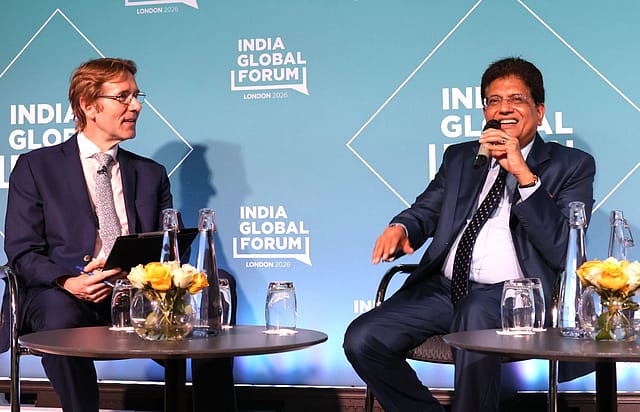
India’s free trade agreement with the United Kingdom is the most comprehensive trade pact signed by the country so far and has the potential to generate economic gains far exceeding current estimates, Union Commerce and Industry Minister Piyush Goyal said on Thursday.
Speaking at the India Global Forum (IGF) UK-India Week in London, Goyal said businesses on both sides should adopt an ambitious approach to fully leverage the India-UK Comprehensive Economic and Trade Agreement (CETA), which is scheduled to come into force on July 15. The minister is on a three-day visit to the UK to review implementation readiness and engage with government and industry stakeholders ahead of the agreement’s rollout.
Trade potential far exceeds official estimates
Describing the pact as a landmark agreement, Goyal said it brings together two complementary economies with strong historical, cultural and business ties.
“The UK free trade agreement will be the first most comprehensive agreement that India has entered into so far,” Goyal said. “It’s a partnership between two complementary economies, two growing economies. We understand each other; our mindsets have a lot of similarities. If our businesses leverage the benefits of the CETA, the sky is the limit.”
The minister also downplayed projections by the UK government that tariff reductions under the agreement could add around £25 billion annually to bilateral trade over the coming years.
“That is very modest… I would think our businesses should be ambitious on both sides. I would beseech all the people in this room and take this message to all those who are not in this room to seize the moment,” he said.
India and the UK currently share a bilateral trade relationship valued at around £48 billion annually, with both governments expecting the agreement to significantly boost trade and investment flows.
Focus shifts to implementation
During the visit, Goyal is scheduled to hold talks with UK Secretary of State for Business and Trade Peter Kyle. Discussions are expected to focus on regulatory alignment, customs coordination and operational mechanisms required for the smooth implementation of the agreement.
The minister also praised the UK for maintaining continuity in negotiations despite a change in government during the course of the talks. “Ministers may have changed, but I must compliment the UK for continuity in decisions and continuity in following through on what was already negotiated,” he said.
Why the India-UK pact matters
The India-UK CETA was formally concluded earlier this year after prolonged negotiations and is regarded as one of India’s most significant trade agreements. The pact aims to lower or eliminate tariffs on a wide range of goods, ease non-tariff barriers, strengthen intellectual property protections, facilitate digital trade and improve market access for businesses.
Peter Kyle recently described the agreement as a deal that removes both tariff and non-tariff barriers while creating a stronger framework for technology adoption, data sharing and cross-border commerce. He said the agreement would not only make trade more profitable but also faster and more resilient for both economies.
While issues such as the UK’s proposed steel tariffs emerged as last-minute challenges before implementation, Goyal indicated that both sides had successfully navigated these hurdles through constructive engagement. He stressed that the real test of the agreement would now lie in how effectively businesses utilise the opportunities created by the landmark trade pact.