
How BenQ solved the smart classroom problem in India
ADVERTISEMENT
May 2005. Kanpur, Uttar Pradesh.
The screen flickers. Then dies.
A low hum cuts out. The fan keeps turning, slow and tired. Heat presses in. Chalk dust settles back into the room. Forty students stare at a blank wall. The teacher taps the remote. Nothing. Tries again. Still nothing. A lesson that was meant to move—freeze-framed.
This is how India’s early experiments with digital classrooms often ended. Not with transformation, but with breakdown. Projectors overheated, dust clogged machines, and power cuts wiped out momentum.

The idea worked. The environment didn’t. Then, slowly, the wall began to light up again. This time, it stayed on.
Across thousands of classrooms—through heat, voltage swings, and long school days—a different kind of system began to take hold. One built not just for content, but for the conditions it had to survive.
Behind that shift sits a company most people may have never heard of. Quietly, this Taiwanese display major has powered over 400,000 smart classrooms—more than 60% of the country’s installed base—since 2012, according to industry estimates. This has quietly turned BenQ India into one of the most influential, invisible forces inside India’s education system.
The problem nobody solved
Let us dial back to the early days. For a while, it looked like India would leapfrog into digital learning.
Content companies moved first. Firms like Educomp and others began building rich multimedia lessons—animations, videos, interactive modules designed to replace static blackboards. The promise was compelling: make classrooms engaging, visual, and scalable.
But inside schools, the experience kept breaking. Projectors failed within months. Dust clogged internal components. Heat pushed machines beyond operating limits. In many classrooms, temperatures climbed past 45°C in summer. Air conditioning was rare. Power supply was erratic. Even when the hardware worked, voltage fluctuations would shut systems down mid-lesson.
Schools improvised. Some swapped projectors for televisions. Others simply abandoned the setup after repeated breakdowns.
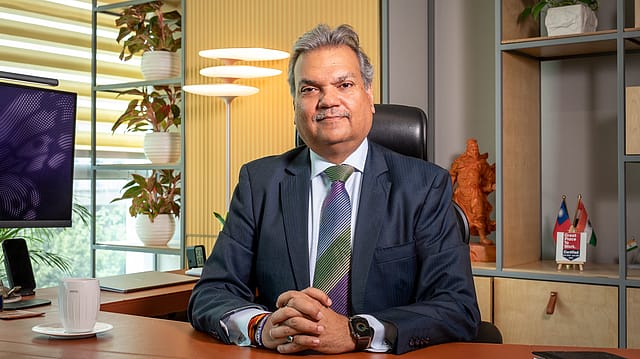
The gap was execution. “There was content, but no reliable way to deliver it,” recalls Rajeev Singh, who joined BenQ India in 2009 after stints at Motorola, Samsung, Canon, and Philips.
At the time, BenQ was a small player in India’s projector market—ranked around sixth, with limited scale and visibility. The business existed, but it wasn’t decisive. India itself was not central to the company’s global ambitions; its revenues were a fraction of markets like Indonesia.
But Singh saw something others didn’t.
If digital classrooms were to work in India, the solution couldn’t be imported. It had to be rebuilt—from the ground up—for Indian conditions. That meant rethinking the product. And the model. Not just a projector, but a system. One that could survive heat, absorb dust, handle unstable electricity, and still deliver a seamless classroom experience, day after day.
And crucially, one that didn’t exist yet.
Building what didn’t exist
The answer began with a partnership.
At the time, while companies like Educomp were racing to supply digital content to schools, they lacked a reliable way to bring that content alive inside the classroom.
BenQ stepped into that gap.
Instead of selling projectors as standalone devices, Singh and his team began stitching together a full-stack solution—hardware, software, and support—built around how Indian classrooms actually functioned.
A typical setup was practical.
There was a projector, an interactive whiteboard, a small-form computer loaded with content, speakers, and almost always, a UPS—because power cuts were not an exception, they were routine. Each component solved for a failure point the system had already exposed. “We started giving a complete solution for the classroom,” says Singh, MD of BenQ India & South Asia.
But the real work was happening inside the machine.
Projectors had to be re-engineered to handle dust-heavy environments. Cooling systems had to withstand extreme heat. Performance had to remain stable despite voltage fluctuations. The plan was not to build the best projector in the world but to build one that wouldn’t break down in the country’s schools.
At the same time, BenQ aligned itself tightly with content providers—integrating its hardware into their offerings, becoming the delivery layer for an ecosystem that was just beginning to scale.
The timing clicked.
By 2011, adoption began to accelerate. Schools that had struggled with earlier setups began to see systems that actually worked. Word spread. Orders followed.
Within two years, BenQ went from a fringe player to the leader in India’s projector market—overtaking established competitors like Epson.
The category itself had changed. What began as an experiment had turned into infrastructure. And BenQ was right at the centre of it.
The break, the burn, the return
Scale, though, attracts shortcuts.
By 2012, the smart classroom model was no longer experimental. It was booming. Large contracts, repeat orders, expanding networks—what had taken years to build was now moving fast.
And fast markets invite cheaper alternatives.
One of BenQ’s biggest partners at the time was approached by a Chinese manufacturer offering projectors at 30–40% lower prices. The pitch was simple: same outcome, lower cost and higher margins. For a company deploying at scale, the math was hard to ignore.
BenQ’s biggest partner switched. For BenQ, it wasn’t just business lost. It was a stress test of everything it had built. “We told them—it may be cheaper, but it won’t survive Indian classroom conditions,” recalls Singh.
The warning didn’t land. The machines did.
And then, slowly, they began to fail. Dust seeped in. Heat took its toll. Performance dropped. Within a year, nearly half the installed base ran into issues. Service support struggled to keep up. Classrooms that had just begun to stabilise slipped back into disruption.
The system broke again. Only this time, the failure was measurable. The partner returned not just as a customer, but on BenQ’s terms.
For Singh, it was validation.
The problem in India was never price alone. It was durability, reliability, and consistency under pressure. And those weren’t features you could discount.
From classrooms to scale
By then, the momentum was irreversible.
What started as a workaround had become a category standard. Over the next decade, BenQ’s classroom footprint expanded across the country—private schools, chains, smaller towns, deeper markets.
The numbers tell part of the story. Over 400,000 classrooms converted, which is more than 60% of India’s installed smart classroom base, according to industry estimates.
But the bigger shift was less visible. The system simplified. What once required multiple components—projector, whiteboard, CPU, speakers—began collapsing into a single device: the interactive flat panel. Cleaner, more integrated, easier to deploy.
Only one thing stayed constant. The UPS. Why? Because some problems don’t go away.
As the classroom business scaled, so did BenQ’s presence inside Indian homes. Monitors, projectors, displays—what began in schools started spilling into living rooms, work desks, and eventually, creator studios.
India, once a small market within the company, had become one of its most important ones.
And the playbook that worked in classrooms—build for India, not import for it—was about to be tested again.
Killing the old to build the new
Even as BenQ’s classroom business scaled, another part of the company was quietly under pressure: Monitors.
In the early years, BenQ India played at the bottom of the market—entry-level screens, thin margins, and constant price wars. It was a volume game, and a fragile one. A small price cut from competitors like Acer could stall sales overnight. The business worked. But it didn’t build anything.
Then came a decision that looked, at the time, almost reckless.
Globally, BenQ chose to exit the low-end monitor segment and move up the value chain—mid-range, premium, specialised use-cases. In India, where price sensitivity defined most categories, the call felt counterintuitive.
The impact was immediate. Sales dropped from 10,000–15,000 units a month to under 2,000. For nearly three years, the business stayed there. It was flat. It remained uncertain. Inside the team, the question lingered: had they misread India? “We used to feel maybe this strategy is for developed markets, not for India,” Singh admits.
But the company didn’t step back. Instead, it doubled down—building a portfolio that didn’t exist yet in the market. It started building monitors for coders and programmers, for designers and photographers, for Mac users priced out of Apple’s ecosystem, for gamers and for content creators.
Then, the market moved after March 2020.
The pandemic didn’t just shift where people worked. It changed how they used screens. Laptops were no longer enough; work stretched longer and content creation surged. Gaming grew and home setups became permanent.
And when demand spiked, it didn’t land at the entry level. It landed exactly where BenQ had spent years building. From that point on, the curve flipped.
Over the next five years, BenQ’s monitor business in India grew at over 30% annually—even as the broader market remained largely flat.
More telling, however, was the shift in perception. A brand that once had to price itself 20% below competitors like Samsung and LG was now selling at a premium—8–10% higher—and still gaining preference.
The bet had worked not by chasing demand but by waiting for it.
The next screen
If classrooms built the base, and monitors rebuilt the brand, the next battle is already taking shape: Inside homes.
For decades, the television has been the centrepiece of entertainment—fixed, dominant, unquestioned. BenQ is betting that this may not hold.
Projectors are evolving. Fast. What was once bulky, installation-heavy hardware is becoming portable, adaptive, and almost invisible. Newer devices can project on any surface—wall, ceiling, even uneven spaces—auto-adjusting for colour, angle, and obstruction. There is no fixed setup. No dedicated room.
For a generation that doesn’t like being tied down, that matters. “The millennial consumer is mobile-first,” Singh says. “They don’t want something fixed like a TV.”
It’s already visible in pockets of the market. In parts of Andhra Pradesh and Punjab, demand for high-end home projectors—priced anywhere between ₹2-7 lakh—is coming not just from big cities, but smaller ones as well. The appeal isn’t subtle. It’s scale. A larger-than-life experience, without the permanence of a traditional home theatre.
BenQ currently holds a dominant share in India’s 4K UHD projector segment, a premium category that continues to grow even as the broader projector market shifts.
At the same time, another screen is emerging: that of the creators. YouTubers. Designers. Video editors. Streamers. A growing base of users who don’t just consume content—they produce it. And for them, accuracy matters as much as size.
BenQ has begun building specifically for this segment—high-end monitors tailored for content creation, colour precision, and workflow refinement. Early adoption is still concentrated at the top end, but the direction is clear.
From classrooms to work desks to studios, the company is expanding across use-cases that didn’t exist at scale a decade ago.
All tied together by one underlying shift: Screens are no longer just devices. They are becoming environments.
The long game
Across both bets—classrooms and premium displays—a consistent philosophy runs through.
Don’t chase the cheapest. Build for value. “A market like India is not just price-conscious. It is value-conscious,” Singh says. It’s a distinction that has shaped the company’s decisions over the past 15 years.
Walk away from low-margin volume, invest in durability where others optimise for cost and hold positioning, even through slow years. The rewards, when they come, compound.
Marketing experts say BenQ is now reaping the rewards of premiumisation in India. “It never positioned itself as a price warrior,” says Ashita Aggarwal, professor of marketing at SP Jain Institute of Management & Research. That restraint helped it avoid being lumped with aggressive Chinese rivals chasing discounts. “BenQ held on to its Taiwanese identity—and that built trust and aspiration,” she adds.
No wonder, India today is among BenQ’s top global markets—far ahead of where it stood when Singh first walked into the business in 2009, when revenues were a fraction of its Southeast Asian peers. In 2023, India overtook Japan to become BenQ’s largest market in the Asia Pacific. Globally, it now ranks third—behind China and the US.
By 2026, the order hasn’t changed. The numbers have only grown. But the playbook isn’t without friction.
Currency volatility continues to push up prices. Local manufacturing remains limited, with only 20–25% of components sourced domestically. Geopolitical disruptions—from policy shifts to unexpected conflicts—can stall entire segments overnight, as seen in the recent slowdown in government-led education spending.
Take, for instance, a blip in FY25. Revenue fell from ₹634.97 crore in FY24 to ₹462.50 crore in FY25. Profit dropped sharply—from ₹19.06 crore to just ₹40.49 lakh.
Singh lays out what went wrong.
The dip in 2024–25 was driven by a mix of macro pressure and an unexpected operational setback. Currency volatility pushed up import costs and squeezed margins—especially for a business like BenQ’s that relies heavily on global supply chains. At the same time, a fire at one of its factories disrupted operations and forced financial adjustments. Insurance claims and reversals were accounted for conservatively, in line with standard practice, temporarily weighing on reported profitability.
But the MD is quick to clarify: this wasn’t a demand problem. The core business remained strong, with revenue momentum intact. The insurance impact is expected to unwind next year, with reversals supporting profitability in 2025–26. With operations stabilising and costs easing, the recovery, he says, should be sharp.
The direction, then, remains unchanged.
This year, BenQ India is aiming to cross ₹1,000 crore in revenue—a milestone set not just as a target, but as a signal of how far the business has come, and how much further it believes it can go.
And yet, for all the volatility, the test remains disarmingly simple. Does it still work where it matters most?
The screen doesn’t flicker this time.
In a classroom in Delhi, the lights dim slightly as a lesson begins. A diagram expands across the wall—clean, bright and uninterrupted. A teacher moves between slides with a tap. Students lean forward. Some take notes. Others watch, eyes fixed on motion instead of chalk.
No one looks at the machine. It just works. There is no dust choking it. No heat slowing it down. No interruption breaking the flow. The system has disappeared into the experience—exactly as it was meant to.
Outside the classroom, Singh stands in the corridor, watching quietly.
Fifteen years in, the variables are different now. The problems are bigger. The bets, sharper. This time, it isn’t about making a classroom work. It’s about scaling what already does, about pushing the business past ₹1,000 crore and about doubling it. It’s also about carrying the same playbook—build for India, wait for the shift—into categories that are still forming.
And then, later this year, when Singh plans to attend BenQ’s 25 years in India celebrations in Taiwan, he wants to walk into a room and put that number up on a screen: ₹1,000 crore. And if it lands the way he expects, the man who spent a decade fixing what screens couldn’t do in India may finally be known, simply, as—the Projector Man.