
GE Aerospace partners with NASA, BETA Technologies, and Boeing on world’s first high-altitude hybrid electric flight
ADVERTISEMENT
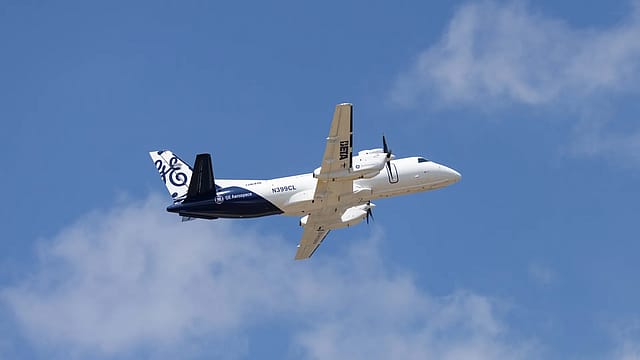
GE Aerospace on Tuesday announced it has successfully completed the aviation industry's first hybrid-electric flight above 30,000 feet, marking a key milestone in the development of more electric aircraft propulsion systems. The record-setting demonstration, carried out in collaboration with NASA, BETA Technologies, and Boeing, saw a modified Saab 340B aircraft reach commercial passenger aircraft cruising altitudes while operating with a hybrid-electric propulsion system. The team also completed its longest hybrid-electric flight of more than two hours.
The test campaign was enabled by GE Aerospace's fully integrated megawatt-class, multi-kilovolt hybrid-electric propulsion system, developed under NASA's Electrified Powertrain Flight Demonstration (EPFD) programme.
"The aviation industry's first high-altitude hybrid-electric flight is one for the history books," said H. Lawrence Culp Jr., Chairman and CEO of GE Aerospace. "This milestone reflects the collaborative efforts of NASA, BETA Technologies and Boeing to accelerate hybrid-electric technologies that can deliver greater efficiency, durability and range."
The flight-test aircraft was modified with a hybrid-electric system housed inside an inverted nacelle for enhanced ventilation. The system integrates GE Aerospace-developed motor-generators, power converters, inverters, controllers, gearboxes, propellers, heat exchangers, torque-sensing equipment, engine harnesses and a CT7 engine. BAE Systems supplied the batteries while Boeing subsidiary Aurora Flight Sciences developed the complete nacelle.
Pilots from GE Aerospace and BETA Technologies conducted the flight tests in the US, where the altitude milestone was achieved. BETA also ferried the aircraft to the UK for the Farnborough International Airshow, operating the hybrid-electric system throughout each leg of the transatlantic journey.
Kyle Clark, Founder and CEO of BETA Technologies, said the hybrid-electric system improved high-altitude performance and climb capability while serving as a flying laboratory for future propulsion technologies. "This is the first of many important milestones for hybrid-electric aviation," Clark said.
Public demonstration flights are scheduled during the Farnborough International Airshow, with the aircraft also on static display for visitors.
Graham Drozeski, Chief Technology Officer at Aurora Flight Sciences, a Boeing company, said the project successfully integrated a high-voltage electrified propulsion system into an aircraft operating at commercial cruising altitudes, representing a major advance for hybrid-electric aviation.
Hybrid-electric propulsion
Hybrid-electric propulsion combines an electric powertrain with a conventional gas turbine engine to optimise power delivery during different phases of flight. According to GE Aerospace, the technology is compatible with multiple fuel types and next-generation engine architectures, including Open Fan designs.
During the test flights, the electric propulsion system successfully powered the propeller while also generating electricity to recharge the battery. Engineering teams addressed key technical challenges such as thermal management, reduced atmospheric pressure at high altitude and power density using flight-certified components designed to meet aviation safety and reliability standards.
Mohamed Ali, President and CEO of GE Aerospace Commercial Engines & Services, said the successful high-altitude demonstration validates the readiness of hybrid-electric technologies for future aircraft. "By flying a hybrid-electric engine system at altitudes never achieved before, we're demonstrating the advanced capabilities these technologies can bring to next-generation aircraft," he said.
Years of development
GE Aerospace was awarded NASA's EPFD contract in 2021 to demonstrate the flight readiness of hybrid-electric propulsion technologies for single-aisle commercial aircraft.
The company highlighted several milestones in the programme, including the first electric motor-driven propeller ground test in 2016, altitude testing of a megawatt-class hybrid-electric propulsion system at NASA's Electric Aircraft Testbed in 2022, strategic collaboration with BETA Technologies in 2025, successful hybrid-electric narrowbody engine demonstrations under NASA's HyTEC project in 2025, and ground testing of the EPFD propulsion system earlier this year.
The company said technologies developed through NASA programmes are also supporting the CFM International RISE programme, an advanced engine technology demonstrator launched in 2021. The programme has completed around 500 test campaigns and more than 3,000 endurance cycles, with a goal of delivering over 20% lower fuel burn than today's commercial aircraft engines.