
Indian Railways targets commissioning 4,000–5,000 km of projects annually, says Railway Board member Rajesh Agarwal
ADVERTISEMENT
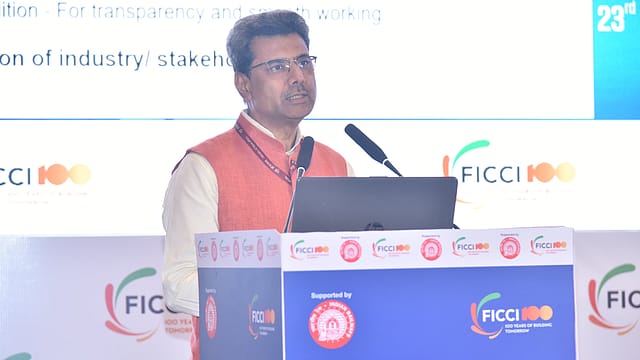
Indian Railways is targeting the commissioning of 4,000–5,000 km of railway projects every year, with the aim of completing more than 90% of its sanctioned projects over the next five years, as freight demand is projected to reach around 8,000 million tonnes by 2030, Rajesh Agarwal, Additional Member, Railway Board, said on Thursday.
Speaking at FICCI's Future Rail India Conclave 2026, Agarwal said the national transporter is undertaking one of its largest infrastructure expansion programmes to enhance network capacity, which is currently under severe strain due to rising passenger and freight traffic.
"Almost all of our routes are operating at 150% to 180% of their designed capacity. While a substantial expansion programme has already been undertaken, we now have to execute future capacity enhancement in a far more efficient manner," he said.
Indian Railways currently accounts for nearly 24% of the country's total freight movement, but Agarwal said this share needs to increase significantly to support India's long-term economic growth and infrastructure ambitions.
According to him, the Railways has 514 sanctioned projects covering new railway lines, doubling works, and third and fourth line expansion, spanning nearly 40,000 km. Of these, around 13,000 km has already been commissioned, while about 27,000 km is under various stages of execution. He added that another 5,000 km or more is expected to be sanctioned in the coming years.
Majority of projects focused on capacity expansion
Agarwal said the bulk of the sanctioned projects are aimed at strengthening the capacity of the existing railway network.
"The largest component is capacity enhancement of the existing railway network that accounts for about 360 projects. The remaining 169 projects relate to connecting new areas through new railway lines. I can clearly tell you that there is still a great deal of work left to be done," he said.
Of the 514 sanctioned projects, 455 are currently active, involving nearly 23,000 km of railway lines that need to be completed.
"Starting from the current year, we aim to commission 4,000 to 5,000 km every year. This will enable us to complete more than 90% of the current sanctioned projects within the next five years," Agarwal said.
He said the scale of infrastructure creation ahead is significant, involving more than 1,000 km of tunnelling, around 400 major bridges, nearly 7,000 bridges with spans exceeding 12 metres, besides thousands of minor bridges and other bridge structures.
Capacity constraints remain the biggest challenge
Despite being the world's second-largest cargo-carrying railway network, Indian Railways continues to face capacity constraints that limit its ability to meet rising freight demand.
"Unless capacity is increased, a significant portion of market demand will continue to remain unmet because we simply do not have enough network capacity to accommodate it," Agarwal said.
He added that the network must simultaneously cater to both passenger and freight traffic. "The railway network has to cater to both passenger and freight traffic, and neither segment can be compromised. It cannot be a question of passengers giving way to freight or freight giving way to passengers. We have to serve both," he said.
Need for private sector participation
Calling for greater industry participation, Agarwal said the Railways cannot achieve its ambitious infrastructure targets without stronger collaboration with the private sector in technology, innovation and project execution.
He highlighted the success of public-private partnerships, noting that nearly 137 of around 360 multimodal terminals have already been developed with private participation, attracting investments of about ₹8,000 crore and generating revenues of nearly ₹10,000 crore.
He also said modern locomotives are increasingly being manufactured under the PPP model, with around 214 locomotives produced over the past two years at facilities in Madhya Pradesh, Uttar Pradesh, Maharashtra, and Gujarat.
Agarwal added that the Railways is revamping its project execution strategy by initiating activities such as land acquisition, utility shifting, statutory clearances and site preparation much earlier in the project cycle to reduce delays.
"We all have a common goal of 2047, and for that, in infrastructure, we definitely have to move at a faster pace. We cannot continue at the pace at which we are currently working. Time is short, and 2047 is not far away. For this purpose, collaborative participation with the industry is a must," he added.