
India–US FTA likely to shut out EV imports; allow limited ICE car access on EU-style quotas
ADVERTISEMENT
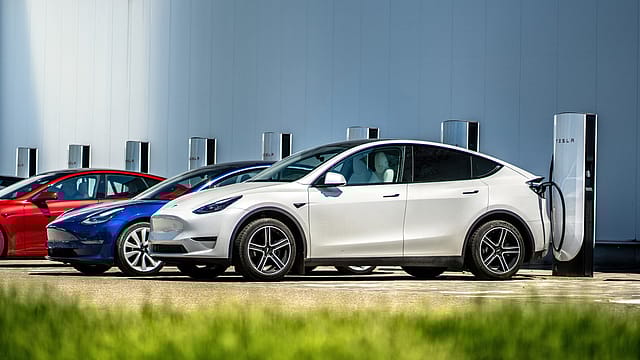
India is set to exclude all battery electric vehicles (BEVs), across price points, from tariff concessions under the proposed India–US Free Trade Agreement (FTA), while allowing limited imports of higher-value internal combustion engine (ICE) vehicles under a tightly controlled, quota-based framework, according to people familiar with the discussions. If the development materialises, it could effectively rule out Tesla’s ability to sell electric vehicles in India at reduced prices.
Sources said the automotive chapter of the India–US trade deal is being structured along the lines of the India–EU FTA, under which New Delhi offered “calibrated market access” without opening up the mass passenger vehicle segment.
“All EVs, irrespective of price points, are outside the scope of tariff concessions in the India–US FTA,” a source privy to the negotiations told Fortune India, adding that India is keen to protect domestic electric mobility investments that are still scaling up.
Under the framework being discussed, internal combustion engine (ICE) vehicles priced at a cost, insurance and freight (CIF) value of $30,000 and above may be permitted to enter India at reduced duties, but only in limited batches linked to annual quotas and price thresholds, the same source said, requesting anonymity. Vehicles priced below this level will continue to attract existing high import duties, effectively insulating the mass market where Indian manufacturers such as Tata Motors and Mahindra & Mahindra dominate.
Notably, at current exchange rates, $30,000 is equivalent to ₹27.2 lakh.
Fortune India could not reach the Ministry of Commerce and Industry to independently verify the development.
EU template as the reference point
Fortune India has also learnt from sources that negotiators are drawing heavily from the India–EU FTA, which introduced a “structured opening” rather than “blanket liberalisation”. Under that agreement, India allowed up to 250,000 European-made vehicles annually at concessional tariffs, compared with just 37,000 units under the India–UK pact.
Within this, around 160,000 ICE vehicles were eligible for phased duty cuts, with tariffs gradually reduced from as high as 110% to about 10% over roughly five years, subject to value thresholds.
EVs under the EU deal were treated far more cautiously, with tariff concessions linked to longer transition periods stretching up to a decade, reflecting concerns over domestic capacity and cost competitiveness. India also permitted a limited number of completely knocked-down (CKD) kits at reduced duties for local assembly, while excluding semi-knocked-down units.
“A similar architecture—combining volume caps, price bands and long phase-out periods—is being replicated in the India–US negotiations to prevent sudden import surges,” another source said, requesting anonymity.
EVs and advanced parts remain protected
Beyond finished vehicles, sources said certain EV parts and advanced automotive components covered under India’s Production-Linked Incentive (PLI) schemes will also be excluded from tariff concessions under the US deal. These include technologies linked to batteries, power electronics and next-generation vehicle platforms.
“The idea is to avoid a situation where trade liberalisation undermines investments already incentivised through PLI,” one of the sources said. “Trade policy and industrial policy are being aligned more tightly than before.”
Calibrated opening, strategic continuity
Industry observers said the proposed thresholds and quotas effectively confine concessional access to premium segments, limiting competitive pressure on domestically manufactured vehicles.
“Anything below the $30,000 mark is where Indian OEMs are most exposed. The guardrails are clearly deliberate,” said Puneet Gupta, Director, S&P Global Mobility.