
Why Larry Fink, Mukesh Ambani will give bankers sleepless nights
ADVERTISEMENT
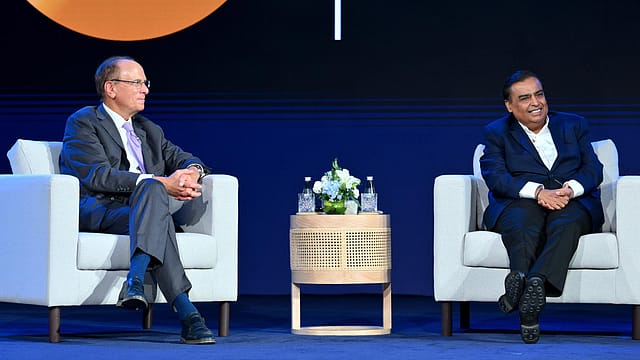
When Larry Fink, chairman and CEO of BlackRock, sat down with Mukesh Ambani in Mumbai for a chat to mark their new-found association, the messaging was hard to miss.
The world's largest asset manager—with assets under management (AUM) that recently crossed $14 trillion for the first time, powered by a record $698 billion in client inflows in 2025—made a blunt pitch: India's savings culture needs to evolve into an investing culture. What was not explicitly said: invest through passive funds.
The numbers tell a stark story.
BlackRock's AUM is 3.41 times India's current GDP of $4.1 trillion. But the engine driving this juggernaut is exchange-traded funds (ETFs) and index funds.
The passive empire that BlackRock built
In the U.S., ETFs saw total inflows of $1.48 trillion in 2025, surpassing the prior full year record of $1.1 trillion by 34%. Equity ETFs alone saw a record $923 billion in inflows. What’s notable though is that traditional mutual funds hemorrhaged $551 billion, an indication that US investors are losing confidence in active fund managers.
"What we've learned in the US for that segment of the population that had invested with the growth of America is that they're far better off than those who just kept all their money in a bank account," Fink told the audience in the room.
For Fink, the message was clear: "If you believe in the era of India, which I believe in, we need to get more people investing alongside the growth of a country."
India's passive awakening
While active funds still dominate the country's mutual fund industry—with total AUM at Rs 80.55 lakh crore as of November 2025—passive funds are gaining momentum. The AUM of passive funds such as ETFs and index funds surged 27% from Rs 11.11 lakh crore in 2024 to Rs 14.07 lakh crore as of November 2025.
Capital markets are playing an increasingly prominent role in capital formation. During FY26 (up to December 2025), total resource mobilisation from primary markets stood at ₹10.7 lakh crore. Over the past five years, primary markets mobilised a total of ₹53 lakh crore through equity and debt issuances.
More tellingly, household behavior is shifting.
The share of equity and mutual funds in annual household financial savings rose from around 2% in FY12 to over 15.2% in FY25. Individual investors' share in equity ownership increased to 18.8% by September 2025.
Yet India still has a long way to go. Ambani highlighted the paradox: "Just the last year, we as India imported $60 billion worth of gold and we imported $10-15 billion worth of silver and all of this not for industrial use, but really for domestic savings. This is unproductive."
The new engine of passive investing
What's different this time around is how BlackRock is weaponizing technology to make passive investing work at scale. Fink was emphatic about AI's role in transforming asset management.
For BlackRock, AI isn't not just about portfolio optimization but also about democratising access. "Through AI, you have better understanding of your clients, better understanding of your inventory controls. You have so many advantages by the application of AI and technology," said Fink.
The message to Indian savers was reinforced by Ambani, who framed technology as the great equalizer: "We see that young Indians adapt to technology faster than everybody. We've seen it first hand over the last five years... we should use that to our competitive advantage."
The JioBlackRock Gambit
The partnership between Reliance and BlackRock—forged, as Ambani revealed, over a five-minute car ride—is betting on this convergence. "For us at JioBlackRock, the opportunity is to encourage Indians to save. But to make sure that we give them the options to convert those savings into earnings, and hopefully compound their earnings," Ambani said.
Fink doubled down on the philosophy: "If you are working on behalf of each and every client, and you're serving that client over a long horizon with good advice, with maybe a degree of safety and importantly, just confidence building about the opportunities of compounding over a long period of time through the utilization of technology to intersect more often, more frequently, to have a deeper, broader relationship with your clients. That's how disruption occurs."
The stakes are enormous. "The $110 trillion world with AI productivity will go up to a $300 trillion world in three decades," Ambani projected. "India has the opportunity to take its share... So that is $35 trillion. So we have $30 trillion of new value that has to be created."
The message to young India
Both leaders addressed India's youth directly, urging them to think generationally rather than quarterly.
"If India can grow 10% a year, let's assume that the stock market only grows at 10% a year... that means you're doubling your pool of money every six and a half years," Fink explained. "That's much better than keeping your money in a bank account."
Ambani was equally direct: "Money in a bank account lying in simple interest is not compounding. Money in the stock market is compounding. And India has an efficient market. We have now regulated well."
The irony in the room
Perhaps the most striking aspect of the evening was the audience: India's top private and foreign bankers, sitting in a plush hall of Jio Convention Centre, being told that their core business model—deposits—is fundamentally flawed for wealth creation.
The banking sector's numbers tell their own story. Deposits surged from ₹18.4 lakh crore to ₹241.5 lakh crore and advances from ₹11.5 lakh crore to ₹191.2 lakh crore during FY05–FY25, signaling massive scale expansion of the banking system. But the speed has been much faster in the case of advances. The Credit-Deposit (C-D) Ratio increased from 69% in FY21 to 79% in FY25—a sign that banks are already stretched, lending out more of their deposits than ever before. While overall current account and savings account CASA ratio remained around 37% for public sector banks, private banks managed to bump up their CASA by 700 basis points.
The message was received. In a room filled with custodians of India's savings, Fink and Ambani argued that those very savings, if left in bank accounts, would fail to capture the "era of India".
The weighted average domestic term deposit rate on fresh rupee term deposits of banks is currently at 5.59%, net of inflation that’s further down 180-200 bps. What’s revealing is that according to the Reserve Bank of India’s inflation expectations survey from December, households perceive inflation to be 6.6% with expectations of hitting 8% in a year, much higher than the 1.33% reported in December. In comparison, three-year annualised returns of index funds have averaged between 21.24% and 15.72%.
"As more and more families invest alongside the growth of India, India has less needs for the importation of capital," Fink observed, alluding to a future where domestic capital, not foreign capital, would fuel India's rise.
For the bankers in attendance, the writing is on the wall. Their deposit war is intensifying even as their best customers are being courted away to capital markets. For investors, the question is whether they'll heed the call. If BlackRock's $14 trillion kitty is any indication, they will not be passive about it.