
Markets are cold machines. Investors are emotional: Ray Dalio
ADVERTISEMENT
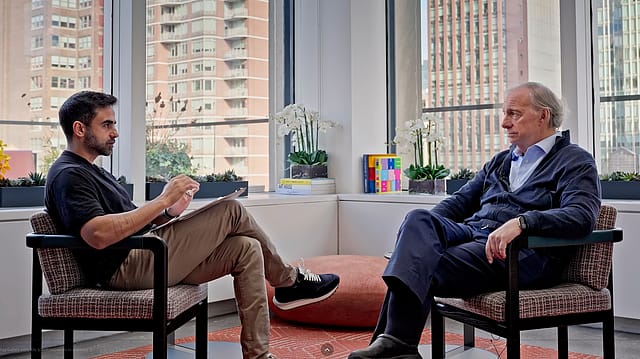
In a world gripped by debt, geopolitical churn and technological disruption, legendary investor Ray Dalio believes the biggest mistake investors make is emotional decision-making.
That message comes through clearly in his latest conversation with Zerodha co-founder Nikhil Kamath on the WTF is Finance podcast, a long-form discussion that spans markets, money, meditation—and India’s moment in the global order. Dalio, founder of Bridgewater Associates, strips down complex macroeconomic ideas into first principles, offering Indian investors a rare mix of global context and deeply practical advice.
Kamath opens the conversation with a deceptively simple question: does the stock market have emotion? Dalio’s answer is unequivocal. Markets, he says, are “cold machines” that merely reflect the collective psychology of participants.
“The problem isn’t the market,” Dalio explains. “We are emotional.”
To counter that, he advocates what he famously practised at Bridgewater—turning intuition into rules. Every decision, Dalio says, must be broken down into logic, tested across history, and executed without emotional wrestling. For him, algorithmic discipline is not about removing judgment, but about surviving one’s own humanity.
Dalio dismisses textbook learning as insufficient. True understanding, he argues, comes only from “visceral learning”—feeling the weight of real decisions. His advice to young aspirants is straightforward: play the game early, even with small capital, and place yourself around people who are already good at it. “Proximity accelerates learning,” he suggests, framing markets as a craft best learnt through immersion rather than theory.
In a moment that will resonate strongly in India, Dalio calls real estate one of the most practical assets for governments to tax—precisely because it cannot move. He goes further, suggesting that property taxation could even act as a tool to flush out black money and corruption embedded in land and housing. However, he warns against overburdening any single sector, arguing instead for balanced taxation that penalises harmful activity while protecting productive growth.
Against this volatile backdrop, Dalio is unusually optimistic about India. He calls it the strongest growth outlier for the next decade, drawing parallels with China’s economic opening in the 1980s. India’s low debt, large workforce and geopolitical neutrality, he argues, place it in a uniquely advantageous position. He even likens Prime Minister Narendra Modi to Deng Xiaoping in terms of structural reform momentum. For long-term builders, Dalio says, India is “a great place to contribute to over the next 40 years”.
When asked how a 25-year-old with just $100 should invest, Dalio sidesteps stocks, crypto, and gold altogether. The first investment, he insists, should be in oneself—skills, learning, and exposure that compound over decades. Financial assets matter, but human capital matters more, feels Dalio.